THE CLASSIC COLLECTION✦An outlaw’s diary: the CommuneCLASSIC FREE BOOKS
An outlaw’s diary: the Commune
Cécile Tormay
THE CLASSIC COLLECTION · 1853
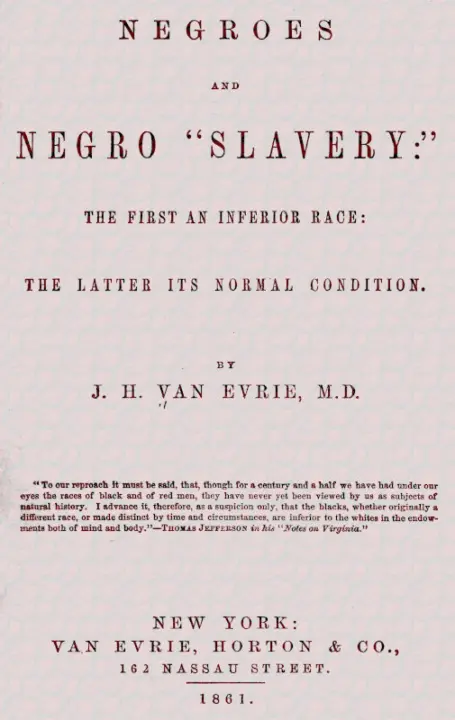
"Negroes and Negro 'Slavery:' the first an inferior race: the latter its normal condition" by J. H. Van Evrie, M.D. is a controversial treatise written in the mid-19th century. The work argues against the abolitionist movement, asserting that it is based on erroneous beliefs about racial equality and the nature of slavery. The author positions the black race as inherently inferior and maintains that slavery is the natural condition for those of African descent. At the start of the book, the author presents a preface discussing the political and social turmoil in America amid the rising anti-slavery sentiment and the onset of the Civil War. He critiques the abolitionist movement as rooted in delusion and foreign influence, particularly from European ideals. Van Evrie aims to provide a justification for the existing social order in the southern United States, asserting that it is rooted in natural law and necessity rather than moral failing. He sets the stage for a detailed exploration of the supposed differences between races, intending to argue for the social subordination of African Americans as not just preferable but essential for societal stability.
Introduction adapted from the source catalogue; source summaries may be automatically generated.
Free to read · English · 105,969 words · No account needed
MAKE TIME FOR A GOOD BOOK
On by default. Untick to stop anonymous reading totals. Each page counts after 10 seconds in view. How this works.
Anonymous counting is on unless you have switched it off.
Next to color, there is nothing so palpable to the sense as the hair, or nothing that reveals the specific difference of race so unmistakably as the natural covering of the head. The hair of the Caucasian is a graceful and imposing feature or quality, of course in perfect harmony with everything else, but sometimes, and especially in the case of females, it is an attribute of physical beauty more striking and attractive than any other. Its color, golden or sunny brown, and the dazzling hues of black, purple, and auburn tresses, has been the theme of poets from time immemorial, while its luxuriance, and silky softness, and graceful length will continue to be the pride of one sex and the admiration of the other as long as the perception of beauty remains.
In the Mongol, Malay, or Indian, as well as the Negro, it remains the same through all the stages of life, and it is only in extreme old age that it becomes gray or silvery white, or even falls off from any portion of the head. The coarse, stiff, black hair of the Indian child is that also of its parents—and a gray-headed or bald-headed Indian, except in some cases of extreme old age, is as rare perhaps as that of a bald-headed negro. But the child of the Caucasian, with perfectly white or flaxen hair, expands into the maiden with clustering ringlets of auburn or perhaps raven black, to be threaded with silver, in middle life perhaps, and though less common than with the other sex, a few years later it becomes again, as in early childhood, perfectly white. But there are no exceptions to the uniform color of the hair in other races. Such a thing as a flaxen-haired or a light-haired negro child never existed. There may be sometimes a slight approximation in this respect among Mongols, but the hair of the negro, except in some cases of extreme old age, remains absolutely the same at all periods, from the cradle to the grave. The elementary structure as shown by the elaborate microscopical observations of Mr. Peter A. Browne, of Philadelphia, differs as widely as the external or superficial modifications. The popular notion that it is wool instead of hair that covers the negro head is like many others, founded on a mere external resemblance, without any actual correspondence. It is hair, but sui generis, or rather specific and common to the negro alone, and however widely different from that of white people, it is no more so than any other quality or feature of the negro nature. The variations of this feature in the white race are almost unlimited. Hair dressing even has been elevated to the respectability of an art, if not to the dignity of a science. For many generations the kings of France kept artistes of this character, who often received a salary equal to the ministers of the crown, and one of them, Oliver Le Dain, became in fact, if not in form, the actual ruler of the kingdom. But it was the princesses and ladies of the court that exalted this “art” to its highest pitch of extravagance and display. Marie Antoinette—one of the most unhappy women that ever lived—made it an important part of every day’s employment, and exacted the same labor from her attendants. Even in our own more sensible times, the Empress Eugenie changes the fashions in this respect almost every month, and the styles or modes of dressing their hair is an extravagant though amiable weakness of our own fair countrywomen. There is in fact no mere physical quality of the female so attractive, or that is capable of being rendered so charming, as the hair, and the elaborate dressings, the time and labor spent on its decoration, proceed as much perhaps from that delicate perception of the beautiful innate in woman as it does from female vanity or the love of display. But with this “wealth of beauty” of the Caucasian woman, what an immeasurable interval separates her from the negress! Is it possible for any who sees the latter, with her short, stiff, uncombable fleece of seeming wool, to endow her with the attribute of beauty or comeliness? And though somewhat less palpable in the other sex, the hair is an essential element of manly beauty as well as dignity, and the “love locks” of the cavaliers and even the “soap locks” of more modern times, are identified with certain conceptions of manly grace. Can any one form such conceptions in respect to the hair of the negro? Can he identify any of these things with the crisp, stiff, seeming wool that covers the head of that race? Can the sentiment of beauty, grace or dignity, or indeed any idea whatever—except as a necessary provision of nature for covering the negro head—attach to the hair of the negro? This is all that is possible to the mind of a white person in actual juxtaposition with the negro, and therefore while the European Abolitionist may fancy his head adorned by “ambrosial curls,” our own native Abolitionists are wholly unable to conceive of any use or purpose whatever for that dense mat of wiry and twisted hair which covers the negro head, except as a provision of nature for its protection. The protection of the head, or rather of the brain, is the purpose or the function of the hair in all races, but while that, in our race, is identified with elevated and striking qualities, it is the sole purpose in the case of the negro. The short, crisp, dense mass that covers the negro head, like every other quality or attribute of the negro nature, is in perfect harmony with the climatic and external circumstances with which God has surrounded him. The popular notion that the negro skull is much thicker than that of the white man originated from this peculiarity of the covering of the negro head. The hair is so dense, so curled and twisted together, and forms such a complete mat or net work as to be wholly impenetrable to the rays of a vertical sun, and to furnish a vastly better protection for the brain than the thickest felt hat does to that of the white man. Thus, though negroes on our southern plantations, with the imitative instincts of their race, copy after the whites and wear hats, it is merely a “fashionable folly,” and dictated by no natural want, nor in the slightest degree adds to their happiness. And beside the protection from the fierce heats of the tropics, the hair of the negro protects his head in other respects. It is so hard and wiry, and in fact triangular in form, that a blow from the hand of a master would doubtless injure the latter vastly more than it would the head of the negro, and the common practice among them of butting each other with their heads, though knocking them off their feet, and the concussion heard at considerable distances, never results in injury, for the dense mat of semi-wool that covers the head protects it from mischief. The negro hair is then designed solely for the protection of the negro head, and not only differs widely from that of the Caucasian, but from that of all other races, for the negro is a tropical race, and the hair, like all other attributes of the negro being, physical and moral, is adapted to a tropical clime, and in perfect accord with the physical wants and moral necessities of the race.
Your reading position is saved on this browser. Take it to another device with a library code. Reading pages adapt to text, rather than matching a printed edition.
BEHIND THE BOOK
This eBook is for the use of anyone anywhere in the United States and most other parts of the world at no cost and with almost no restrictions whatsoever. You may copy it, give it away or re-use it under the terms of the Project Gutenberg License included with this eBook or online at www.gutenberg.org. If you are not located in the United States, you will have to check the laws of the country where you are located before using this eBook. Read the source licence.
The original source file, including credits and licence, is retained by this library. Request an original-format copy at no charge. Please include the book title and Project Gutenberg identifier #61063.
KEEP YOUR CURIOSITY GOING
Cécile Tormay

Moritz Busch
John L. Ransom
Frances Wright
Cécile Tormay

Mabel Potter Daggett