THE CLASSIC COLLECTION✦An outlaw’s diary: the CommuneCLASSIC FREE BOOKS
An outlaw’s diary: the Commune
Cécile Tormay
THE CLASSIC COLLECTION · 1853
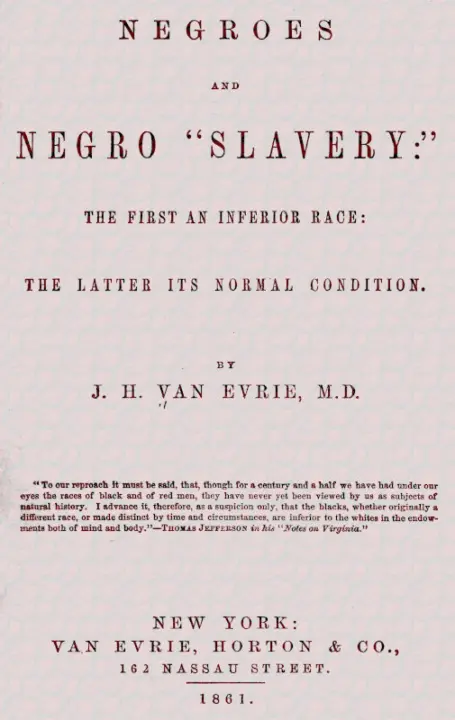
"Negroes and Negro 'Slavery:' the first an inferior race: the latter its normal condition" by J. H. Van Evrie, M.D. is a controversial treatise written in the mid-19th century. The work argues against the abolitionist movement, asserting that it is based on erroneous beliefs about racial equality and the nature of slavery. The author positions the black race as inherently inferior and maintains that slavery is the natural condition for those of African descent. At the start of the book, the author presents a preface discussing the political and social turmoil in America amid the rising anti-slavery sentiment and the onset of the Civil War. He critiques the abolitionist movement as rooted in delusion and foreign influence, particularly from European ideals. Van Evrie aims to provide a justification for the existing social order in the southern United States, asserting that it is rooted in natural law and necessity rather than moral failing. He sets the stage for a detailed exploration of the supposed differences between races, intending to argue for the social subordination of African Americans as not just preferable but essential for societal stability.
Introduction adapted from the source catalogue; source summaries may be automatically generated.
Free to read · English · 105,969 words · No account needed
MAKE TIME FOR A GOOD BOOK
On by default. Untick to stop anonymous reading totals. Each page counts after 10 seconds in view. How this works.
Anonymous counting is on unless you have switched it off.
The surface of the earth is naturally divided into zones or centres of existence. These great centres of creation have each their Fauna and Flora, their animal and vegetable life peculiar to themselves alone. Geographical writers use these terms, and speak of the temperate, frigid, and torrid zones, etc., as mere designations of certain portions of the earth where the climate is widely varied; but this is very subordinate to the real differences that separate the great centres of organic life. All creatures, indeed all organic and living things, have their centres of existence, their local habitations, their places in the mighty programme of creation. They are all adapted to these great centres of life—their organic structure, their faculties, and the purposes they were designed to fulfil, all harmonizing with their localities, the positions the Almighty has assigned to them. There are approximating forms of life, certain genera among animals and plants, that may be said to belong to the same family or group, but which are found in different zones or centres of existence, but there is no such thing as the same species being found in more than one centre of creation. All the animals and plants of Europe are, therefore, different from those of America, as all the creatures that belong to the northern region of this continent are specifically different from those of the tropics.
Each and every specific creation is different from every other specific existence, and differs just as widely in the circumstances that surround it, and to which it is adapted, as it does in its own organic structure. If an animal, for example, it has a special structure with special instincts, qualities, etc., and the external circumstances, the climate, the vegetation, all things are in perfect harmony. This law may be said to be universal, for the few seeming exceptions scarcely deserve notice. There are a few plants and cereals suited to all climates. The potato, of American origin, is cultivated with equal success in Europe, while most of our ordinary vegetables are of European origin. Wheat grows with equal luxuriance in the Valley of the Nile, the table-lands of Mexico, and the great Northwest. But while all of these things, and many more, are thus capable of successful cultivation in different localities from those in which they were originally created, the external conditions must be preserved—the same or similar soil, and, to a certain extent, the same climate or the same heat and moisture are essential in their cultivation. This is also generally true of animals. Our domestic animals are all suited to different climates. The horse, dog, ox, sheep, etc., are of European origin—some of them Asiatic—and they live and multiply with equal certainty under the fervid suns of the tropics, or amid the icy blasts of the extreme North. They are striking exceptions, however, to the general law which adapts—all creatures to their own centres of existence, and, it would seem, were designed by the Almighty and beneficent Creator for the especial purpose of benefiting man. They have accompanied him in all his wanderings, especially the dog and horse, shared his fortunes, aided in fighting his battles, and however subordinate, played an important rôle in the civilization of mankind. They are closely associated in this capacity for resisting external circumstances with man himself, that is, the Caucasian, or master man, who, as regards mere climate, is capable of living and of enjoying the healthy development of all his faculties in all climates alike, unless, perhaps, the polar regions, or extreme North. As a general law, all creatures, as they ascend in the scale of being, become less and less subject to external influences; but some of our domestic animals are certainly exceptions, for the dog and horse, at all events, are capable of living where the negro, and possibly the Mongol, would surely become extinct. The same general laws of climate affect the human races, not exactly similarly, of course, but approximatively as they do animals, and with a certain modification, as they do plants—that is, they have all centres of existence to which they are specifically adapted, with the sole exception of the Caucasian, as some of our domestic animals, and indeed some vegetable existences are exceptions. The white man, as has been said, can exist everywhere, where life of any kind is possible, except the extreme North, and even here, as shown by Kane and other explorers in those bleak and barren regions, by proper precautions, or by complying with certain conditions, life is possible for certain periods. He is, doubtless, designed for the temperate latitudes, industrially considered, but, as regards climate, he is at home everywhere. Writers, ignorant of the laws of climate, and indeed ignorant of the specific character of races, have supposed that they become weak, effete, and imbecile in tropical latitudes, and this notion is, perhaps, very generally entertained by otherwise intelligent people. The population found in these regions are negro, Indian, or Malay, intermixed often with white blood, and these inferior people are supposed to be a result of climate, and to exhibit the natural consequences of a warm and enervating atmosphere! The white man under the equator, living, or rather attempting to live, the life of the negro—to labor under the rays of a vertical sun—would rapidly decline and die, for his organic structure could not resist the external influences that tend to destroy him. The malaria springing from the decomposition of the rank vegetation, which ascends in the early portion and descends to the earth in the later portion of the day, would soon poison all the springs of life, and fever would close the scene. Any attempt at labor in midday would be still more rapidly fatal, for the caloric generated by the exertion, without an excretory system to relieve it, would end in fatal congestions of the vital organs, especially the brain. We constantly witness an approximation to this in our Western States and Territories, where nearly a generation voluntarily sacrifice themselves in the effort of preparing comfortable homes for their offspring. But after a certain progress is made, the causes of disease subside, and the temperate climate enables them to labor at all times.
Your reading position is saved on this browser. Take it to another device with a library code. Reading pages adapt to text, rather than matching a printed edition.
BEHIND THE BOOK
This eBook is for the use of anyone anywhere in the United States and most other parts of the world at no cost and with almost no restrictions whatsoever. You may copy it, give it away or re-use it under the terms of the Project Gutenberg License included with this eBook or online at www.gutenberg.org. If you are not located in the United States, you will have to check the laws of the country where you are located before using this eBook. Read the source licence.
The original source file, including credits and licence, is retained by this library. Request an original-format copy at no charge. Please include the book title and Project Gutenberg identifier #61063.
KEEP YOUR CURIOSITY GOING
Cécile Tormay

Moritz Busch
John L. Ransom
Frances Wright
Cécile Tormay

Mabel Potter Daggett