THE CLASSIC COLLECTION✦An outlaw’s diary: the CommuneCLASSIC FREE BOOKS
An outlaw’s diary: the Commune
Cécile Tormay
THE CLASSIC COLLECTION · 1853
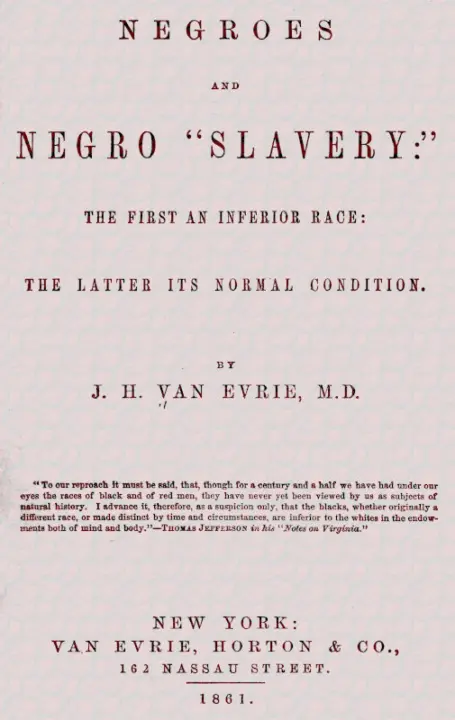
"Negroes and Negro 'Slavery:' the first an inferior race: the latter its normal condition" by J. H. Van Evrie, M.D. is a controversial treatise written in the mid-19th century. The work argues against the abolitionist movement, asserting that it is based on erroneous beliefs about racial equality and the nature of slavery. The author positions the black race as inherently inferior and maintains that slavery is the natural condition for those of African descent. At the start of the book, the author presents a preface discussing the political and social turmoil in America amid the rising anti-slavery sentiment and the onset of the Civil War. He critiques the abolitionist movement as rooted in delusion and foreign influence, particularly from European ideals. Van Evrie aims to provide a justification for the existing social order in the southern United States, asserting that it is rooted in natural law and necessity rather than moral failing. He sets the stage for a detailed exploration of the supposed differences between races, intending to argue for the social subordination of African Americans as not just preferable but essential for societal stability.
Introduction adapted from the source catalogue; source summaries may be automatically generated.
Free to read · English · 105,969 words · No account needed
MAKE TIME FOR A GOOD BOOK
On by default. Untick to stop anonymous reading totals. Each page counts after 10 seconds in view. How this works.
Anonymous counting is on unless you have switched it off.
The white or Caucasian is the only historic race—the race which is alone capable of those mental manifestations which, written or unwritten, leave a permanent impression behind. What was its first or earliest condition upon the earth? This, except the meagre account given by Moses, is unknown, nor is it of much importance that it should be known, for though it never was nor could be savage or barbarous, as these terms are understood in modern times, still its intellectual acquisitions were doubtless so limited that if really known to us, they would be of little or no service. Moses scarcely attempts any description of social life before the time of Abraham, and that then presented does not differ very materially from what exists in the same locality at the present day. The pastoral habitudes of Abraham, Isaac and Jacob, the sale of Joseph to the Ishmaelites by his brethren, his purchase in Egypt, and sudden exaltation at the court of the Egyptian Monarch, is an almost exact counterpart of scenes witnessed now, and with little varieties in the same lands, for the last four thousand years. The starting-point—the locality where the race first came into being, is equally hidden as the time or period of its creation. Biblical writers have usually supposed somewhere in Asia Minor, on the banks of the Euphrates, while ethnologists are inclined to believe that the high table-lands of Thibet and Hindoo Koosh may have been the cradle of the race. Nor is a knowledge of this material, or indeed of the slightest consequence, except as an aid in determining its true centre of existence—that is, its physical adaptation or specific affinities for a certain locality. But this is determined by experience; and it is demonstrated beyond doubt that while the elaborate and relatively perfect structure of the Caucasian Man enables him to resist all external agencies, and to exist in all climates capable of supporting animal life, he can only till the soil or perform manual labor in the temperate zones. It is, therefore, immaterial when or where he first came into being, or what was the starting-point of the race—its centre of existence is alike in all the great temperate latitudes of Asia, Africa, Europe, and America. The history of the race may be said to be divided into three great cycles or distinct periods; all, however, connecting with each other, and doubtless mainly resembling each other in their essential nature, however widely different in their external manifestation. The first period, beginning with its actual existence on the earth, may be said to terminate in the era of authentic history. The second, or historic era, may be assumed as extending to the overthrow of the Roman Empire by the so-called northern barbarians, or, perhaps, to what is usually termed the dark ages. And finally, there is another grand cycle in human destiny, which, beginning with the restoration of learning, comes down to and includes our own times. In regard to the first, we actually know little of it, for, leaving out of view the Sacred Scriptures, we have only a few imperfect glimpses of the actual life of the countless millions that preceded the historic period. What little knowledge we have depends on tradition and mythology, sometimes, perhaps, true enough, but the greater portion thus transmitted to our times we know is false, because conditions are assumed that are in contradiction with the laws that govern our animal being. If the race, however, was created in Asia, we know that portions of it migrated to Africa, at a very remote period; indeed, leaving the Bible out of view, the first knowledge we have of its existence, or the earliest traces of its existence, is in Africa. Caucasian tribes or communities entered the valley of the Nile possibly before the delta of the lower country was sufficiently hardened to admit of cultivation, as they evidently occupied localities considerably removed from the outlet of that great river. These early adventurers conquered the aboriginal population, subjected them to their control, compelled them to labor for them, built magnificent cities, temples, palaces, founded a mighty Empire and advanced, to a certain extent, in civilization. But wealth and luxury, with their effeminate consequences, probably, too, injustice and crime in the rulers, and certainly, and worst of all, interunion and affiliation with the conquered races, tempted purer and hardier branches of the race to invade them, and indeed the delicious climate and fertile soil must have always tempted Caucasian tribes into the Valley of the Nile, from the earliest periods, and whenever they felt themselves strong enough to attack the existing community. Of course we can only deal in conjecture, in regard to this matter, but it is probable that numerous invasions took place, each passing through much the same course as its predecessors. First came conquest, then the erection of a mighty Empire, followed by a grand civilization; then came effeminacy, affiliation with the subject races, debauchment and debility inviting a new conquest by pure Caucasians, and they, in their turn, going through the same round of glory and decay, of conquest and degradation. Such seems to have been the condition of Egypt when the Romans invaded it, and made it a province of that great Empire. The effete remains of these Egyptian populations afterward, became known to the Roman writers, and, to a certain extent, may be said still to exist. The great Asiatic empires were doubtless similar to the Egyptian, except in respect to the debauchment of blood. The Assyrians, Persians, Chaldeans, Babylonians, Hebrews, etc., each in their turn, were conquerors and conquered, masters and slaves, but their downfall, in one essential respect, differed widely from those of Africa. They were pure, unmixed Caucasians, for at that time the Mongol element was unknown in that portion of Asia, and the Negro, except a few household servants, never existed on that continent. The Mongolian race was first known about five hundred years anterior to the Christian Era, and whether originally it existed in a more northern region, or had not reached a full development as regards numbers, can not be known, on account of our limited knowledge of the earth at that time. The old Caucasian populations of Asia knew nothing of it, and had no admixture of Mongolic blood. But all is conjecture, mystery, doubt and uncertainty, in regard to these ancient and extinct Empires. We know that they existed—that they were white men—beings like ourselves—our own ancestors, with the same wants, the same instincts, in short, the same nature that we have, and therefore, in the main, acted, as we do now. Of course we call them heathens, pagans, savages, barbarians, etc., but were they thus?
Your reading position is saved on this browser. Take it to another device with a library code. Reading pages adapt to text, rather than matching a printed edition.
BEHIND THE BOOK
This eBook is for the use of anyone anywhere in the United States and most other parts of the world at no cost and with almost no restrictions whatsoever. You may copy it, give it away or re-use it under the terms of the Project Gutenberg License included with this eBook or online at www.gutenberg.org. If you are not located in the United States, you will have to check the laws of the country where you are located before using this eBook. Read the source licence.
The original source file, including credits and licence, is retained by this library. Request an original-format copy at no charge. Please include the book title and Project Gutenberg identifier #61063.
KEEP YOUR CURIOSITY GOING
Cécile Tormay

Moritz Busch
John L. Ransom
Frances Wright
Cécile Tormay

Mabel Potter Daggett