THE CLASSIC COLLECTION✦An outlaw’s diary: the CommuneCLASSIC FREE BOOKS
An outlaw’s diary: the Commune
Cécile Tormay
THE CLASSIC COLLECTION · 1853
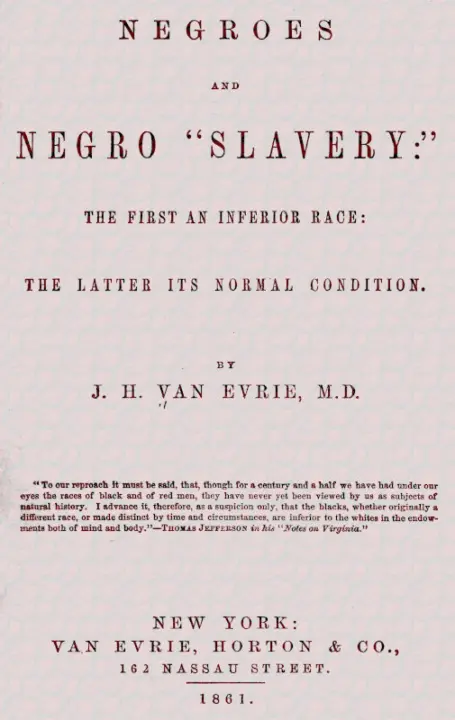
"Negroes and Negro 'Slavery:' the first an inferior race: the latter its normal condition" by J. H. Van Evrie, M.D. is a controversial treatise written in the mid-19th century. The work argues against the abolitionist movement, asserting that it is based on erroneous beliefs about racial equality and the nature of slavery. The author positions the black race as inherently inferior and maintains that slavery is the natural condition for those of African descent. At the start of the book, the author presents a preface discussing the political and social turmoil in America amid the rising anti-slavery sentiment and the onset of the Civil War. He critiques the abolitionist movement as rooted in delusion and foreign influence, particularly from European ideals. Van Evrie aims to provide a justification for the existing social order in the southern United States, asserting that it is rooted in natural law and necessity rather than moral failing. He sets the stage for a detailed exploration of the supposed differences between races, intending to argue for the social subordination of African Americans as not just preferable but essential for societal stability.
Introduction adapted from the source catalogue; source summaries may be automatically generated.
Free to read · English · 105,969 words · No account needed
MAKE TIME FOR A GOOD BOOK
On by default. Untick to stop anonymous reading totals. Each page counts after 10 seconds in view. How this works.
Anonymous counting is on unless you have switched it off.
Nothing, perhaps, is so repugnant to the northern mind as the notion that marriage does not exist among the “slaves” of the South, and the Abolition lecturers have given this subject the most prominent place in their terrible bill of indictment against their southern brethren. The spectacle, or the seeming spectacle, of four millions of human beings living without marriage, without family, without children, with nothing but offspring, shut out, like the brutes that perish, from all the household charities, and doomed to live in universal concubinage, as it has been termed, was, to the northern and European mind, such a stupendous outrage on “humanity,” that we need not wonder at their fierce indignation, or at the wild and unsparing denunciation heaped upon the authors of such boundless and unparalleled iniquity. Especially were northern women shocked and indignant, and above all others, the women of New England were excited at times to a “Divine fury” when contemplating this mighty “wickedness.” Our fair countrywomen are believed to be equally virtuous and lovely, but the domestic education of those of New England, in some respects, is more admirable than that of others or any other country. They are taught to labor, to be their own housekeepers, to regard life, and the duties of life, as a solemn mission to be faithfully and conscientiously fulfilled, and though it imparts a certain materialism bordering on hardness, perhaps, to the New England woman, it is associated with such simple and transparent love of truth, and such an earnest and abiding sense of duty, that the harsher features of the character are lost in these gentler and more exalted qualities. Hence they are taught to regard a violation of the family relation as the one most heinous and unpardonable sin. To women thus educated, with the utmost abhorrence of any violation of marital obligations, the seeming universal disregard of this relation, and the duties embraced in it, among the “slaves” of the South, was probably the most transcendent wrong that the mind could conceive of, and the “anti-slavery” delusion of the North has doubtless been increased to a considerable extent by this strictness or severity of female education. And if the facts were what they suppose, then indeed would their indignation and abhorrence be just enough, but strange that they should never have doubted or mistrusted these facts. Many of the most intelligent have known their sisters of the South, known them to be as virtuous, refined and womanly as themselves, and yet living every day of their lives in the shadow of this mighty wrong, and in the midst of this supposititious iniquity. Could that be possible? Could woman retain her purity, her womanly delicacy, or expand into the full stature of a true womanhood with such surroundings, in an atmosphere thus corrupt and corrupting, in a social condition where four millions of people were living without marriage, in open and utter disregard of the fundamental principle of morality as well as of social order? No, indeed, it could not be possible, and, as remarked, it is strange that the women of the North have not had misgivings of this kind, or have not mistrusted the assumed facts of “negro slavery” in this respect. But before the actual facts involved are presented to the reader, it is necessary to clearly understand what marriage itself is. It may be defined as the pledge of two persons of different sex to live together for life—pledged to each other and to society, for the presence of witnesses to a marriage contract or a marriage ceremony has simply this meaning, and none other. With us marriage is a mere civil or legal contract. It is the same in France, and, to a certain extent, in England, but in other countries it is combined with religious considerations, and the Catholic church makes it a sacrament. This is marriage, as ordinarily understood, as the necessities of the social order compel us to accept and regard it. Nevertheless, every one’s instincts will assure him that marriage consists in reality of vastly more than this description of it. A man and woman may pledge themselves to each other and to society—all the legal and customary forms may be complete, and yet we know, or may know that there is no true marriage, for these parties may be entirely indifferent, or even objects of actual dislike to each other. The obligations or duty to society may be fulfilled, the interests of families provided for, the legal rights of the parties themselves properly protected, even the welfare of offspring appropriately guarded, nevertheless, if the parties are not united by affection, by those mysterious affinities with which God Himself has endowed them, and for this precise purpose, then there is no true marriage, and, abstractly considered, they are as entirely separate as if they stood on different sides of the Atlantic instead of at the altar where the ceremony is being performed. It is clear, therefore, that marriage, truly considered, involves vastly more than the mere external ceremony or legal formularies, which the universal interest demands, however, as an essential accompaniment. “Increase and multiply” is an ordinance of nature as well as the command of holy writ. All the innumerable tribes of inferior beings obey this command with a regularity, order and completeness that admit of no exception or interruption. They are all governed by instinct, by a wise necessity which impels them to fulfill this Divine decree and in modes adapted to their specific nature. Birds choose their mates, are faithful to them, share together, in some instances, the care and nurture of the common offspring, and all other animals of the higher order exhibit a tendency to form these temporary unions. But in addition to the natural instinct impelling us, in common with all other creatures, to fulfill the universal command to “multiply and replenish the earth,” the Almighty Creator has given us reason and endowed us with capacities of affection which are designed to guide us in these respects. A youth and maiden are thrown into each other’s society, an acquaintance, an intimacy, a mutual affection and reciprocal love follow. They feel themselves united, not merely harmonized, but morally consolidated, as it were, into a single being, and they mutually pledge each other to be thus as long as they both shall live. They are united, not by their pledges to each other, their mutual declarations of affection, but by those beautiful and mysterious affinities that God has planted in the soul itself, and the pledges and promises are the mere outward expression of their actual existence.
Your reading position is saved on this browser. Take it to another device with a library code. Reading pages adapt to text, rather than matching a printed edition.
BEHIND THE BOOK
This eBook is for the use of anyone anywhere in the United States and most other parts of the world at no cost and with almost no restrictions whatsoever. You may copy it, give it away or re-use it under the terms of the Project Gutenberg License included with this eBook or online at www.gutenberg.org. If you are not located in the United States, you will have to check the laws of the country where you are located before using this eBook. Read the source licence.
The original source file, including credits and licence, is retained by this library. Request an original-format copy at no charge. Please include the book title and Project Gutenberg identifier #61063.
KEEP YOUR CURIOSITY GOING
Cécile Tormay

Moritz Busch
John L. Ransom
Frances Wright
Cécile Tormay

Mabel Potter Daggett