THE CLASSIC COLLECTION✦An outlaw’s diary: the CommuneCLASSIC FREE BOOKS
An outlaw’s diary: the Commune
Cécile Tormay
THE CLASSIC COLLECTION · 1853
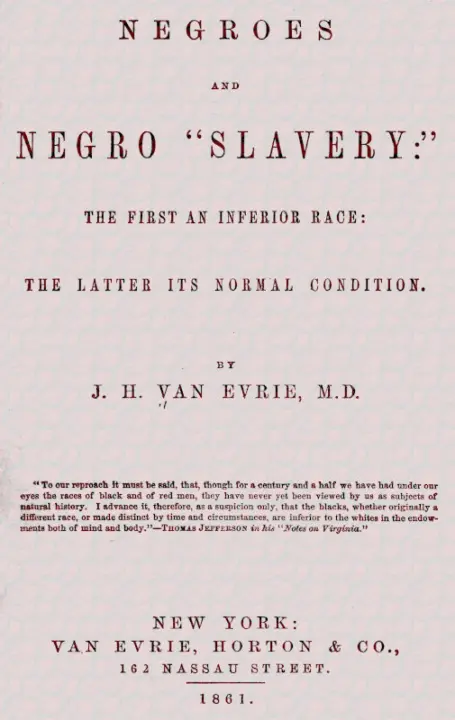
"Negroes and Negro 'Slavery:' the first an inferior race: the latter its normal condition" by J. H. Van Evrie, M.D. is a controversial treatise written in the mid-19th century. The work argues against the abolitionist movement, asserting that it is based on erroneous beliefs about racial equality and the nature of slavery. The author positions the black race as inherently inferior and maintains that slavery is the natural condition for those of African descent. At the start of the book, the author presents a preface discussing the political and social turmoil in America amid the rising anti-slavery sentiment and the onset of the Civil War. He critiques the abolitionist movement as rooted in delusion and foreign influence, particularly from European ideals. Van Evrie aims to provide a justification for the existing social order in the southern United States, asserting that it is rooted in natural law and necessity rather than moral failing. He sets the stage for a detailed exploration of the supposed differences between races, intending to argue for the social subordination of African Americans as not just preferable but essential for societal stability.
Introduction adapted from the source catalogue; source summaries may be automatically generated.
Free to read · English · 105,969 words · No account needed
MAKE TIME FOR A GOOD BOOK
On by default. Untick to stop anonymous reading totals. Each page counts after 10 seconds in view. How this works.
Anonymous counting is on unless you have switched it off.
But the mere covering of the head, or the mere protection of the brain, is not all that distinguishes the different races in these respects. The beard is equally radical and universal, though not so palpable a specialty as color, and in some respects it may be said to be a more important one. The Caucasian alone has a beard, for though all others approximate to it in this respect, it is the only bearded race, and some writers on ethnology have been so impressed with this imposing and striking distinction that they have sought to make it the basis of a classification of races. And there certainly is no physical or outward quality that so imposingly impresses itself on the senses as a mark of superiority, or evidence of supremacy, as a full and flowing beard. Color, when in repose, or when it does not give expression to the inner nature, does not, in reality, constitute a distinction at all, but the beard is an evidence of superiority, that, however varied the action or whatever the circumstances, is equally distinct and universal as an attribute of supremacy. This is sufficiently illustrated in our own race and our every day experience. The youth is beardless, and pari passu as he approaches to the maturity of manhood there is a corresponding development of beard. The intellect—the mental strength—the moral beauty, all the qualities of the inner being, as well as those outward attributes tangible to the sense, harmonize perfectly with the growth of the beard, and when that has reached its full development, it is both the signal and the proof of mature manhood—an exact admeasurement and absolute proof of the maturity of the individual as well as the type and standard of the race. This is equally true when applied to different races. The Caucasian is the only bearded race, but all others approximate in this respect, and the negro is furthest removed of all, for the tropical woolly-haired African or negro, except a little tuft on the chin and sometimes on the upper lip, has nothing that can be confounded with a beard. People sometimes see negroes with considerable hair on their faces, and hence conclude that they are as likely to have beards as white men; but they forget that all in our society who are not whites are considered negroes, and therefore those bearded negroes have a large infusion, and doubtless sometimes a vastly predominating infusion of Caucasian blood. The beard symbolizes our highest conceptions of manhood—it is the outward evidence of mature development—of complete growth, mental as well as physical—of strength, wisdom and manly grace, and the full, flowing, and majestic beard of the Caucasian, in contrast with the negro or other subordinate races, is as striking and imposing as the mane of the lion when compared with the meaner beasts of the animal world. Like color or any other of the great fundamental facts separating races, the beard is sufficient to determine their specific character and their specific relations to each other, and we have only to apply our every day experience as regards this outward symbol of inner manhood to measure the relative inferiority of the negro. The Abolitionists demand that the “equal manhood” of the negro shall be recognized, and complain bitterly of a government that refuses to respond to their wishes in this respect, but if this “equal manhood” was actually revealed to them in the person of the negro as it is in the persons of white men, and as God has alone provided and ordained or permitted it to be revealed, they would be overwhelmed with astonishment or convulsed with laughter. A negro with a full and flowing beard, with this symbol of perfect manhood or with this outward manifestation of the inner (Caucasian) being, would be a ludicrous monstrosity, as impossible, of course, as the Caliban of Shakespeare; but if such a supernatural being should suddenly make his appearance in an Abolition conventicle, the “friends of humanity” would be as much astonished as if an inhabitant of another world had come among them. A youth, with the majestic and flowing beard of adult life, if the monstrosity did not shock and disgust us, would be irresistibly comical, and equally so in the case of the childish and romping negro. Thus, were the leaders of the “anti-slavery enterprise” busily engaged in discussing the “equal manhood” of the negro, and in earnestly denouncing those who, unable to see it, decline to admit such a thing, and a negro should enter the room with the actual proof of its existence—with the full, flowing beard of the Caucasian, and therefore the outward symbol of an “equal manhood,” as the hand of the Eternal has revealed it in the person of the former—the whole Abolition congregation, if not paralyzed with horror, would burst into uncontrollable laughter. The wrongs of the “slave,” the cruelties of the master, the “hopes of humanity,” the most doleful stories and the saddest tales of the suffering “bondmen,” would be interrupted by screams of laughter at such a ludicrous spectacle as a negro with the majestic and flowing beard of the white man. This outward symbol of complete manhood, or this external indication which typifies the high nature and lofty qualities of the Caucasian, is no more impossible, however, to the negro than that “equal manhood” which is demanded for him, and therefore were the “friends of humanity” to vary their programme and demand an “equal” beard, or that we shall grant the negro the full and flowing beard of the Caucasian, they would render their performances more interesting without giving up any of their “principles,” as the absurdity is exactly the same in either case.
Your reading position is saved on this browser. Take it to another device with a library code. Reading pages adapt to text, rather than matching a printed edition.
BEHIND THE BOOK
This eBook is for the use of anyone anywhere in the United States and most other parts of the world at no cost and with almost no restrictions whatsoever. You may copy it, give it away or re-use it under the terms of the Project Gutenberg License included with this eBook or online at www.gutenberg.org. If you are not located in the United States, you will have to check the laws of the country where you are located before using this eBook. Read the source licence.
The original source file, including credits and licence, is retained by this library. Request an original-format copy at no charge. Please include the book title and Project Gutenberg identifier #61063.
KEEP YOUR CURIOSITY GOING
Cécile Tormay

Moritz Busch
John L. Ransom
Frances Wright
Cécile Tormay

Mabel Potter Daggett