THE CLASSIC COLLECTION✦An outlaw’s diary: the CommuneCLASSIC FREE BOOKS
An outlaw’s diary: the Commune
Cécile Tormay
THE CLASSIC COLLECTION · 1853
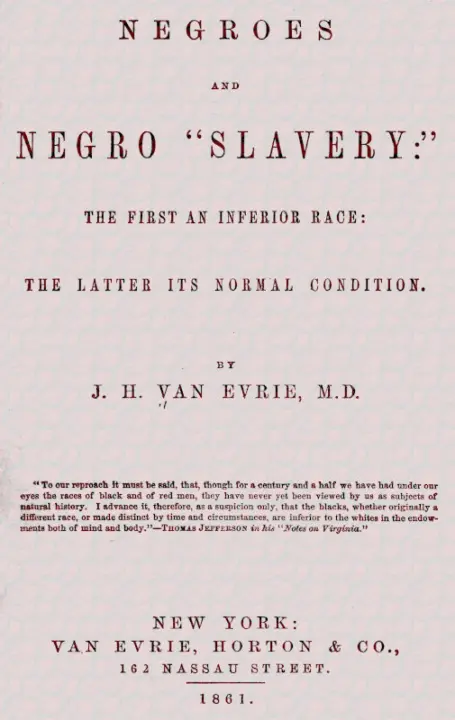
"Negroes and Negro 'Slavery:' the first an inferior race: the latter its normal condition" by J. H. Van Evrie, M.D. is a controversial treatise written in the mid-19th century. The work argues against the abolitionist movement, asserting that it is based on erroneous beliefs about racial equality and the nature of slavery. The author positions the black race as inherently inferior and maintains that slavery is the natural condition for those of African descent. At the start of the book, the author presents a preface discussing the political and social turmoil in America amid the rising anti-slavery sentiment and the onset of the Civil War. He critiques the abolitionist movement as rooted in delusion and foreign influence, particularly from European ideals. Van Evrie aims to provide a justification for the existing social order in the southern United States, asserting that it is rooted in natural law and necessity rather than moral failing. He sets the stage for a detailed exploration of the supposed differences between races, intending to argue for the social subordination of African Americans as not just preferable but essential for societal stability.
Introduction adapted from the source catalogue; source summaries may be automatically generated.
Free to read · English · 105,969 words · No account needed
MAKE TIME FOR A GOOD BOOK
On by default. Untick to stop anonymous reading totals. Each page counts after 10 seconds in view. How this works.
Anonymous counting is on unless you have switched it off.
What might have been, it is useless to conjecture; but the notion of a certain class of sentimentalists among us, that we have done the Indian great wrong, and that, had we treated him with kindness and justice, he might have become civilized, and a part of our permanent population, of course, is absurd; for it is founded on that foolish dogma of a single race, which Europe has fastened on the American mind, and which supposes the Indian, as the Negro, etc., to have the same nature as themselves. Nor is the notion of others, that the Indian is incapable of civilization, and therefore destined to give way before the advance of the white man, worthy of any consideration; for this involves the paradox of being created without a purpose, a supposition not to be entertained a moment; for the most insignificant beings in the lowest forms of organic life have their uses, and the human creature, surely, was not created in vain. The simple truth is, that we need to know what the Indian is in fact, his true nature and true relations to our own race, and then, as we have done in the case of the Negro, adapt the social and governmental machinery to the wants of both races. But this employment and consequent destruction of the Indians of America by the monarchists of Europe, though often inflicting great temporary evil on our border settlements, did not retard our progress in the least, nor did England, to any appreciable extent, succeed in her objects. The theory or dogma of a single race, which her writers and publicists had set up about the time of the Revolution, produced, however, immense practical results both in Europe and America. The doctrines of the American Revolution, as was foreseen by British statesmen, soon became universally accepted in France, and threatened to overturn monarchy all over the Continent, and indeed in England itself. Dr. Johnson, Wilberforce, Pitt, and all the great writers and leaders of England, naturally enough adopted the notion that Indians, Negroes, etc., were men like themselves, except in color, cultivation, etc.; but they were impelled, by the necessities of their system and the preservation of monarchical institutions, to practicalize this theory to the utmost extent in their power, and thus divert the attention of their own oppressed white people from their wrongs, by holding up before them continually the imaginary wrongs of “American slaves.” They said, “It is true, you laborers of Yorkshire and operatives of Birmingham have a hard life, a life of constant toil and privation; but you are free-born Englishmen, and your own masters, and in all England there is not a single slave; while in America, in that so-called land of freedom, where there is no king, or noble, or law of primogeniture, and where, in theory, it is declared that all men are created free and equal, one sixth of the population are slaves, so abject and miserable that they are sold in the public markets, like horses and oxen. What, then, are your oppressions or your wrongs in comparison with those of American slaves? or what are the evils or the injustice of monarchy when contrasted with those dark and damning crimes of American democracy, that thus, in these enlightened times, dooms one sixth of the population to open and undisguised slavery?” Such was the argument of the British writers, and it was unanswerable if it had rested on fact—if the foundation were true, then the inference, of course, was unavoidable. If the so-called American slave was created free and equal with his master, then all that the British writers charged would have been true enough, and American slavery, in comparison with British liberty—or what passed for such in Yorkshire and Birmingham—would have been a wrong, so deep, damning, and fathomless, that no words in our language would be able to express its enormity. How was the poor, ignorant, and helpless laborer, or even his defenders, Fox, Sheridan, and other liberal leaders of the day, to answer this argument? They did not attempt it. They admitted that “American slavery” was all that it was charged to be—that it was a wrong and evil immeasurably greater and more atrocious than any of those which the people of France had risen against, or that the masses in England suffered under; but they hoped that the great principle of the American Revolution was strong enough to overcome this wrong, and in the process of time, to “abolish slavery,” and that liberty would become universal among Americans. Indeed, some of those who had been the most devoted believers in the great American doctrine, both in England and France, were so painfully impressed by the seeming wrong done the negro, that they lost their interest, to a great extent, in the real wrongs of the white man, and devoted all their efforts to the former. Societies were formed in London and Paris, funds contributed, books published, tracts distributed, and extensive arrangements entered into, with the sole purpose of relieving the “American slave” from the fancied wrongs that were heaped on him; and their societies, these “Amis des Noirs,” patronized by Robespierre and other leaders of the people, which were formed in almost every town in France and England, popularized the movement, and so identified the imaginary cause of the negro with that of the European masses, that to this day they doubtless seem inseparable. And even in our own times, we have witnessed the sorry spectacle of English laborers contributing of their wretched pittance to glorify some abolition hero or heroine of the “Uncle Tom” pattern, under the deplorable misconception, of course, that these blind tools of the enemies of liberty were faithful defenders of a common cause, when, in truth, they were vastly more dangerous to that cause than the open and avowed friends of despotism. But this very natural mistake of the friends of freedom in Europe, this ignorance and misconception of the negro nature and relations to the white man, which led Fox in England, and Robespierre in France, to confound the cause of the oppressed multitudes of their own race with the imaginary interests of negrodom, extended and unfortunate as it was and still is, was surpassed by a still more insidious and more extended influence. Wilberforce, who, more than any other man, gave form and direction to the great “anti-slavery” delusion of modern times, was eminently pious—as piety is accepted by a large portion of the religious world. He was an Episcopalian in form, but preeminently a Puritan in practice; and, while doubtless sincere in his belief, and perfectly correct in his religious habits, he was one of the most complete bigots, religious, political, and social, the world ever saw. Belonging to the ruling class, and possessed of a considerable fortune, he believed that his own status was the stand-point, and himself the model, for the government of society, and therefore was as doggedly and bitterly opposed to any change in England, or to any reform in English society, as he was earnest in his efforts to relieve the “sufferings of the slave” in America. In a public career of some forty years, as a member of Parliament, he never failed to record his vote against any increase of popular freedom, or any change that tended to ameliorate the condition of the white masses, and just as steadily and uniformly labored to “elevate” the negro to the status of the English laborer, or, at all events, to favor that final “abolition of slavery,” which he himself was not, however, destined to witness in the British American possessions. But throughout he regarded the question rather as a religious than a political one, and at an early period, in this respect, impressed his own character on it. Identified with the Church, all his notions those of the High Church party—substantially the notions that Archbishop Laud entertained two centuries before—by birth and association connected with the landed aristocracy, and yet distinguished for practical piety, for a zeal and devotion to his religious duties that the most zealous among the Dissenters and Evangelicals might imitate but could not surpass, this was just the man to impress a great movement with his own characteristics, and the “anti-slavery cause” became the cause of religion as well as of liberty with the religious world. Nor was it confined to the “American slave;” it embraced the whole world of heathendom; and a religious crusade sprang up, that finally became more extended, and, in some respects, more permanent, than the great political movement inaugurated by Jefferson a few years before. And if the Father of Lies, Lucifer himself, had plotted a plan or scheme for concealing a great truth, and embarrassing a great cause, he could have accomplished nothing more effective than the movement that Wilberforce inaugurated for the professed benefit of the negro and other subordinate races of mankind, which, masked under the form of religious duty, and appealing to the conscience, the love of proselytism, the enthusiasm, and even the bigotries of the religious world, has, for more than half a century, held in thrall the conscience as well as the reason of Christendom. Robespierre, and other patrons of the Amis des Noirs, could only present a common cause, that “universal liberty” which they declared to be the birthright of all men, and which it were better that every conceivable calamity should happen rather than this “great principle” should perish; but when it became the duty of every Christian man and woman, every follower of Christ and professor of religion, to work and pray for “the deliverance of the slave,” then a power was aroused that nothing could resist, for it became an immediate and sacred duty to labor in this cause. Missionary societies were organized, money contributed by millions both in Europe and America, enthusiastic men and women offered their services, even children were taught to give their pocket-money for a cause so holy as that of redeeming the “slave,” while all this time innumerable multitudes of their own race, their own blood, those whom God had created their equals, and endowed with like capacities, instincts, and wants, and therefore designed for the same happiness as themselves, were left to grovel in midnight darkness and abject misery.
Your reading position is saved on this browser. Take it to another device with a library code. Reading pages adapt to text, rather than matching a printed edition.
BEHIND THE BOOK
This eBook is for the use of anyone anywhere in the United States and most other parts of the world at no cost and with almost no restrictions whatsoever. You may copy it, give it away or re-use it under the terms of the Project Gutenberg License included with this eBook or online at www.gutenberg.org. If you are not located in the United States, you will have to check the laws of the country where you are located before using this eBook. Read the source licence.
The original source file, including credits and licence, is retained by this library. Request an original-format copy at no charge. Please include the book title and Project Gutenberg identifier #61063.
KEEP YOUR CURIOSITY GOING
Cécile Tormay

Moritz Busch
John L. Ransom
Frances Wright
Cécile Tormay

Mabel Potter Daggett