THE CLASSIC COLLECTION✦An outlaw’s diary: the CommuneCLASSIC FREE BOOKS
An outlaw’s diary: the Commune
Cécile Tormay
THE CLASSIC COLLECTION · 1853
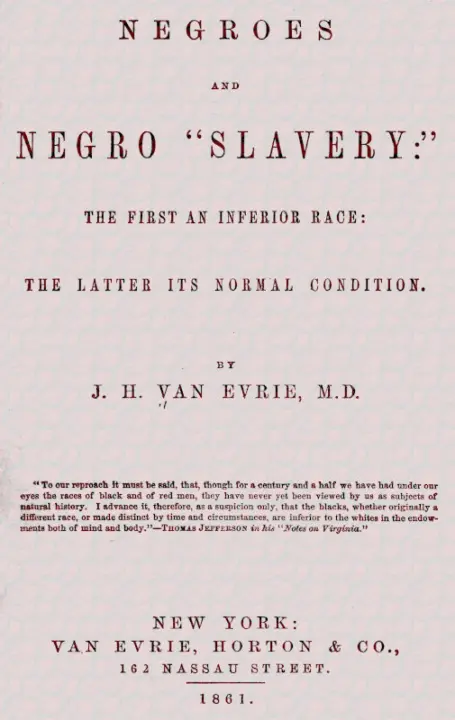
"Negroes and Negro 'Slavery:' the first an inferior race: the latter its normal condition" by J. H. Van Evrie, M.D. is a controversial treatise written in the mid-19th century. The work argues against the abolitionist movement, asserting that it is based on erroneous beliefs about racial equality and the nature of slavery. The author positions the black race as inherently inferior and maintains that slavery is the natural condition for those of African descent. At the start of the book, the author presents a preface discussing the political and social turmoil in America amid the rising anti-slavery sentiment and the onset of the Civil War. He critiques the abolitionist movement as rooted in delusion and foreign influence, particularly from European ideals. Van Evrie aims to provide a justification for the existing social order in the southern United States, asserting that it is rooted in natural law and necessity rather than moral failing. He sets the stage for a detailed exploration of the supposed differences between races, intending to argue for the social subordination of African Americans as not just preferable but essential for societal stability.
Introduction adapted from the source catalogue; source summaries may be automatically generated.
Free to read · English · 105,969 words · No account needed
MAKE TIME FOR A GOOD BOOK
On by default. Untick to stop anonymous reading totals. Each page counts after 10 seconds in view. How this works.
Anonymous counting is on unless you have switched it off.
But this drawback on American progress—this clinging to the habitudes of the Old World, which kept the Spanish and French colonies in abject submission to the mother country, and which England, at a later period, sought to force on her colonies—was not the sole embarrassment in the progress of the colonists. They were confronted by wild and ferocious savages, who disputed every step of the white European; and though, previous to the independence of the colonies, the mother country united with the latter against the former, from the breaking out of hostilities in 1776 to the close of the War of 1812 the interests of monarchy and savagism may be said to have been inseparable, and to have formed a common barrier against the march of republicanism. Indeed, it is a truth, attested by the whole history of the past, and equally so by the circumstances of the present, that the subordinate races of this continent—the Indian, Negro, Mongrel, etc.—constitute the material, the very stock in trade, of European monarchists, to embarrass the progress of American institutions; and in every instance where we have been engaged in Indian wars, that portion of our people who, in their ignorance and blindness, have condemned the course of their own government, have been the unconscious instruments of the enemies of their country, and in their sickly sentimentality and folly, they have sought to obstruct the progress of American civilization. Monarchy consists in artificial distinctions of kings, nobles, peasants, etc., or it may be defined as the rule of classes of the same race, and, from the inherent necessities of its organization, it is forced to make war on the natural distinction of races. Prior to the breaking out of the American Revolution, there was no necessity for calling in the aid of the Negro or the Indian to crush out the liberty of the white man. The colonists, as has been observed, were practical republicans, and substantially governed themselves; but they had not questioned the European system or theory of monarchism. When they did this, however, in that grand Declaration of Mr. Jefferson, that all men (meaning, of course, his own race) were created free and equal, the British monarchists instinctively and, indeed necessarily, resorted to the means at hand—to the subordinate races of America—to demoralize and break down this immortal truth. An English judge, anticipating the coming rebellion of the Americans, had already ruled that “slavery,” or social subordination of the negro to the white man, was a result of municipal law—a creature of the lex loci; and though this was in language that led vast numbers of people into error, its technical as well as absolute falsehood is apparent, when we remember that no such “law” has ever existed, either now or at any other time, in American history, from the Canadian Lakes to Cape Horn. But it served as a foundation and stand-point for that wide-spread imposture and world-wide delusion which has since so overshadowed the land, and, with the best intentions on their part, so deluded Americans themselves into a blind warfare against the progress, prosperity, and indeed the civilization, of their country and continent. In the seven years’ war waged to crush out the rebellion of the Colonies, England subsidized the savage Indian tribes wherever it was possible to do so; and in the subsequent War of 1812, her agents partially succeeded in combining all the savages on our western border, under Tecumseh, with the design of shutting us out forever from the country west of the Mississippi. The result of this monstrous alliance of European monarchists and American savages to beat back the advancing civilization of the New World, to hold in check, and, if possible, to defeat and overthrow republicanism, has ended in the destruction and almost utter annihilation of the North American Indians. General Jackson’s campaigns in Florida, as well as those of Harrison in the West, and, to a certain extent, even the later Seminole War, all had their origin in the same causes, the open or secret intrigues of British agents, stimulating the savages to resist the onward march of American civilization. Nor was it anything like the former contests of the agents of England and France to enlist the aid of the savages against each other; for, repulsive and iniquitous as it may be for men of the same race to employ subordinate races against their own blood, they were struggling for possession of a continent, and all means, doubtless, seemed legitimate that should give them victory. But in this case it was a war against Americanism—against a new order of political society—against a system based on a principle of utter antagonism to monarchism, and which if permitted to develop its legitimate results, to grow into a new and grander order of civilized society than the world had ever yet witnessed, the rotten and worn-out systems of Europe were doomed to certain and perhaps early overthrow. It is true, the agents employed did not know this—indeed, their European masters were ignorant, perhaps, of the principles involved; but the instinct of self-preservation, the instinct inherent in hostile systems impelled them forward, while the ends to be reached, or the consequences of success, were always too apparent to be mistaken. But their savage instruments were destroyed in the conflict, in the uses to which they were applied by their European allies; and whatever may be the future fate of the Aborigines in Spanish America, the North American Indian is virtually annihilated. A few wild tribes of the West and South-west, whose means for preserving existence are every day growing less, still remain, and some remnants of semi-civilized tribes, which are perishing even more rapidly than the former, are to be found on our Western frontier; but the time is not distant, perhaps, when they will be wholly and absolutely extinct.
Your reading position is saved on this browser. Take it to another device with a library code. Reading pages adapt to text, rather than matching a printed edition.
BEHIND THE BOOK
This eBook is for the use of anyone anywhere in the United States and most other parts of the world at no cost and with almost no restrictions whatsoever. You may copy it, give it away or re-use it under the terms of the Project Gutenberg License included with this eBook or online at www.gutenberg.org. If you are not located in the United States, you will have to check the laws of the country where you are located before using this eBook. Read the source licence.
The original source file, including credits and licence, is retained by this library. Request an original-format copy at no charge. Please include the book title and Project Gutenberg identifier #61063.
KEEP YOUR CURIOSITY GOING
Cécile Tormay

Moritz Busch
John L. Ransom
Frances Wright
Cécile Tormay

Mabel Potter Daggett