THE CLASSIC COLLECTION✦An outlaw’s diary: the CommuneCLASSIC FREE BOOKS
An outlaw’s diary: the Commune
Cécile Tormay
THE CLASSIC COLLECTION · 1853
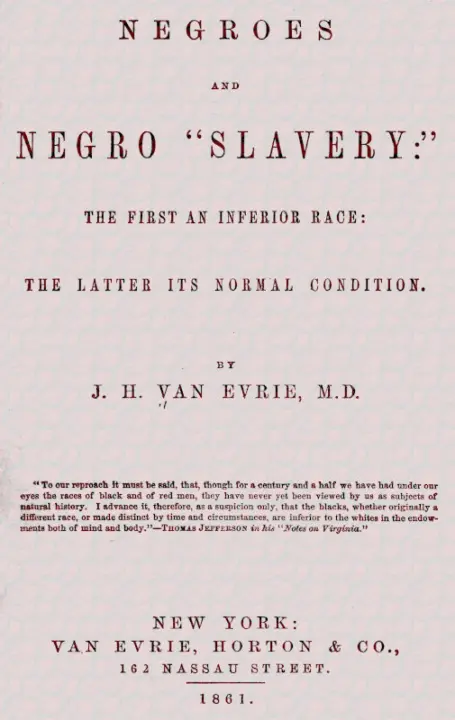
"Negroes and Negro 'Slavery:' the first an inferior race: the latter its normal condition" by J. H. Van Evrie, M.D. is a controversial treatise written in the mid-19th century. The work argues against the abolitionist movement, asserting that it is based on erroneous beliefs about racial equality and the nature of slavery. The author positions the black race as inherently inferior and maintains that slavery is the natural condition for those of African descent. At the start of the book, the author presents a preface discussing the political and social turmoil in America amid the rising anti-slavery sentiment and the onset of the Civil War. He critiques the abolitionist movement as rooted in delusion and foreign influence, particularly from European ideals. Van Evrie aims to provide a justification for the existing social order in the southern United States, asserting that it is rooted in natural law and necessity rather than moral failing. He sets the stage for a detailed exploration of the supposed differences between races, intending to argue for the social subordination of African Americans as not just preferable but essential for societal stability.
Introduction adapted from the source catalogue; source summaries may be automatically generated.
Free to read · English · 105,969 words · No account needed
MAKE TIME FOR A GOOD BOOK
On by default. Untick to stop anonymous reading totals. Each page counts after 10 seconds in view. How this works.
Anonymous counting is on unless you have switched it off.
The leaders very generally assumed, as they often expressed it, that society was naturally divided into the few and the many—the educated minority, and the laboring majority—and as such was the actual social condition of the population as well as the mental habits of the leaders, it is not at all surprising that they sought to found a government on such a basis. The agricultural population of the Northern and Middle States were then very ignorant indeed, when compared with the present. Feudalism had not been long overthrown in England or Europe, and the serf transformed into the peasant, and though the American farmer of 1776 was a great advance over the latter, he still largely partook of that general apathy, stolidity, and ignorance which in all times, until now, in our own favored land, have distinguished the tillers of the soil. The large population at the North otherwise employed, the mechanics, artisans, shop-keepers, laborers, etc., were generally, as in the mother country, without representation in the provincial legislatures, and as the interests of the educated classes, the capitalists, merchants, lawyers, divines, etc., were supposed to be, and were in fact, in conflict with those of the former, they always desired strong governments to hold them in order. Indeed, the idea of mob ascendency, of anarchy, the wild rule of the rabble, was the constant terror of the Northern leaders, and in all the arguments of Hamilton, the Adamses, etc., this was put prominently forward. Their rhetorical formula was always the same—“the rule of the uneducated mass will degenerate into license and anarchy, from which the country can only be saved by the strong hand of some military chief, who, first a dictator, will finally don the purple, and the rôle so often played in the Old World will be repeated in the New.” This notion and this reasoning was legitimate—the consistent result of the social condition as well as the offspring of the inherited traditions of the Northern mind. The capitalists, all those who inherited wealth, the “well-born” and educated class, in short, the few who had the power in their hands, naturally sought, to preserve it and to build up a strong government; which, while it specially benefited themselves, should always be able to “preserve order”—that is, while founded on existing social distinctions, was sufficiently strong to repress the efforts of the multitude to change the social condition. They had no negroes, no natural substratum in the social elements or natural distinctions of society. They had nothing before their eyes but the results of chance, of the accidents of life—nothing but wealth and education—nothing, in short, but the débris of the old societies—those class distinctions which in the Old World constitute the basis of the political and social order, and their mental habits, their opinions, their notions of government and its uses, were, of course, in accord with these things, and their minds were incapable of rising above the existing condition, of over-leaping the barriers and escaping from the external circumstances that surrounded them. There were, doubtless, individual exceptions—some men who were deeply imbued with the grand idea promulgated by Jefferson in the Declaration of Independence. There were many in the Middle States who had an imperfect but advancing conception of this glorious truth, and there was still a larger number, perhaps, who were groping in darkness with a vague but earnest desire to embrace it. But the dominant thought, the prevalent opinion, the general mental habit, was reflected by the representative men, the great Northern leaders, Hamilton, Adams, Otis, and their companions, who desired to found a government on the British model, which, though it should be a great improvement over the former, was to be based on the same foundation—for, to their minds, their mental habits, there was no other, or, at all events, no other safe basis for government. They were honest and patriotic men—men of gifted minds and large attainments—men sorely tried and tested by the hardships and sufferings of a seven years’ war, through which they walked with their lives in their hands, and the scaffold always frowning on them in the distance, and the purity of intentions, the unselfish and patriotic desires of such men, should never be questioned. They could not rise above the circumstances that surrounded them; they could not comprehend the grand idea of Mr. Jefferson; they saw before them only class distinctions, the rich and the poor, the educated few and the toiling many, and they desired to build the government on the status quo, and therefore demanded a strong government, that should always be able to restrain the multitude and keep them in subjection to their “rulers.”
Your reading position is saved on this browser. Take it to another device with a library code. Reading pages adapt to text, rather than matching a printed edition.
BEHIND THE BOOK
This eBook is for the use of anyone anywhere in the United States and most other parts of the world at no cost and with almost no restrictions whatsoever. You may copy it, give it away or re-use it under the terms of the Project Gutenberg License included with this eBook or online at www.gutenberg.org. If you are not located in the United States, you will have to check the laws of the country where you are located before using this eBook. Read the source licence.
The original source file, including credits and licence, is retained by this library. Request an original-format copy at no charge. Please include the book title and Project Gutenberg identifier #61063.
KEEP YOUR CURIOSITY GOING
Cécile Tormay

Moritz Busch
John L. Ransom
Frances Wright
Cécile Tormay

Mabel Potter Daggett