THE CLASSIC COLLECTION✦An outlaw’s diary: the CommuneCLASSIC FREE BOOKS
An outlaw’s diary: the Commune
Cécile Tormay
THE CLASSIC COLLECTION · 1853
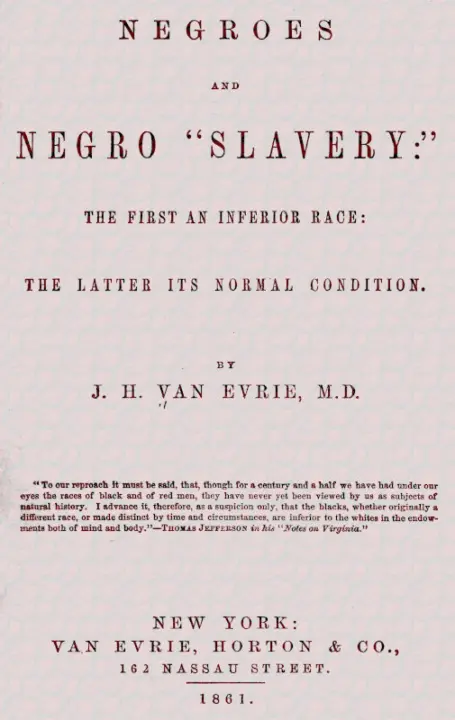
"Negroes and Negro 'Slavery:' the first an inferior race: the latter its normal condition" by J. H. Van Evrie, M.D. is a controversial treatise written in the mid-19th century. The work argues against the abolitionist movement, asserting that it is based on erroneous beliefs about racial equality and the nature of slavery. The author positions the black race as inherently inferior and maintains that slavery is the natural condition for those of African descent. At the start of the book, the author presents a preface discussing the political and social turmoil in America amid the rising anti-slavery sentiment and the onset of the Civil War. He critiques the abolitionist movement as rooted in delusion and foreign influence, particularly from European ideals. Van Evrie aims to provide a justification for the existing social order in the southern United States, asserting that it is rooted in natural law and necessity rather than moral failing. He sets the stage for a detailed exploration of the supposed differences between races, intending to argue for the social subordination of African Americans as not just preferable but essential for societal stability.
Introduction adapted from the source catalogue; source summaries may be automatically generated.
Free to read · English · 105,969 words · No account needed
MAKE TIME FOR A GOOD BOOK
On by default. Untick to stop anonymous reading totals. Each page counts after 10 seconds in view. How this works.
Anonymous counting is on unless you have switched it off.
South Carolina, and perhaps some others, may seem exceptions to this very general truth, but if so in reality, it is owing to peculiar causes, such as the education of many of its people abroad, in Europe, and at the North, etc., but even as regards that State, so exceptional in many respects, land is more equally divided than in any other State, and where such a fact obtains, the general tendency to equality in citizenship must be strikingly manifested.
The great revolutionary movement of 1776 gave full expression to the new modes of thought, the grand ideas, the glorious truths thus developed in the mind of Virginia, and relatively in the other colonies, where this cause, this negro element had anything like a stationary existence. It was no accident or chance that made Mr. Jefferson the author of the great idea, or rather the exponent of the idea embodied in the Declaration of Independence, the grand and immortal truth, that all white men are created equal, and therefore entitled to equal rights, or, as he expressed it, to “life, liberty, and happiness.” True, some other Virginian might have done this, and possibly some mind in the Middle Provinces, New Jersey, or New York, might have formed a tolerably clear conception of this great fixed and unchangeable truth that underlies the whole superstructure of our political society; but no man in the Northern Provinces could have risen to this mental elevation at that period in our history; indeed comparatively few are even now capable of it. Massachusetts and the neighboring colonies grasped the idea of independence with great clearness, and urged it with an earnestness, bravery, and indomitable perseverance certainly unsurpassed, if equalled elsewhere, but it was independence of a foreign dominion, and not independence of foreign ideas or of a hostile system. They were without negroes, without any natural substratum in the social elements, without any test or standard to determine men’s natural relations to each other, and clinging to the mental habits of their British ancestors, they were therefore incapable of forming those grand and truthful conceptions of equality which Mr. Jefferson, and Virginians generally, under the influences that have been stated, so clearly apprehended. The accidental and artificial distinctions of society—family influence, wealth, education, etc., were as in England, though, of course, not to the same extent—the standards, the tests, the landmarks of the political as well as the social order, and the phrase often used by New England writers of our own day, that “representation was inseparable from taxation,” fully expressed the mental habits and imperfect political conceptions of the Northern mind. In England, except the titled aristocracy, the House of Lords or Peerage, which pretends to rest on blood or birth (?), wealth alone gives rights. The man is nowhere, no part or portion, or element even of the political system. In every county where he happens to have property, he has a vote, but if without property, he has no voice whatever, and, as observed, is not even an element of representation, as are the negroes of the South. Taxation and representation, therefore, are inseparable, so far as forms are concerned, in the British system, though, as a fact, it is the working classes, who are not represented at all, that must pay all the taxes in the end. The mental habits of the North, in 1776, were fashioned on this model; they saw only those accidental things that separate classes in England, as, wealth, education, etc., and though they had an earnest desire for liberty, this liberty was a vague, undefined, shadowy sentiment, rather than any precise idea resting on fact as in Virginia. The immediate want and common impulse of independence, however, impelled all parties to act harmoniously for its accomplishment, and though the grand truths presented by Jefferson in the Declaration of Independence were far above the then intellectual standard of the North, it did not conflict with the mental habits of the Northern people sufficiently to interfere with the common object. But when that object was accomplished—when the foreign dominion was overthrown and the common independence secured, and a new political system was to be created, then a conflict of ideas was developed that was found to be so grave, that many good and patriotic men for some time feared it could not be compromised. The leading men of the North—the representative men—the men who desired independence from foreign domination, but with, at best, vague notions of liberty, or of a new political system—Hamilton, Adams, Morris, etc.—now came into serious conflict with the democratic ideas of Virginia. They desired a monarchy without a king, or a republic without the rule of the masses. The general notion was, the British model without its defects, or the British system without its corruptions, and so entirely were some wedded to this, that they declared it, with all its corruptions, the best government in the world.
Your reading position is saved on this browser. Take it to another device with a library code. Reading pages adapt to text, rather than matching a printed edition.
BEHIND THE BOOK
This eBook is for the use of anyone anywhere in the United States and most other parts of the world at no cost and with almost no restrictions whatsoever. You may copy it, give it away or re-use it under the terms of the Project Gutenberg License included with this eBook or online at www.gutenberg.org. If you are not located in the United States, you will have to check the laws of the country where you are located before using this eBook. Read the source licence.
The original source file, including credits and licence, is retained by this library. Request an original-format copy at no charge. Please include the book title and Project Gutenberg identifier #61063.
KEEP YOUR CURIOSITY GOING
Cécile Tormay

Moritz Busch
John L. Ransom
Frances Wright
Cécile Tormay

Mabel Potter Daggett