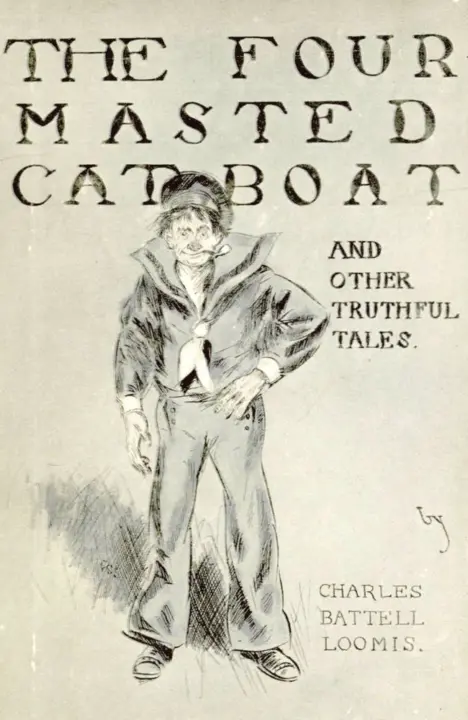
The Four-Masted Cat-Boat, and Other Truthful Tales
Charles Battell Loomis

THE CLASSIC COLLECTION · 1905
"Minerva's Manoeuvres: The Cheerful Facts of a 'Return to Nature'" by Charles Battell Loomis is a light-hearted novel written in the early 20th century. The story revolves around Minerva, a cook from New York City, who is compelled to move to a more rustic environment when her employer, Mrs. Vernon, invites her to Clover Lodge in the countryside after their original cook falls ill. The narrative highlights the amusing culture clash Minerva experiences as she grapples with her new rural lifestyle. The opening of the book introduces readers to the charm and humor of the situation, particularly through the dynamic between Minerva and her employers. As Minerva reluctantly agrees to leave the city for the countryside, she portrays a mix of comedy and exasperation, often lamenting about her aversion to rural life. The scenes that unfold during their journey to Clover Lodge, including Minerva’s comical interactions with a noisy cat, set the stage for a series of misadventures. Loomis's engaging tone and vibrant characterizations promise a delightful exploration of themes around adaptation, identity, and the quirks of transitioning from city to country life.
Introduction adapted from the source catalogue; source summaries may be automatically generated.
Free to read · English · 75,269 words · No account needed
MAKE TIME FOR A GOOD BOOK
On by default. Untick to stop anonymous reading totals. Each page counts after 10 seconds in view. How this works.
Anonymous counting is on unless you have switched it off.
It was certainly a very unpleasant position for both of us, and I felt that my white lies were coming home to roost way ahead of roosting time.
“Did he give you a part of the spoils as a reward for having fed
him?”
“No, sir.” This indignantly.
“He didn’t give you this?” said he, pulling out of his pocket a
silver vase.
“No.”
At this Minerva actually began to sob. “Oh, Mist. Vernon, how could you say that? I found that vase in the kitchen this morning, and this man says it was stolen from them people. Oh, why did I come up here?”
“Philip, you might as well tell the whole story,” said Ethel, coming back from the parlour. “We’ll probably lose Minerva now, anyway.”
“So there is a story,” said the constable, crossing his legs in a most irritating way. In fact he couldn’t have done anything that would not have been irritating.
I saw that the best thing to do was to tell the truth, ridiculous as it might sound with Minerva there. Indeed, the very fact of my telling it might soften the girl and show her how much we were willing to descend in our efforts to keep her valuable services. But I made a wrong start. I said:
“I knew that the man was a burglar—”
Minerva immediately burst out sobbing and left the kitchen and went to her room, and my mental eye could see her remorselessly packing her trunk.
“Go on,” said the constable, and then, “Go outside,” said he to
the mulatto.
“Well, now that they’ve gone,” said I in a relieved tone, “I can tell you the whole thing, farcical as it is. Have you a servant?”
“My wife has a hired girl. What’s that got to do with it?”
“Do you have trouble in keeping her?”
“We have trouble in keeping them. It’s one after another. They all get the itch for the mills or the stores.”
“Good! Then you’ll understand me,” said I, and I told him the whole story, going on to say:
“When we were roused by this burglar, and I realized that Minerva would throw up her position if she was unduly startled, I resolved to throw myself on the burglar’s mercy, and ask him to pose as my friend, so as to deceive Minerva. It worked all right, or would have worked all right if you hadn’t come here to upset her worse than ever. She’s probably packing her trunk, now—”
“By Godfrey, I’m sorry,” said the constable, who seemed a very decent sort of fellow, now that I knew him better.
Your reading position is saved on this browser. Take it to another device with a library code. Reading pages adapt to text, rather than matching a printed edition.
Charles Battell Loomis
Charles Battell Loomis
BEHIND THE BOOK
This eBook is for the use of anyone anywhere in the United States and most other parts of the world at no cost and with almost no restrictions whatsoever. You may copy it, give it away or re-use it under the terms of the Project Gutenberg License included with this eBook or online at www.gutenberg.org. If you are not located in the United States, you will have to check the laws of the country where you are located before using this eBook. Read the source licence.
The original source file, including credits and licence, is retained by this library. Request an original-format copy at no charge. Please include the book title and Project Gutenberg identifier #56872.
KEEP YOUR CURIOSITY GOING
Coulson Kernahan

Maurice Baring
Frances Wright
Cécile Tormay

Frederic Jesup Stimson

W. H. P. (William Henry Pope) Jarvis