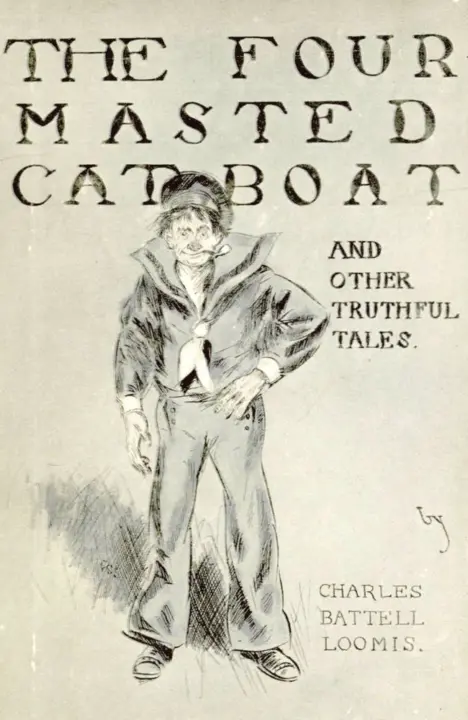
The Four-Masted Cat-Boat, and Other Truthful Tales
Charles Battell Loomis
THE CLASSIC COLLECTION · 1905
"Minerva's Manoeuvres: The Cheerful Facts of a 'Return to Nature'" by Charles Battell Loomis is a light-hearted novel written in the early 20th century. The story revolves around Minerva, a cook from New York City, who is compelled to move to a more rustic environment when her employer, Mrs. Vernon, invites her to Clover Lodge in the countryside after their original cook falls ill. The narrative highlights the amusing culture clash Minerva experiences as she grapples with her new rural lifestyle. The opening of the book introduces readers to the charm and humor of the situation, particularly through the dynamic between Minerva and her employers. As Minerva reluctantly agrees to leave the city for the countryside, she portrays a mix of comedy and exasperation, often lamenting about her aversion to rural life. The scenes that unfold during their journey to Clover Lodge, including Minerva’s comical interactions with a noisy cat, set the stage for a series of misadventures. Loomis's engaging tone and vibrant characterizations promise a delightful exploration of themes around adaptation, identity, and the quirks of transitioning from city to country life.
Introduction adapted from the source catalogue; source summaries may be automatically generated.
Free to read · English · 75,269 words · No account needed
MAKE TIME FOR A GOOD BOOK
On by default. Untick to stop anonymous reading totals. Each page counts after 10 seconds in view. How this works.
Anonymous counting is on unless you have switched it off.
TOM had discontinued work on the lean-to for some untold reason, and just after lunch he and Hepburn had gone over to Bert’s to get the horse and go for the cots.
The rest of us broke up into convenient groups and tennised or walked, but by the middle of the afternoon a drowsiness came over us, superinduced by our sleepless night, and with the exception of Ethel and Mrs. Benedict, who were helping prepare dinner, we all slept, some in hammocks, one on the ornate sofa and the rest in the three bedrooms.
And then, just before dinner, Tom and Hepburn not having come, we all went out to look for them.
It ought not to have taken them long to buy two cot beds and bring them up, and they had been gone four hours at least.
We walked upwards of a mile toward town, and at last came to a rock, from the top of which we could command a view of the rest of the road to Egerton, but there was no sign of Bert’s wagon.
“Well,” said Ethel, “we’d better be starting back, for dinner ought to be ready soon.”
And so we sauntered back, expecting every minute to be overtaken
by the cot bringers.
We arrived at the house and all entered by the south door, attracted thereto by the recumbent figures of our truants. Each one was reclining gracefully upon a cot reading, and smoking excellent cigars.
“Here, here,” said Tom, when he saw us. “This will never do. Dinner’s ready this ten minutes, and Hepburn and I are starving.”
As soon as Hepburn had seen us he had risen from his couch, but Tom continued to lie there blocking the doorway.
“What about that lean-to,” said I.
Tom rose and folded up his cot as an Arab is supposed to fold his tent. Then he set it up against the side of the house and said oracularly:
“The lean-to is indefinitely postponed. We know more than we
did this morning.”
“Well, but where have you been? We walked half way to town and didn’t see you,” said Ethel.
“Exploring the country. Haven’t we, Talcott.”
“It’s a beautiful country,” said Talcott, laughing.
All through dinner those two seemed to have a secret, and as near as we could make out, Minerva was in it, because every time she came into the room and looked at Tom she smothered chuckles.
After dinner Tom said, “Mrs. Vernon, what do you say to our taking our coffee in the summer house?”
“In the summer house,” said Ethel, “why, there isn’t any summer
house.”
Your reading position is saved on this browser. Take it to another device with a library code. Reading pages adapt to text, rather than matching a printed edition.
Charles Battell Loomis
Charles Battell Loomis
BEHIND THE BOOK
This eBook is for the use of anyone anywhere in the United States and most other parts of the world at no cost and with almost no restrictions whatsoever. You may copy it, give it away or re-use it under the terms of the Project Gutenberg License included with this eBook or online at www.gutenberg.org. If you are not located in the United States, you will have to check the laws of the country where you are located before using this eBook. Read the source licence.
The original source file, including credits and licence, is retained by this library. Request an original-format copy at no charge. Please include the book title and Project Gutenberg identifier #56872.
KEEP YOUR CURIOSITY GOING
Coulson Kernahan

Maurice Baring
Frances Wright
Cécile Tormay

Frederic Jesup Stimson

W. H. P. (William Henry Pope) Jarvis