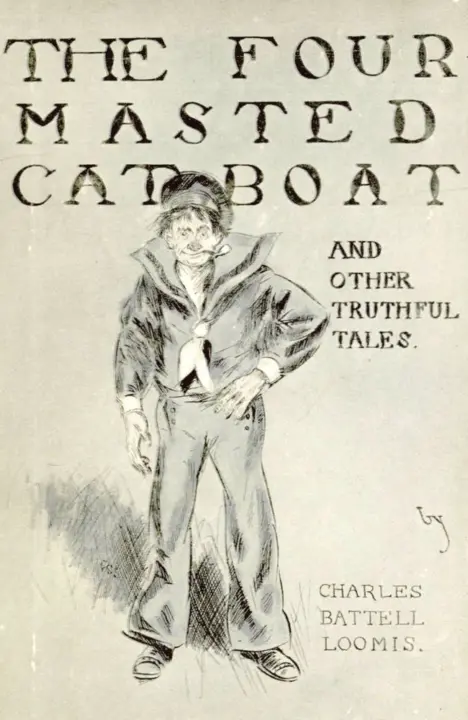
The Four-Masted Cat-Boat, and Other Truthful Tales
Charles Battell Loomis
THE CLASSIC COLLECTION · 1905
"Minerva's Manoeuvres: The Cheerful Facts of a 'Return to Nature'" by Charles Battell Loomis is a light-hearted novel written in the early 20th century. The story revolves around Minerva, a cook from New York City, who is compelled to move to a more rustic environment when her employer, Mrs. Vernon, invites her to Clover Lodge in the countryside after their original cook falls ill. The narrative highlights the amusing culture clash Minerva experiences as she grapples with her new rural lifestyle. The opening of the book introduces readers to the charm and humor of the situation, particularly through the dynamic between Minerva and her employers. As Minerva reluctantly agrees to leave the city for the countryside, she portrays a mix of comedy and exasperation, often lamenting about her aversion to rural life. The scenes that unfold during their journey to Clover Lodge, including Minerva’s comical interactions with a noisy cat, set the stage for a series of misadventures. Loomis's engaging tone and vibrant characterizations promise a delightful exploration of themes around adaptation, identity, and the quirks of transitioning from city to country life.
Introduction adapted from the source catalogue; source summaries may be automatically generated.
Free to read · English · 75,269 words · No account needed
MAKE TIME FOR A GOOD BOOK
On by default. Untick to stop anonymous reading totals. Each page counts after 10 seconds in view. How this works.
Anonymous counting is on unless you have switched it off.
His tone was insolent, and my tone was correspondingly
dignified.
“Why, I haven’t the slightest idea where the thief that robbed the Fayerweather’s is now,” said I, wishing with all my heart that the constable was on his vacation at some pleasant summer resort, far, far away.
“Minerva,” said I, trying to take the bull by the horns, “what makes you say that I entertained a thief last night?”
“I didn’ say so, Mist. Vernon. This ge’man said that a man, now—robbed that house, an’ ast me if we had a mid—a midnight vis’ter; an’ I said no one but your frien’ that I cooked the om’let for; an’ he ast me how he looked, an’ I told him it couldn’ be him, because you an’ him was great frien’s, an’ I knowed you wasn’ no frien’s with a burglar.”
“Hm,” said I, wondering why in thunderation I had been placed in such an unpleasant position as this, solely through my well-meant efforts to keep Minerva contented.
“Did you entertain a friend here after midnight, last night?” asked the constable, who seemed a painfully direct sort of individual.
“There was a man came here late last night, and we had a little chat together, and a—a little supper, you might call it.”
I paused and looked at Ethel. She was the color of a carnation.
“Go on,” said the constable.
At this I remembered my dignity, and again stood upon it.
“Why should I go on? Who are you to cross-question me in this
way?”
“I am the constable, as I said before, and I consider it very suspicious that you should be visited by a man who had a bag that jingled, at midnight.”
“Why shouldn’t it jingle at midnight?” said I with a desperate attempt to impart a tone of lightness to the conversation. “If I choose to give a meal to a wayfarer with a jingling bag, I suppose it is my own concern.”
“Mist. Vernon, he warn’t no tramp. He was a good dresser,” said Minerva, looking at me reproachfully.
“Was—this—man—a—friend—of—yours—or—not?” asked the constable doggedly.
“He was a friend of mine last night,” said I, thinking of the debt of gratitude I felt I owned him when he went away.
“Did you suspect him of being a thief?” said the constable, in such a casual way that without thinking I said “Yes.”
Minerva’s arms had been folded on her breast. They dropped to her side. Ethel slipped behind the constable and went into the parlour—to cool her red cheeks, I suppose.
Your reading position is saved on this browser. Take it to another device with a library code. Reading pages adapt to text, rather than matching a printed edition.
Charles Battell Loomis
Charles Battell Loomis
BEHIND THE BOOK
This eBook is for the use of anyone anywhere in the United States and most other parts of the world at no cost and with almost no restrictions whatsoever. You may copy it, give it away or re-use it under the terms of the Project Gutenberg License included with this eBook or online at www.gutenberg.org. If you are not located in the United States, you will have to check the laws of the country where you are located before using this eBook. Read the source licence.
The original source file, including credits and licence, is retained by this library. Request an original-format copy at no charge. Please include the book title and Project Gutenberg identifier #56872.
KEEP YOUR CURIOSITY GOING
Coulson Kernahan

Maurice Baring
Frances Wright
Cécile Tormay

Frederic Jesup Stimson

W. H. P. (William Henry Pope) Jarvis