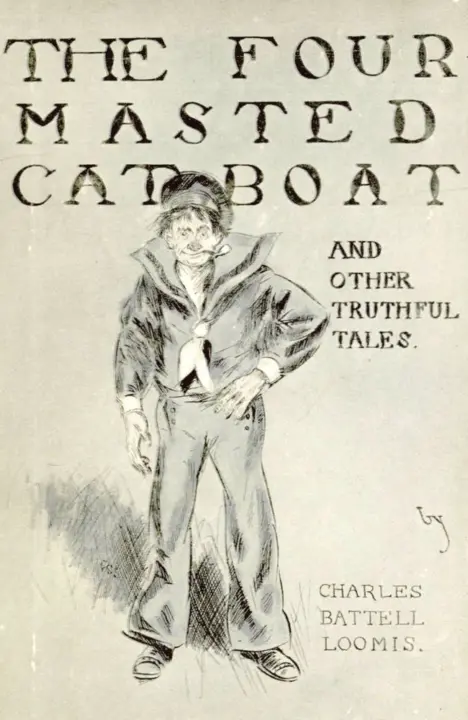
The Four-Masted Cat-Boat, and Other Truthful Tales
Charles Battell Loomis
THE CLASSIC COLLECTION · 1905
"Minerva's Manoeuvres: The Cheerful Facts of a 'Return to Nature'" by Charles Battell Loomis is a light-hearted novel written in the early 20th century. The story revolves around Minerva, a cook from New York City, who is compelled to move to a more rustic environment when her employer, Mrs. Vernon, invites her to Clover Lodge in the countryside after their original cook falls ill. The narrative highlights the amusing culture clash Minerva experiences as she grapples with her new rural lifestyle. The opening of the book introduces readers to the charm and humor of the situation, particularly through the dynamic between Minerva and her employers. As Minerva reluctantly agrees to leave the city for the countryside, she portrays a mix of comedy and exasperation, often lamenting about her aversion to rural life. The scenes that unfold during their journey to Clover Lodge, including Minerva’s comical interactions with a noisy cat, set the stage for a series of misadventures. Loomis's engaging tone and vibrant characterizations promise a delightful exploration of themes around adaptation, identity, and the quirks of transitioning from city to country life.
Introduction adapted from the source catalogue; source summaries may be automatically generated.
Free to read · English · 75,269 words · No account needed
MAKE TIME FOR A GOOD BOOK
On by default. Untick to stop anonymous reading totals. Each page counts after 10 seconds in view. How this works.
Anonymous counting is on unless you have switched it off.
“HOW are we going over to the fair at Oakham?” asked Cherry, the evening before that event.
“I’ve provided for it,” said I.
“Not th’ ould scut?” said Ethel.
“Hardly. Let’s see, there are ten of us.”
“Twelve,” said Ethel, “or thirteen.”
“No, ten.”
“Twelve. Minerva and James are going and we’re to have lunch
over there.”
“Five buggies, two in each,” said Sibthorp as unconsciously as
he could.
“Fine,” said Hepburn and Billy in the same breath, and Cherry
blushed rose red.
“Couldn’t get buggies, but I think you’ll all be pleased at the conveyance,” said I. “It’ll be quite a ride. Three hours there and three hours back.”
“Goodness,” said Cherry; “I thought it was only about seven
miles away.”
“It might be 200 miles away if we took a special,” said Sibthorp
suggestively.
“And only a few rods if we took snails,” said Tom and laughed
uproariously.
“It’s something between snails and specials,” said I, but further than that I was sphynxlike.
Next morning was a crisp, smoke scented October morning, the air full of the snap of early fall, the landscape hinting at coming crimsons and yellows, the sky a clear blue, guiltless of clouds.
We rose early and while we were at breakfast we heard the lowing
of cattle.
“Whose cow’s loose this morning?” asked Tom.
“That’s the voice of our steeds, if I’m not mistaken. Get your wraps and traps and come.”
Scowls of surprise were bent on me by all.
“Behold the chariot of Apollo and the horses thereof,” said I, and led the way to the front door, whither I was followed by all.
In front of the house stood a comfortable-looking hay wagon carpeted with straw and hitched to it were twelve oxen.
They were of all sorts and sizes, from a pair of huge white blanketed ones to two little black Holstein leaders; they were mottled, brown, mahogany and fawn color and the black Holsteins had gold leafed horns in honor of the occasion. At the side of this “string” stood Sam Goodman and his son.
“Are we going in that?”
“That we are going in,” said I proudly. “If we have luck we’ll get there inside of three hours. How far is it, Mr. Goodman?”
“Between six an’ seven miles. What d’yer think of the string?
Prize winners?”
“They ought to be.”
“What does he do with so many cows?” said Cherry.
“Where—where did you come from, baby dear?” said Tom. “Those are called oxen in this part of the country. Not all yours are they?” turning to Sam.
Your reading position is saved on this browser. Take it to another device with a library code. Reading pages adapt to text, rather than matching a printed edition.
Charles Battell Loomis
Charles Battell Loomis
BEHIND THE BOOK
This eBook is for the use of anyone anywhere in the United States and most other parts of the world at no cost and with almost no restrictions whatsoever. You may copy it, give it away or re-use it under the terms of the Project Gutenberg License included with this eBook or online at www.gutenberg.org. If you are not located in the United States, you will have to check the laws of the country where you are located before using this eBook. Read the source licence.
The original source file, including credits and licence, is retained by this library. Request an original-format copy at no charge. Please include the book title and Project Gutenberg identifier #56872.
KEEP YOUR CURIOSITY GOING
Coulson Kernahan

Maurice Baring
Frances Wright
Cécile Tormay

Frederic Jesup Stimson

W. H. P. (William Henry Pope) Jarvis