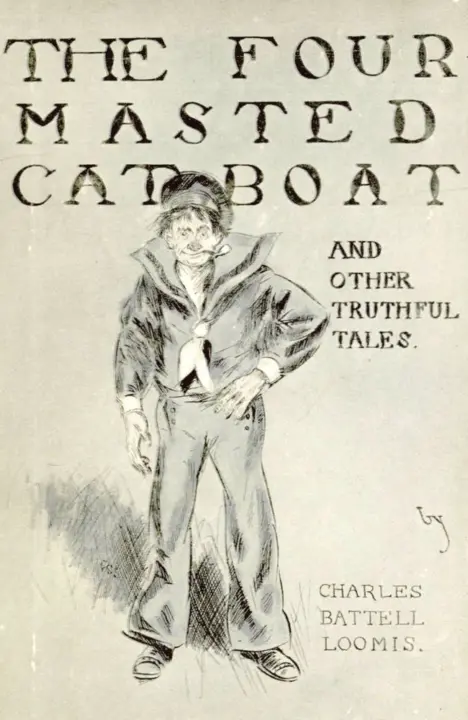
The Four-Masted Cat-Boat, and Other Truthful Tales
Charles Battell Loomis
THE CLASSIC COLLECTION · 1905
"Minerva's Manoeuvres: The Cheerful Facts of a 'Return to Nature'" by Charles Battell Loomis is a light-hearted novel written in the early 20th century. The story revolves around Minerva, a cook from New York City, who is compelled to move to a more rustic environment when her employer, Mrs. Vernon, invites her to Clover Lodge in the countryside after their original cook falls ill. The narrative highlights the amusing culture clash Minerva experiences as she grapples with her new rural lifestyle. The opening of the book introduces readers to the charm and humor of the situation, particularly through the dynamic between Minerva and her employers. As Minerva reluctantly agrees to leave the city for the countryside, she portrays a mix of comedy and exasperation, often lamenting about her aversion to rural life. The scenes that unfold during their journey to Clover Lodge, including Minerva’s comical interactions with a noisy cat, set the stage for a series of misadventures. Loomis's engaging tone and vibrant characterizations promise a delightful exploration of themes around adaptation, identity, and the quirks of transitioning from city to country life.
Introduction adapted from the source catalogue; source summaries may be automatically generated.
Free to read · English · 75,269 words · No account needed
MAKE TIME FOR A GOOD BOOK
On by default. Untick to stop anonymous reading totals. Each page counts after 10 seconds in view. How this works.
Anonymous counting is on unless you have switched it off.
WE wanted Cherry to play, but we did not feel that we ought to ask her to do it; she would be tired, after her journey, and piano playing to her was no novelty.
But when, after dinner, while passing through the sitting room, on our way to the veranda she ran a harmony enticing hand over the keys as she walked by the piano, I could not help saying,
“Don’t you feel like following that up with the other hand?”
She laughed, and sitting down at the piano she said, “Why, certainly. What shall it be?”
“Oh, we leave that to you,” said Ethel. “Play what you like and you’ll play what we like.”
“Is Grieg getting old fashioned?” I asked.
“I never inquired,” said Cherry. “I don’t believe in fashions in arts. I liked Grieg, and Schumann, and Beethoven, and Mendelssohn, and Wagner, and Johann Strauss when I was a child, and so I’ll always like them. And Grieg is always fresh. What shall I play—‘Anitra’s Dance’?”
“Yes, do,” said Ethel. “I never hear that without thinking of Seidl and Brighton Beach and the throngs of doting Brooklyn women who didn’t go to hear the music, but to see Seidl. But it was beautiful music—when the roar of the surf didn’t drown it.”
Cherry found the piano stool at just the right height, and without any airs or graces beyond those which were part of her endowment, she started in to play. The windows were open and the music and the moonlight, and the hum of the insects, and the landscape became indissolubly blended, and I blessed Minerva once more for the truly “Puss-in-boots” service she had rendered to the “Marquis of Carabas.”
The dance ended, Cherry turned around on the piano stool and
said,
“Minerva chose a very nice piano.”
There was a sound of steps on the porch and the shadow of a man fell across the square hallway. There was also a subdued rap on the door post.
I stepped to the door and found a tramp standing there. He was the typical tramp of the comic papers; unshaven, dusty, blear-eyed, unkempt, stoop shouldered, ragged, un-prepossessing.
“What do you wish?” said I, irritated at the interruption.
He hesitated a moment.
“I’d like a glass of milk,” said he, huskily.
“Well, go around to the back door and the girl will give you one. Don’t you want some meat?”
“Thanks; I don’t care if I do,” said he, wiping his mouth as if my invitation had been a bibulous one.
Your reading position is saved on this browser. Take it to another device with a library code. Reading pages adapt to text, rather than matching a printed edition.
Charles Battell Loomis
Charles Battell Loomis
BEHIND THE BOOK
This eBook is for the use of anyone anywhere in the United States and most other parts of the world at no cost and with almost no restrictions whatsoever. You may copy it, give it away or re-use it under the terms of the Project Gutenberg License included with this eBook or online at www.gutenberg.org. If you are not located in the United States, you will have to check the laws of the country where you are located before using this eBook. Read the source licence.
The original source file, including credits and licence, is retained by this library. Request an original-format copy at no charge. Please include the book title and Project Gutenberg identifier #56872.
KEEP YOUR CURIOSITY GOING
Coulson Kernahan

Maurice Baring
Frances Wright
Cécile Tormay

Frederic Jesup Stimson

W. H. P. (William Henry Pope) Jarvis