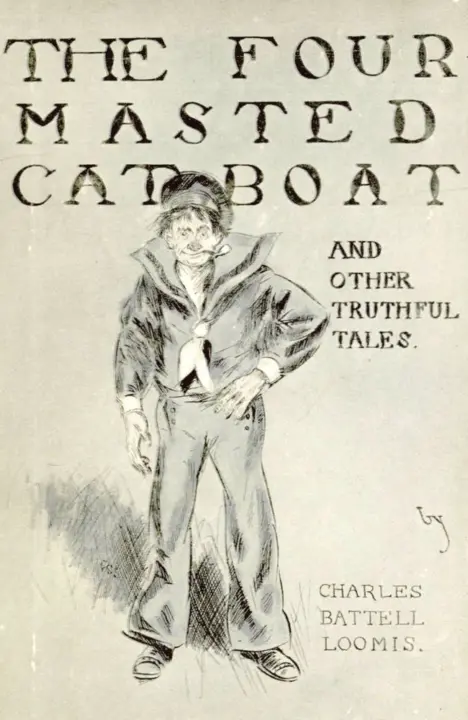
The Four-Masted Cat-Boat, and Other Truthful Tales
Charles Battell Loomis
THE CLASSIC COLLECTION · 1905
"Minerva's Manoeuvres: The Cheerful Facts of a 'Return to Nature'" by Charles Battell Loomis is a light-hearted novel written in the early 20th century. The story revolves around Minerva, a cook from New York City, who is compelled to move to a more rustic environment when her employer, Mrs. Vernon, invites her to Clover Lodge in the countryside after their original cook falls ill. The narrative highlights the amusing culture clash Minerva experiences as she grapples with her new rural lifestyle. The opening of the book introduces readers to the charm and humor of the situation, particularly through the dynamic between Minerva and her employers. As Minerva reluctantly agrees to leave the city for the countryside, she portrays a mix of comedy and exasperation, often lamenting about her aversion to rural life. The scenes that unfold during their journey to Clover Lodge, including Minerva’s comical interactions with a noisy cat, set the stage for a series of misadventures. Loomis's engaging tone and vibrant characterizations promise a delightful exploration of themes around adaptation, identity, and the quirks of transitioning from city to country life.
Introduction adapted from the source catalogue; source summaries may be automatically generated.
Free to read · English · 75,269 words · No account needed
MAKE TIME FOR A GOOD BOOK
On by default. Untick to stop anonymous reading totals. Each page counts after 10 seconds in view. How this works.
Anonymous counting is on unless you have switched it off.
ETHEL was out in the little orchard south of the house with Minerva, looking for “queen’s lace.” She had two purposes in mind. To teach Minerva something more of nature and to make a conventionalized design of the ground plan of the flower for use in her everlasting embroidery.
“Mis. Vernon.”
“What is it, Minerva?”
“Don’t the apples we have in the city come from the country?”
“Why, yes,” said Ethel.
She told me of the conversation later, I being at the time
fishing for trout (in all innocence) with James (who knew the
law).
“Well, then, how come that apples here is so little and city
apples is so big?”
“Why,” said Ethel, “these haven’t grown yet.”
“Do they grow on the tree?” said Minerva.
“Why, certainly. You surely didn’t suppose that they grew after
they were picked.”
“But the stems is so little that I wouldn’t think they’d hold apples like I see in the grocery stores.”
“Why, but the stems grow, too.”
“Oh,” said Minerva.
Minerva’s ignorance of common things was a never-ending marvel.
“Who do you pay for these apples, Mis. Vernon,” she went on.
“Why, nobody. They go with the house.”
And then Minerva gave utterance to a wise remark.
“Ain’t it queer, Mis. Vernon, that in the country, where you don’t have to pay for apples, every man has apple trees of his own, and in the city, where you do have to pay, nobody has any?”
“Just what do you mean?” said Ethel, wishing (as she told me) to draw out Minerva’s thought.
“Why, I mean poor people in the city has to pay for apples, an’ in the country people don’t have to pay for ’em, but it don’t do no good, because they have their own trees.”
“Well, but if they didn’t have their own trees, they would have to pay for them,” said Ethel, puzzled.
“Yas’m, but people in the city, if they had trees,—I mean poor people, then they wouldn’t have to pay for apples and they could use their money for somethin’ else, and people in the country has more money than poor people in the city, and they don’t have to spend it on apples, because they have ’em on their own trees.”
Your reading position is saved on this browser. Take it to another device with a library code. Reading pages adapt to text, rather than matching a printed edition.
Charles Battell Loomis
Charles Battell Loomis
BEHIND THE BOOK
This eBook is for the use of anyone anywhere in the United States and most other parts of the world at no cost and with almost no restrictions whatsoever. You may copy it, give it away or re-use it under the terms of the Project Gutenberg License included with this eBook or online at www.gutenberg.org. If you are not located in the United States, you will have to check the laws of the country where you are located before using this eBook. Read the source licence.
The original source file, including credits and licence, is retained by this library. Request an original-format copy at no charge. Please include the book title and Project Gutenberg identifier #56872.
KEEP YOUR CURIOSITY GOING
Coulson Kernahan

Maurice Baring
Frances Wright
Cécile Tormay

Frederic Jesup Stimson

W. H. P. (William Henry Pope) Jarvis