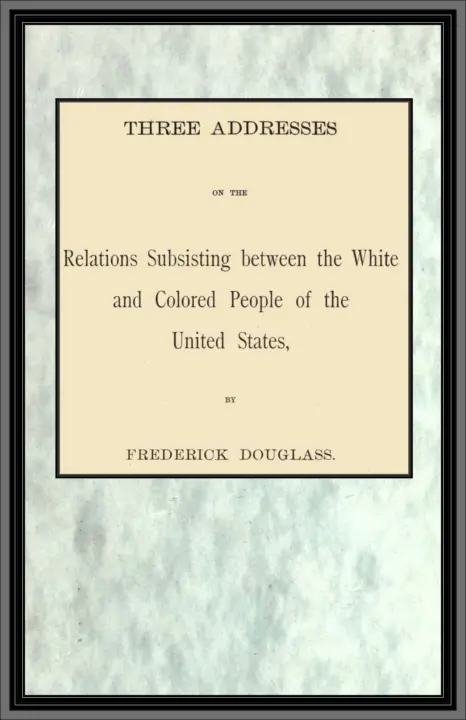
Three addresses on the relations subsisting between the white and colored people of the United States
Frederick Douglass
THE CLASSIC COLLECTION · 1881
"Life and Times of Frederick Douglass: His Early Life as a Slave, His Escape..." by Frederick Douglass is an autobiography published in 1881 and revised in 1892. This third and final autobiography reveals details about Douglass's enslavement and escape that were too dangerous to share earlier. It chronicles his entire life, from childhood memories with his grandparents through his experiences during and after the Civil War, including encounters with Presidents Lincoln and Garfield, and his service as U.S. Marshall of the District of Columbia.
Introduction adapted from the source catalogue; source summaries may be automatically generated.
Free to read · English · 192,936 words · No account needed
MAKE TIME FOR A GOOD BOOK
On by default. Untick to stop anonymous reading totals. Each page counts after 10 seconds in view. How this works.
Anonymous counting is on unless you have switched it off.
As soon as we had come to anchor, Mr. Thomas despatched a note to Col. Edward Lloyd, announcing my presence on board his Cutter, and inviting him to meet me, informing him it was my desire, if agreeable to him, to revisit my old home. In response to this note, Mr. Howard Lloyd, a son of Col. Lloyd, a young gentleman of very pleasant address, came on board the Cutter, and was introduced to the several gentlemen and myself.
He told us that his father was gone to Easton on business, expressed his regret at his absence, hoped he would return before we should leave, and in the meantime received us cordially and invited us ashore, escorted us over the grounds, and gave us as hearty a welcome as we could have wished. I hope I shall be pardoned for speaking of this incident with much complacency. It was one which could happen to but few men, and only once in the life time of any. The span of human life is too short for the repetition of events which occur at the distance of fifty years. That I was deeply moved, and greatly affected by it, can be easily imagined. Here I was, being welcomed and escorted by the great grandson of Colonel Edward Lloyd--a gentleman I had known well 56 years before, and whose form and features were as vividly depicted on my memory as if I had seen him but yesterday. He was a gentleman of the olden time, elegant in his apparel, dignified in his deportment, a man of few words and of weighty presence; and I can easily conceive that no Governor of the State of Maryland ever commanded a larger measure of respect than did this great grandfather of the young gentleman now before me. In company with Mr. Howard was his little brother Decosa, a bright boy of eight or nine years, disclosing his aristocratic descent in the lineaments of his face, and in all his modest and graceful movements. As I looked at him I could not help the reflections naturally arising from having seen so many generations of the same family on the same estate. I had seen the elder Lloyd, and was now walking around with the youngest member of that name. In respect to the place itself, I was most agreeably surprised to find that time had dealt so gently with it, and that in all its appointments it was so little changed from what it was when I left it, and from what I have elsewhere described it. Very little was missing except the squads of little black children which were once seen in all directions, and the great number of slaves on its fields. Col. Lloyd’s estate comprised twenty-seven thousand acres, and the home-farm seven thousand. In my boyhood sixty men were employed in cultivating the home farm alone. Now, by the aid of machinery, the work is accomplished by ten men. I found the buildings, which gave it the appearance of a village, nearly all standing, and I was astonished to find that I had carried their appearance and location so accurately in my mind during so many years. There was the long quarter, the quarter on the hill, the dwelling-house of my old master, Aaron Anthony; the overseer’s house, once occupied by William Sevier, Austin Gore, James Hopkins, and other overseers. In connection with my old master’s house was the kitchen where Aunt Katy presided, and where my head had received many a thump from her unfriendly hand. I looked into this kitchen with peculiar interest, and remembered that it was there I last saw my mother. I went round to the window at which Miss Lucretia used to sit with her sewing, and at which I used to sing when hungry, a signal which she well understood, and to which she readily responded with bread. The little closet in which I slept in a bag had been taken into the room; the dirt floor, too, had disappeared under plank. But upon the whole, the house is very much as it was in the olden time. Not far from it was the stable formerly in charge of old Barney. The store-house at the end of it, of which my master carried the keys, had been removed. The large carriage house, too, which in my boy days contained two or three fine coaches, several phaetons, gigs, and a large sleigh (for the latter there was seldom any use) was gone. This carriage house was of much interest to me because Col. Lloyd sometimes allowed his servants the use of it for festal occasions, and in it there was at such times music and dancing. With these two exceptions, the houses of the estate remained. There was the shoemaker’s shop, where Uncle Abe made and mended shoes; and there the blacksmith’s shop, where Uncle Tony hammered iron, and the weekly closing of which first taught me to distinguish Sundays from other days. The old barn, too, was there--time-worn, to be sure, but still in good condition--a place of wonderful interest to me in my childhood, for there I often repaired to listen to the chatter and watch the flight of swallows among its lofty beams, and under its ample roof. Time had wrought some changes in the trees and foliage. The Lombardy poplars, in the branches of which the red-winged black birds used to congregate and sing, and whose music awakened in my young heart sensations and aspirations deep and undefinable, were gone; but the oaks and elms where young Daniel (the uncle of the present Edward Lloyd) used to divide with me his cakes and biscuits, were there as umbrageous and beautiful as ever. I expressed a wish to Mr. Howard to be shown into the family burial ground, and thither we made our way. It is a remarkable spot--the resting place for all the deceased Lloyds for two hundred years, for the family have been in possession of the estate since the settlement of the Maryland colony.
Your reading position is saved on this browser. Take it to another device with a library code. Reading pages adapt to text, rather than matching a printed edition.
Frederick Douglass
Frederick Douglass
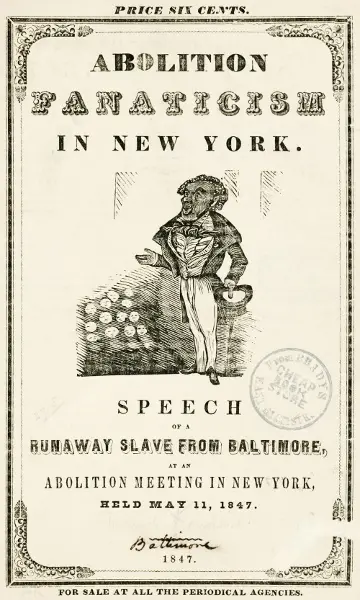
Frederick Douglass
Frederick Douglass
BEHIND THE BOOK
This eBook is for the use of anyone anywhere in the United States and most other parts of the world at no cost and with almost no restrictions whatsoever. You may copy it, give it away or re-use it under the terms of the Project Gutenberg License included with this eBook or online at www.gutenberg.org. If you are not located in the United States, you will have to check the laws of the country where you are located before using this eBook. Read the source licence.
The original source file, including credits and licence, is retained by this library. Request an original-format copy at no charge. Please include the book title and Project Gutenberg identifier #71893.
KEEP YOUR CURIOSITY GOING
Cécile Tormay

Moritz Busch
John L. Ransom
Frances Wright
Cécile Tormay

Mabel Potter Daggett