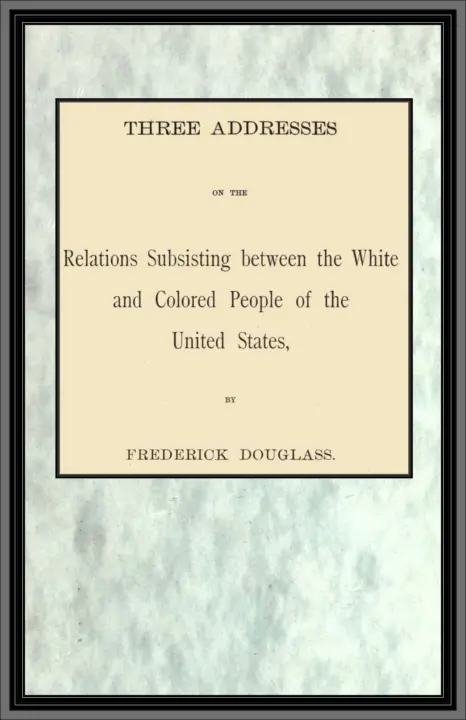
Three addresses on the relations subsisting between the white and colored people of the United States
Frederick Douglass
THE CLASSIC COLLECTION · 1881
"Life and Times of Frederick Douglass: His Early Life as a Slave, His Escape..." by Frederick Douglass is an autobiography published in 1881 and revised in 1892. This third and final autobiography reveals details about Douglass's enslavement and escape that were too dangerous to share earlier. It chronicles his entire life, from childhood memories with his grandparents through his experiences during and after the Civil War, including encounters with Presidents Lincoln and Garfield, and his service as U.S. Marshall of the District of Columbia.
Introduction adapted from the source catalogue; source summaries may be automatically generated.
Free to read · English · 192,936 words · No account needed
MAKE TIME FOR A GOOD BOOK
On by default. Untick to stop anonymous reading totals. Each page counts after 10 seconds in view. How this works.
Anonymous counting is on unless you have switched it off.
From the first, I, for one, saw in this war the end of slavery; and truth requires me to say that my interest in the success of the North was largely due to this belief. True it is that this faith was many times shaken by passing events, but never destroyed. When Secretary Seward instructed our ministers to say to the governments to which they were accredited, that, “terminate however it might, the status of no class of the people of the United States would be changed by the rebellion--that the slaves would be slaves still, and that the masters would be masters still”--when General McClellan and General Butler warned the slaves in advance that if any attempt was made by them to gain their freedom, it would be suppressed with an iron hand-- when the government persistently refused to employ colored troops-- when the emancipation proclamation of General John C. Fremont in Missouri was withdrawn--when slaves were being returned from our lines to their masters--when Union soldiers were stationed about the farm houses of Virginia to guard and protect the master in holding his slaves--when Union soldiers made themselves more active in kicking colored men out of their camps than in shooting rebels--when even Mr. Lincoln could tell the poor negro that “he was the cause of the war,” I still believed, and spoke as I believed, all over the North, that the mission of the war was the liberation of the slave, as well as the salvation of the Union; and hence from the first I reproached the North that they fought the rebels with only one hand, when they might strike effectually with two--that they fought with their soft white hand while they kept their black iron hand chained and helpless behind them--that they fought the effect while they protected the cause, and that the Union cause would never prosper till the war assumed an anti-slavery attitude, and the negro was enlisted on the loyal side. In every way possible, in the columns of my paper and on the platform, by letters to friends, at home and abroad, I did all that I could to impress this conviction upon this country. But nations seldom listen to advice from individuals, however reasonable. They are taught less by theories than by facts and events. There was much that could be said against making the war an abolition war--much that seemed wise and patriotic. “Make the war an abolition war,” we were told, “and you drive the border States into the rebellion, and thus add power to the enemy, and increase the number you will have to meet on the battle-field. You will exasperate and intensify southern feeling, making it more desperate, and put far away the day of peace between the two sections.” “Employ the arm of the negro, and the loyal men of the North will throw down their arms and go home.” “This is the white man’s country, and the white man’s war.” “It would inflict an intolerable wound upon the pride and spirit of white soldiers of the Union, to see the negro in the United States uniform. Besides, if you make the negro a soldier, you cannot depend on his courage: a crack of his old master’s whip would send him scampering in terror from the field.” And so it was that custom, pride, prejudice, and the old-time respect for southern feeling, held back the government from an anti-slavery policy, and from arming the negro. Meanwhile the rebellion availed itself of the negro most effectively. He was not only the stomach of the rebellion, by supplying its commissary department, but he built its forts, and dug its intrenchments, and performed other duties of its camp, which left the rebel soldier more free to fight the loyal army than he could otherwise have been. It was the cotton and corn of the negro that made the rebellion sack stand on end, and caused a continuance of the war. “Destroy these,” was the burden of all my utterances during this part of the struggle, “and you cripple and destroy the rebellion.” It is surprising how long and bitterly the government resisted and rejected this view of the situation. The abolition heart of the North ached over the delay, and uttered its bitter complaints, but the administration remained blind and dumb. Bull Run, Ball’s Bluff, Big Bethel, Fredericksburg, and the Peninsula disasters were the only teachers whose authority was of sufficient importance to excite the attention or respect of our rulers, and they were even slow in being taught by these. An important point was gained, however, when General B. F. Butler, at Fortress Monroe, announced the policy of treating the slaves as “contrabands,” to be made useful to the Union cause, and was sustained therein at Washington, and sentiments of a similar nature were expressed on the floor of Congress by Hon. A. G. Riddle of Ohio. A grand accession was made to this view of the case when Hon. Simon Cameron, then secretary of war, gave it his earnest support, and General David Hunter put the measure into practical operation in South Carolina. General Phelps from Vermont, in command at Carrollton, La., also advocated the same plan though under discouragements which cost him his command. And many and grievous disasters on flood and field were needed to educate the loyal nation and President Lincoln up to the realization of the necessity, not to say justice, of this position, and many devices, intermediate steps, and make-shifts were suggested to smooth the way to the ultimate policy of freeing the slave, and arming the freedmen.
Your reading position is saved on this browser. Take it to another device with a library code. Reading pages adapt to text, rather than matching a printed edition.
Frederick Douglass
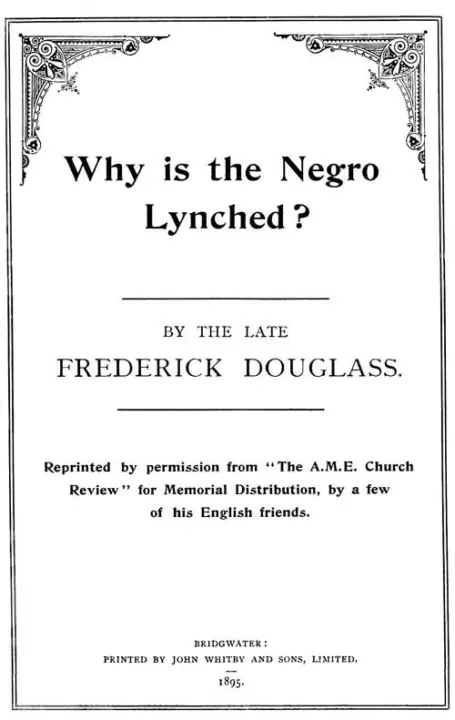
Frederick Douglass
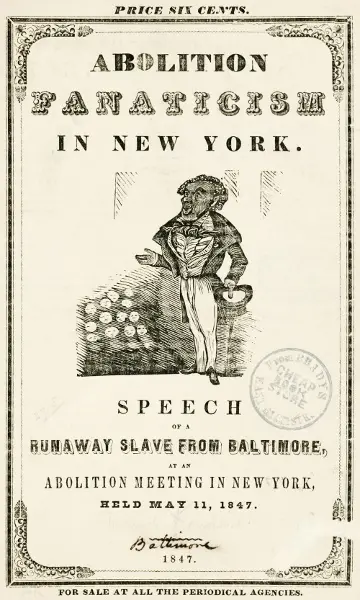
Frederick Douglass
Frederick Douglass
BEHIND THE BOOK
This eBook is for the use of anyone anywhere in the United States and most other parts of the world at no cost and with almost no restrictions whatsoever. You may copy it, give it away or re-use it under the terms of the Project Gutenberg License included with this eBook or online at www.gutenberg.org. If you are not located in the United States, you will have to check the laws of the country where you are located before using this eBook. Read the source licence.
The original source file, including credits and licence, is retained by this library. Request an original-format copy at no charge. Please include the book title and Project Gutenberg identifier #71893.
KEEP YOUR CURIOSITY GOING
Cécile Tormay

Moritz Busch
John L. Ransom
Frances Wright
Cécile Tormay

Mabel Potter Daggett