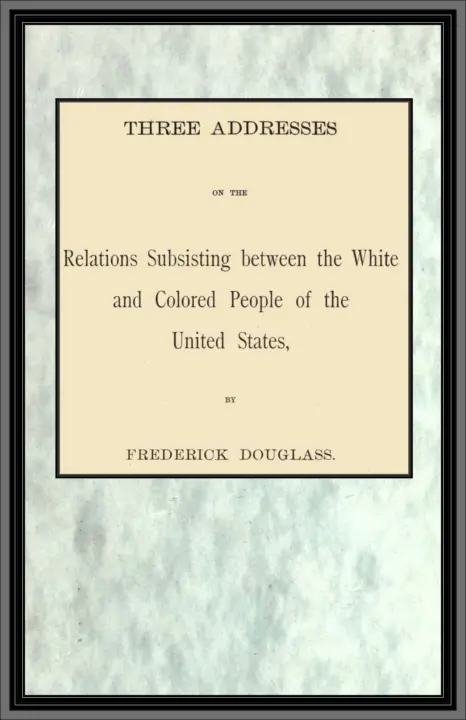
Three addresses on the relations subsisting between the white and colored people of the United States
Frederick Douglass
THE CLASSIC COLLECTION · 1881
"Life and Times of Frederick Douglass: His Early Life as a Slave, His Escape..." by Frederick Douglass is an autobiography published in 1881 and revised in 1892. This third and final autobiography reveals details about Douglass's enslavement and escape that were too dangerous to share earlier. It chronicles his entire life, from childhood memories with his grandparents through his experiences during and after the Civil War, including encounters with Presidents Lincoln and Garfield, and his service as U.S. Marshall of the District of Columbia.
Introduction adapted from the source catalogue; source summaries may be automatically generated.
Free to read · English · 192,936 words · No account needed
MAKE TIME FOR A GOOD BOOK
On by default. Untick to stop anonymous reading totals. Each page counts after 10 seconds in view. How this works.
Anonymous counting is on unless you have switched it off.
Though disappointed in my tour on the Continent, and called home by one of the saddest events that can afflict the domestic circle, my presence here was fortunate, since it enabled me to participate in the most important and memorable presidential canvass ever witnessed in the United States, and to labor for the election of a man who in the order of events was destined to do a greater service to his country and to mankind, than any man who had gone before him in the presidential office. It is something to couple one’s name with great occasions, and it was a great thing to me to be permitted to bear some humble part in this, the greatest that had thus far come to the American people. It was a great thing to achieve American independence when we numbered three millions, but it was a greater thing to save this country from dismemberment and ruin when it numbered thirty millions. He alone of all our Presidents was to have the opportunity to destroy slavery, and to lift into manhood millions of his countrymen hitherto held as chattels and numbered with the beasts of the field.
The presidential canvass of 1860 was three sided, and each side had its distinctive doctrine as to the question of slavery and slavery extension. We had three candidates in the field. Stephen A. Douglas was the standard bearer of what may be called the western faction of the old divided democratic party, and John C. Breckenridge was the standard-bearer of the southern or slaveholding faction of that party. Abraham Lincoln represented the then young, growing, and united republican party. The lines between these parties and candidates were about as distinctly and clearly drawn as political lines are capable of being drawn. The name of Douglas stood for territorial sovereignty, or in other words, for the right of the people of a territory to admit or exclude, to establish or abolish, slavery, as to them might seem best. The doctrine of Breckenridge was that slaveholders were entitled to carry their slaves into any territory of the United States and to hold them there, with or without the consent of the people of the territory; that the Constitution of its own force carried slavery and protected it into any territory open for settlement in the United States. To both these parties, factions, and doctrines, Abraham Lincoln and the republican party stood opposed. They held that the Federal Government had the right and the power to exclude slavery from the territories of the United States, and that that right and power ought to be exercised to the extent of confining slavery inside the slave States, with a view to its ultimate extinction. The position of Mr. Douglas gave him a splendid pretext for the display of a species of oratory of which he was a distinguished master. He alone of the three candidates took the stump, as the preacher of popular sovereignty, called in derision at the time “Squatter” Sovereignty. This doctrine, if not the times, gave him a chance to play fast and loose, and blow hot and cold, as occasion might require. In the South and among slaveholders he could say, “My great principle of popular sovereignty does not and was not intended by me to prevent the extension of slavery; on the contrary it gives you the right to take your slaves into the territories and secure legislation legalizing slavery; it denies to the Federal Government all right of interference against you, and hence is eminently favorable to your interests.” When among people known to be indifferent he could say, “I do not care whether slavery is voted up or voted down in the territory,” but when addressing the known opponents of the extension of slavery, he could say that the people of the territories were in no danger of having slavery forced upon them since they could keep it out by adverse legislation. Had he made these representations before railroads, electric wires, phonography, and newspapers had become the powerful auxiliaries they have done Mr. Douglas might have gained many votes, but they were of little avail now. The South was too sagacious to leave slavery to the chance of defeat in a fair vote by the people of a territory. Of all property none could less afford to take such a risk, for no property can require more strongly favoring conditions for its existence. Not only the intelligence of the slave, but the instincts of humanity, must be barred by positive law, hence Breckenridge and his friends erected the flinty walls of the Constitution and the Supreme Court for the protection of slavery at the outset. Against both Douglas and Breckenridge Abraham Lincoln proposed his grand historic doctrine of the power and duty of the National Government to prevent the spread and perpetuity of slavery. Into this contest I threw myself, with firmer faith and more ardent hope than ever before, and what I could do by pen or voice was done with a will. The most remarkable and memorable feature of this canvass, was that it was prosecuted under the portentous shadow of a threat: leading public men of the South had with the vehemence of fiery purpose, given it out in advance that in case of their failure to elect their candidate (Mr. John C. Breckenridge) they would proceed to take the slaveholding States out of the Union, and that in no event whatever would they submit to the rule of Abraham Lincoln. To many of the peace-loving friends of the Union, this was a fearful announcement, and it doubtless cost the Republican candidates many votes. To many others, however, it was deemed a mere bravado--sound and fury signifying nothing. With a third class its effect was very different. They were tired of the rule-or-ruin intimidation adopted by the South, and felt then, if never before, that they had quailed before it too often and too long. It came as an insult and a challenge in one, and imperatively called upon them for independence, self-assertion, and resentment. Had Southern men puzzled their brains to find the most effective means to array against slavery and slaveholding manners the solid opposition of the North, they could not have hit upon any expedient better suited to that end, than was this threat. It was not only unfair, but insolent, and more like an address to cowardly slaves than to independent freemen; it had in it the meanness of the horse-jockey, who, on entering a race, proposes, if beaten, to run off with the stakes. In all my speeches made during this canvass, I did not fail to take advantage of this southern bluster and bullying.
Your reading position is saved on this browser. Take it to another device with a library code. Reading pages adapt to text, rather than matching a printed edition.
Frederick Douglass
Frederick Douglass
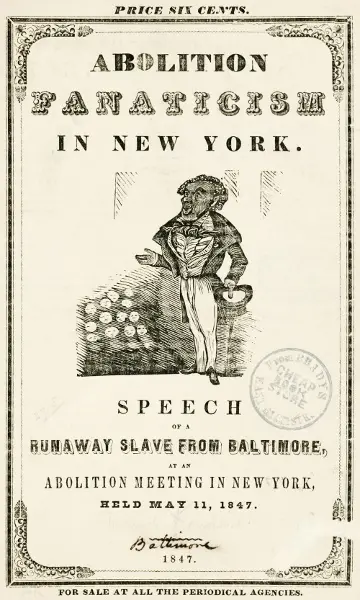
Frederick Douglass
Frederick Douglass
BEHIND THE BOOK
This eBook is for the use of anyone anywhere in the United States and most other parts of the world at no cost and with almost no restrictions whatsoever. You may copy it, give it away or re-use it under the terms of the Project Gutenberg License included with this eBook or online at www.gutenberg.org. If you are not located in the United States, you will have to check the laws of the country where you are located before using this eBook. Read the source licence.
The original source file, including credits and licence, is retained by this library. Request an original-format copy at no charge. Please include the book title and Project Gutenberg identifier #71893.
KEEP YOUR CURIOSITY GOING
Cécile Tormay

Moritz Busch
John L. Ransom
Frances Wright
Cécile Tormay

Mabel Potter Daggett