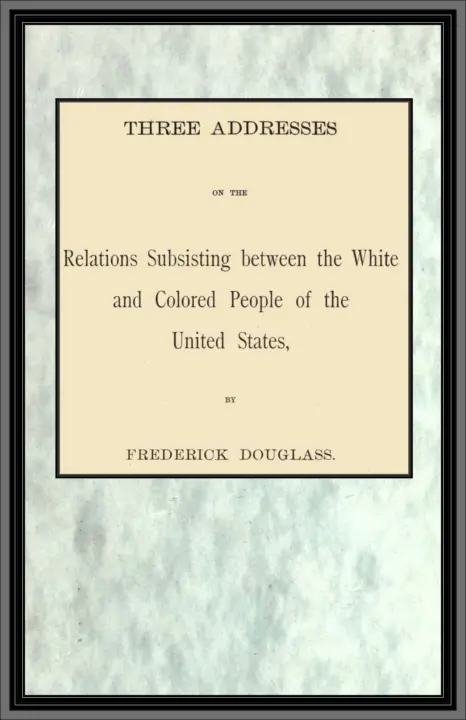
Three addresses on the relations subsisting between the white and colored people of the United States
Frederick Douglass
THE CLASSIC COLLECTION · 1881
"Life and Times of Frederick Douglass: His Early Life as a Slave, His Escape..." by Frederick Douglass is an autobiography published in 1881 and revised in 1892. This third and final autobiography reveals details about Douglass's enslavement and escape that were too dangerous to share earlier. It chronicles his entire life, from childhood memories with his grandparents through his experiences during and after the Civil War, including encounters with Presidents Lincoln and Garfield, and his service as U.S. Marshall of the District of Columbia.
Introduction adapted from the source catalogue; source summaries may be automatically generated.
Free to read · English · 192,936 words · No account needed
MAKE TIME FOR A GOOD BOOK
On by default. Untick to stop anonymous reading totals. Each page counts after 10 seconds in view. How this works.
Anonymous counting is on unless you have switched it off.
Living as I then did in Rochester, on the border of Canada, I was compelled to see the terribly distressing effects of this cruel enactment. Fugitive slaves, who had lived for many years safely and securely in Western New York and elsewhere, some of whom had by industry and economy saved money and bought little homes for themselves and their children, were suddenly alarmed and compelled to flee to Canada for safety as from an enemy’s land--a doomed city--and take up a dismal march to a new abode, empty-handed, among strangers. My old friend Ward, of whom I have just now spoken, found it necessary to give up the contest and flee to Canada, and thousands followed his example. Bishop Daniel A. Payne, of the African Methodist Episcopal church, came to me about this time to consult me as to whether it was best to stand our ground or flee to Canada. When I told him I could not desert my post until I saw I could not hold it, adding that I did not wish to leave while Garnet and Ward remained, “Why,” said he, “Ward, Ward, he is already gone. I saw him crossing from Detroit to Windsor.” I asked him if he was going to stay, and he answered, “Yes; we are whipped, we are whipped! and we might as well retreat in order.” This was indeed a stunning blow. This man had power to do more to defeat this inhuman enactment than any other colored man in the land, for no other could bring such brain power to bear against it. I felt like a besieged city at news that its defenders had fallen at its gates.
The hardships imposed by this atrocious and shameless law were cruel and shocking, and yet only a few of all the fugitives of the Northern States were returned to slavery under its infamously wicked provisions. As a means of recapturing their runaway property in human flesh the law was an utter failure. Its efficiency was destroyed by its enormity. Its chief effect was to produce alarm and terror among the class subject to its operation, and this it did most effectually and distressingly. Even colored people who had been free all their lives felt themselves very insecure in their freedom, for under this law the oaths of any two villains were sufficient to consign a free man to slavery for life. While the law was a terror to the free, it was a still greater terror to the escaped bondman. To him there was no peace. Asleep or awake, at work or at rest, in church or market, he was liable to surprise and capture. By the law the judge got ten dollars a head for all he could consign to slavery, and only five dollars apiece for any which he might adjudge free. Although I was now myself free, I was not without apprehension. My purchase was of doubtful validity, having been bought when out of the possession of my owner and when he must take what was given or take nothing. It was a question whether my claimant could be estopped by such a sale from asserting certain or supposable equitable rights in my body and soul. From rumors that reached me my house was guarded by my friends several nights, when kidnappers, had they come, would have got anything but a cool reception, for there would have been “blows to take as well as blows to give.” Happily this reign of terror did not continue long. Despite the efforts of Daniel Webster and Millard Fillmore and our Doctors of Divinity, the law fell rapidly into disrepute. The rescue of Shadrack resulting in the death of one of the kidnappers, in Boston, the cases of Simms and Anthony Burns, in the same place, created the deepest feeling against the law and its upholders. But the thing which more than all else destroyed the fugitive slave law was the resistance made to it by the fugitives themselves. A decided check was given to the execution of the law at Christiana, Penn., where three colored men, being pursued by Mr. Gorsuch and his son, slew the father, wounded the son, and drove away the officers, and made their escape to my house in Rochester. The work of getting these men safely into Canada was a delicate one. They were not only fugitives from slavery but charged with murder, and officers were in pursuit of them. There was no time for delay. I could not look upon them as murderers. To me, they were heroic defenders of the just rights of man against manstealers and murderers. So I fed them, and sheltered them in my house. Had they been pursued then and there, my home would have been stained with blood, for these men who had already tasted blood were well armed and prepared to sell their lives at any expense to the lives and limbs of their probable assailants. What they had already done at Christiana and the cool determination which showed very plainly especially in Parker, (for that was the name of the leader,) left no doubt on my mind that their courage was genuine and that their deeds would equal their words. The situation was critical and dangerous. The telegraph had that day announced their deeds at Christiana, their escape, and that the mountains of Pennsylvania were being searched for the murderers. These men had reached me simultaneously with this news in the New York papers. Immediately after the occurrence at Christiana, they, instead of going into the mountains, were placed on a train which brought them to Rochester. They were thus almost in advance of the lightning, and much in advance of probable pursuit, unless the telegraph had raised agents already here. The hours they spent at my house were therefore hours of anxiety as well as activity. I dispatched my friend Miss Julia Griffiths to the landing three miles away on the Genesee River to ascertain if a steamer would leave that night for any port in Canada, and remained at home myself to guard my tired, dust-covered, and sleeping guests, for they had been harassed and traveling for two days and nights, and needed rest. Happily for us the suspense was not long, for it turned out, that that very night a steamer was to leave for Toronto, Canada.
Your reading position is saved on this browser. Take it to another device with a library code. Reading pages adapt to text, rather than matching a printed edition.
Frederick Douglass
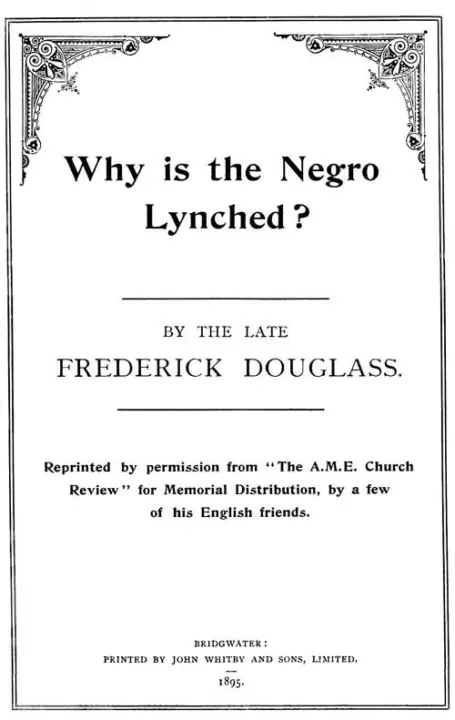
Frederick Douglass
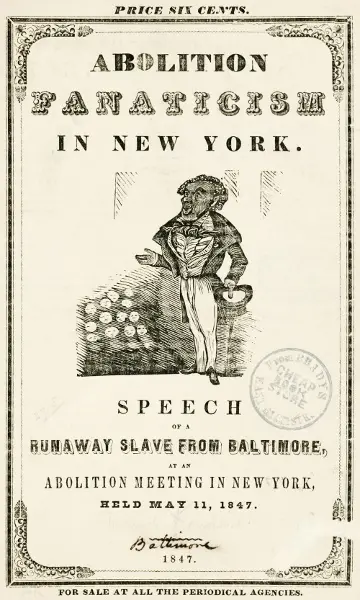
Frederick Douglass
Frederick Douglass
BEHIND THE BOOK
This eBook is for the use of anyone anywhere in the United States and most other parts of the world at no cost and with almost no restrictions whatsoever. You may copy it, give it away or re-use it under the terms of the Project Gutenberg License included with this eBook or online at www.gutenberg.org. If you are not located in the United States, you will have to check the laws of the country where you are located before using this eBook. Read the source licence.
The original source file, including credits and licence, is retained by this library. Request an original-format copy at no charge. Please include the book title and Project Gutenberg identifier #71893.
KEEP YOUR CURIOSITY GOING
Cécile Tormay

Moritz Busch
John L. Ransom
Frances Wright
Cécile Tormay

Mabel Potter Daggett