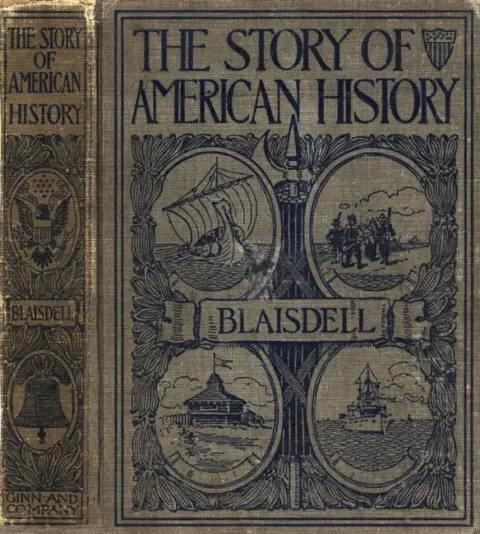
The Story of American History for Elementary Schools
Albert F. (Albert Franklin) Blaisdell
THE CLASSIC COLLECTION · 1903
"Hero Stories from American History" by Albert F. Blaisdell and Francis Kingsley Ball is a collection of historical narratives written in the early 20th century. It serves as an educational reader aimed at students in elementary schools, particularly for those in the sixth and seventh grades. The book focuses on significant figures and events from the first fifty years of American history, presenting them in a way that captures the excitement and drama of these historical moments to engage young readers. The opening of the book introduces the life and adventures of George Rogers Clark, a key figure in the American Revolutionary War. It details his determination and leadership as he navigates the challenges faced by early American settlers in Kentucky, particularly his strategic decision to confront British forces and Indigenous tribes that threatened their safety. The text emphasizes Clark's bravery and innovative military tactics, such as launching surprise attacks on British-held forts, which ultimately contributed to the expansion of American territory. This engaging retelling of history highlights not only the actions of Clark but also the resilience of the early American pioneers.
Introduction adapted from the source catalogue; source summaries may be automatically generated.
Free to read · English · 57,694 words · No account needed
MAKE TIME FOR A GOOD BOOK
On by default. Untick to stop anonymous reading totals. Each page counts after 10 seconds in view. How this works.
Anonymous counting is on unless you have switched it off.
Just think of the days of grief and shame for Captain Bainbridge and his men! Think of them as they looked day after day out of the narrow windows of the pasha's castle, and saw this vessel, one of the handsomest in the world, flying the colors of the enemy! These brave Americans had need of all their grit; but they kept up their courage and bided their time.
Commodore Preble now sailed to Sicily, and cast anchor in the harbor
of Syracuse.
Don't you suppose the recapture of the Philadelphia was talked of
every day?
Of course it was. Everybody in the fleet, from the commodore to the powder monkey, was thinking about it. They must do something, and the sooner the better.
Even Captain Bainbridge in his prison cell wrote several letters with lemon juice, which could be read on being held to the fire, and sent them to Preble. These letters contained plans for sinking the ill-fated ship.
Every one of Preble's young captains was eager to try it. It might mean glory, and promotion, or perhaps failure, and death.
Somehow or other all looked to the dashing Stephen Decatur; for from the first he had taken a leading part in planning the desperate deed.
{161} "For the honor of the flag, sir, the ship must be destroyed. She must never be allowed to sail under that pirate flag," said Commodore Preble to Decatur.
"My father was the ship's first commander," replied the young officer, whose fine black eyes gleamed, "and if I can only rescue her, it will be glory enough for a lifetime."
"You have spoken first," said the commodore, "and it is only right that you should have the first chance."
No time was lost. All hands went to work.
What was their plan?
With a vessel made to look like a Maltese trader, and with his men dressed like Maltese sailors, Decatur meant to steal into the harbor at night, set fire to the Philadelphia, and then make a race for life.
A short time before this, Decatur had captured a small vessel, known
as a ketch. As this kind of boat was common here, nobody would
suspect her.
{162} The little craft, now named the Intrepid, was soon loaded with all kinds of things that would catch fire easily.
On board the Enterprise on the afternoon of February 3, 1803, the order was, "All hands to muster!"
"I want sixty-one men out of this ship's crew," said Decatur, "to leave to-morrow in the Intrepid, to help destroy the Philadelphia. Let each man who wants to go take two steps ahead."
Your reading position is saved on this browser. Take it to another device with a library code. Reading pages adapt to text, rather than matching a printed edition.
Albert F. (Albert Franklin) Blaisdell
BEHIND THE BOOK
This eBook is for the use of anyone anywhere in the United States and most other parts of the world at no cost and with almost no restrictions whatsoever. You may copy it, give it away or re-use it under the terms of the Project Gutenberg License included with this eBook or online at www.gutenberg.org. If you are not located in the United States, you will have to check the laws of the country where you are located before using this eBook. Read the source licence.
The original source file, including credits and licence, is retained by this library. Request an original-format copy at no charge. Please include the book title and Project Gutenberg identifier #31092.
KEEP YOUR CURIOSITY GOING
Cécile Tormay

Moritz Busch
John L. Ransom
Frances Wright
Cécile Tormay

Mabel Potter Daggett