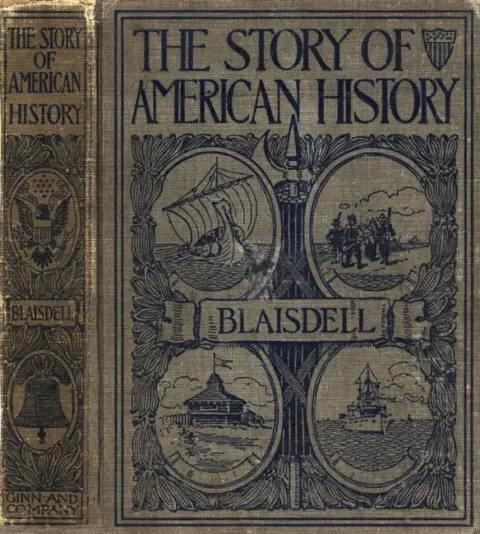
The Story of American History for Elementary Schools
Albert F. (Albert Franklin) Blaisdell
THE CLASSIC COLLECTION · 1903
"Hero Stories from American History" by Albert F. Blaisdell and Francis Kingsley Ball is a collection of historical narratives written in the early 20th century. It serves as an educational reader aimed at students in elementary schools, particularly for those in the sixth and seventh grades. The book focuses on significant figures and events from the first fifty years of American history, presenting them in a way that captures the excitement and drama of these historical moments to engage young readers. The opening of the book introduces the life and adventures of George Rogers Clark, a key figure in the American Revolutionary War. It details his determination and leadership as he navigates the challenges faced by early American settlers in Kentucky, particularly his strategic decision to confront British forces and Indigenous tribes that threatened their safety. The text emphasizes Clark's bravery and innovative military tactics, such as launching surprise attacks on British-held forts, which ultimately contributed to the expansion of American territory. This engaging retelling of history highlights not only the actions of Clark but also the resilience of the early American pioneers.
Introduction adapted from the source catalogue; source summaries may be automatically generated.
Free to read · English · 57,694 words · No account needed
MAKE TIME FOR A GOOD BOOK
On by default. Untick to stop anonymous reading totals. Each page counts after 10 seconds in view. How this works.
Anonymous counting is on unless you have switched it off.
{112} His men never scoffed at their leader's prayers, for it was noticed that the harder "old Dan Morgan" prayed, the more certain they were of being soon led into the jaws of death itself.
Meanwhile, he and his young bride were thrifty and prosperous. They were both ignorant of books, but they studied early and late to make up for lost time. For the next nine years, Morgan, with his household treasures,--his good wife, and his two little daughters,--lived in the pure atmosphere of a Christian home.
The storm cloud of the Revolution was now gathering thick and fast. Events followed each other with startling rapidity. Morgan watched keenly. He never did anything in a half-hearted way; and we may be sure that he took up the cause of the Revolution with all the fervor of his strong nature.
After the bloodshed at Lexington, the Continental Congress called for ten companies from Pennsylvania, Maryland, and Virginia. Morgan received his commission as captain, five days after Bunker Hill. When he shouted, "Come, boys, who's for the camp before Cambridge?" every man in his section turned out.
In less than ten days, Morgan at the head of ninety-six expert riflemen started for Boston. It was six hundred miles away, but they marched the distance in twenty-one days without the loss of a single man.
One day as Washington was riding out to inspect the redoubts, he met
these Virginians.
{113} Morgan halted his men, and saluted the commander in chief, saying, "From the right bank of the Potomac, General!"
Washington dismounted, and, walking along the line, shook hands with
each of them.
Late in the fall of 1775, Morgan and his famous sharpshooters marched with about a thousand other troops on Arnold's ill-fated expedition to Quebec. This campaign, as you have read, was one of the most remarkable exploits of the war.
In the attack upon Quebec, after Arnold had been carried wounded from the field, and Montgomery had been killed, Morgan took Arnold's place and fought like a hero. He forced his way so far into the city that he and all his men were surrounded and captured.
A British officer who greatly admired his daring visited him in
prison, and offered him the rank and pay of a colonel in the royal
army.
"I hope, sir," answered the Virginian patriot, "you will never again insult me, in my present distressed and unfortunate situation, by making me offers which plainly imply that you think me a scoundrel."
Soon after his release, Congress voted him a colonel's commission, with orders to raise a regiment. The regiment reported for service at Morristown, New Jersey, in the winter of 1776.
Your reading position is saved on this browser. Take it to another device with a library code. Reading pages adapt to text, rather than matching a printed edition.
Albert F. (Albert Franklin) Blaisdell
BEHIND THE BOOK
This eBook is for the use of anyone anywhere in the United States and most other parts of the world at no cost and with almost no restrictions whatsoever. You may copy it, give it away or re-use it under the terms of the Project Gutenberg License included with this eBook or online at www.gutenberg.org. If you are not located in the United States, you will have to check the laws of the country where you are located before using this eBook. Read the source licence.
The original source file, including credits and licence, is retained by this library. Request an original-format copy at no charge. Please include the book title and Project Gutenberg identifier #31092.
KEEP YOUR CURIOSITY GOING
Cécile Tormay

Moritz Busch
John L. Ransom
Frances Wright
Cécile Tormay

Mabel Potter Daggett