THE CLASSIC COLLECTION✦An outlaw’s diary: the CommuneCLASSIC FREE BOOKS
An outlaw’s diary: the Commune
Cécile Tormay
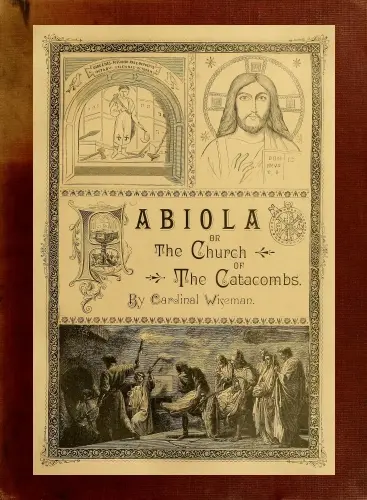
THE CLASSIC COLLECTION · 1885
"Fabiola; Or, The Church of the Catacombs" by Nicholas Patrick Wiseman is a novel first published in 1854. Set in early fourth-century Rome during Diocletian's persecution of Christians, the story follows Fabiola, a spoiled noblewoman whose encounter with her Christian slave girl Syra sparks an unexpected transformation. Meanwhile, young Pancratius prepares for martyrdom while facing betrayal from his nemesis Corvinus. The novel weaves real martyrdom accounts with fictional drama, exploring themes of faith, forgiveness, and community among Rome's underground Christians.
Introduction adapted from the source catalogue; source summaries may be automatically generated.
Free to read · English · 141,871 words · No account needed
MAKE TIME FOR A GOOD BOOK
On by default. Untick to stop anonymous reading totals. Each page counts after 10 seconds in view. How this works.
Anonymous counting is on unless you have switched it off.
[217] Persons freed from slavery retained the title of freedman or freedwoman (libertus, liberta) of the person to whom they had belonged, as “of Augustus.” If they had belonged originally to a free class, they were liberated as ingenuus or ingenua (well-born) and restored by emancipation to that class.
[218] Phil. ii. 7.
[219] Isaias vii. 14.
[220] “Cum arcam suam, in qua Domini sanctum fuit, manibus indignis tentasset aperire, igne inde surgente deterrita est, ne auderet attingere.” “When she attempted to open, with unworthy hands, her chest, in which was the holy (body) of our Lord, she was deterred from daring to touch it, by fire rising up from it.” De Lapsis.
[221] See Martenne, De antiquis Ecclesiæ Ritibus.
[222] So in the eastern liturgies. Fortunatus calls the Blessed Eucharist, “Corporis Agni margaritum ingens.” “The huge pearl of the Body of the Lamb.” Lib. iii. car. 25.
[223] De morte Satyri.
[224] St. Aug. Tract. cxviii. in Joan.
[225] Tertullian (who lived earlier than two hundred years after
Christ, and is the oldest Latin ecclesiastical writer) de Corona
Milit. c. 3.
[226] Audientes.
[227] Genuflectentes.
[228] Electi and competentes.
[229] These will be found, particularly in the baptism of adults, joined with repetitions of the Our Father.
“Agnæ sepulchrum est Romulea in domo,
Fortis puellæ, martyris inclitæ.
Conspectu in ipso condita turrium
Servat salutem virgo Quiritum:
Necnon et ipsos protegit advenas,
Puro ac fideli pectore supplices.”
Prudentius.
“The tomb of Agnes graces Rome,
A maiden brave, a martyr great.
Resting in sight of bastioned gate,
From harm the virgin shields her home;
Nor to the stranger help denies,
If sought with pure and faithful sighs.”
[231] St. Ambrose said Mass in the house of a lady beyond the Tiber. (Paulinus, in his Life, tom. ii. Oper. ed. Bened.) St. Augustine mentions a priest’s saying Mass in a house supposed to be infested with evil spirits. De Civ. D. lib. xxii. c. 6.
[232] Isaias xxxv. 1, 2.
[233] The ceremony employed after desecration.
[234] Euseb. H. E. lib. x. c. 5.
[235] In the East, some governors, wearied with wholesale murders, adopted this more merciful way of treating Christians towards the end of the persecution. See Eusebius.
[236] This scene is described from reality.
[237] Eusebius, ubi sup.
[238] The law of retaliation, such as was prescribed also in the Mosaic law, “an eye for an eye, a tooth for a tooth,” &c.
[239] Clinical baptism, or that of persons confined to their beds was administered by pouring or sprinkling the water on the head. See Bingham, book xi. c. 11.
[241] The religious who lived in community, or common life, were so
called.
[243] Confession of sins in private was made before baptism. See Bingham, Origines, b. xi. ch. viii. § 14.
Your reading position is saved on this browser. Take it to another device with a library code. Reading pages adapt to text, rather than matching a printed edition.
BEHIND THE BOOK
This eBook is for the use of anyone anywhere in the United States and most other parts of the world at no cost and with almost no restrictions whatsoever. You may copy it, give it away or re-use it under the terms of the Project Gutenberg License included with this eBook or online at www.gutenberg.org. If you are not located in the United States, you will have to check the laws of the country where you are located before using this eBook. Read the source licence.
The original source file, including credits and licence, is retained by this library. Request an original-format copy at no charge. Please include the book title and Project Gutenberg identifier #62254.
KEEP YOUR CURIOSITY GOING
Cécile Tormay

Moritz Busch
Coulson Kernahan
John L. Ransom

Maurice Baring
Frances Wright