THE CLASSIC COLLECTION✦An outlaw’s diary: the CommuneCLASSIC FREE BOOKS
An outlaw’s diary: the Commune
Cécile Tormay
THE CLASSIC COLLECTION · 1885
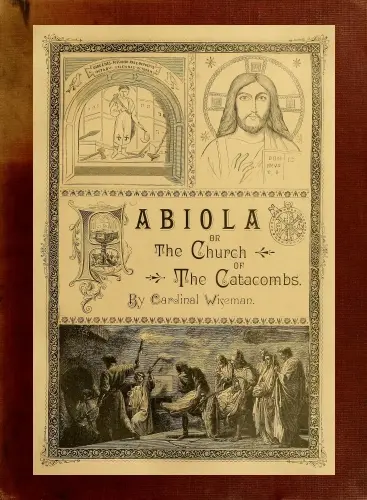
"Fabiola; Or, The Church of the Catacombs" by Nicholas Patrick Wiseman is a novel first published in 1854. Set in early fourth-century Rome during Diocletian's persecution of Christians, the story follows Fabiola, a spoiled noblewoman whose encounter with her Christian slave girl Syra sparks an unexpected transformation. Meanwhile, young Pancratius prepares for martyrdom while facing betrayal from his nemesis Corvinus. The novel weaves real martyrdom accounts with fictional drama, exploring themes of faith, forgiveness, and community among Rome's underground Christians.
Introduction adapted from the source catalogue; source summaries may be automatically generated.
Free to read · English · 141,871 words · No account needed
MAKE TIME FOR A GOOD BOOK
On by default. Untick to stop anonymous reading totals. Each page counts after 10 seconds in view. How this works.
Anonymous counting is on unless you have switched it off.
Early next morning, the pilgrim was passing through the Forum, when he saw a group of persons gathered round one whom they were evidently teasing. He would have paid but little attention to such a scene in a public thoroughfare, had not his ear caught a name familiar to it. He therefore drew nigh. In the centre was a man, younger than himself; but if he looked older than he was, from being wan and attenuated, the other did so much more from being the very contrary. He was bald and bloated, with a face swelled, and red, and covered with blotches and boils. A drunken cunning swam in his eye, and his gait and tone were those of a man habitually intoxicated. His clothes were dirty, and his whole person neglected.
“Ay, ay, Corvinus,” one youth was saying to him, “won’t you get your deserts, now? Have you not heard that Constantine is coming this year to Rome, and don’t you think the Christians will have their turn about now?”
“Not they,” answered the man we have described, “they have not the pluck for it. I remember we feared it, when Constantine published his first edict, after the death of Maxentius, about liberty for the Christians, but next year he put us out of fear, by declaring all religions to be equally permitted.”[237]
“That is all very well, as a general rule,” interposed another, determined further to plague him; “but is it not supposed that he is going to look up those who took an active part in the late persecution, and have the lex talionis,[238] executed on them; stripe for stripe, burning for burning, and wild beast for wild beast?”
“Who says so?” asked Corvinus turning pale.
“Why, it would surely be very natural,” said one.
“And very just,” added another.
“Oh, never mind,” said Corvinus, “they will always let one off for turning Christian. And, I am sure, I would turn any thing, rather than stand--”
“Where Pancratius stood,” interposed a third, more malicious.
“Hold your tongue,” broke out the drunkard, with a tone of positive rage. “Mention his name again, if you dare!” And he raised his fist, and looked furiously at the speaker.
“Ay, because he told you how you were to die,” shouted the youngster, running away. “Heigh! Heigh! a panther here for Corvinus!”
All ran away before the human beast, now lashed into fury, more than they would have done from the wild one of the desert. He cursed them, and threw stones after them.
Your reading position is saved on this browser. Take it to another device with a library code. Reading pages adapt to text, rather than matching a printed edition.
BEHIND THE BOOK
This eBook is for the use of anyone anywhere in the United States and most other parts of the world at no cost and with almost no restrictions whatsoever. You may copy it, give it away or re-use it under the terms of the Project Gutenberg License included with this eBook or online at www.gutenberg.org. If you are not located in the United States, you will have to check the laws of the country where you are located before using this eBook. Read the source licence.
The original source file, including credits and licence, is retained by this library. Request an original-format copy at no charge. Please include the book title and Project Gutenberg identifier #62254.
KEEP YOUR CURIOSITY GOING
Cécile Tormay

Moritz Busch
Coulson Kernahan
John L. Ransom

Maurice Baring
Frances Wright