THE CLASSIC COLLECTION✦An outlaw’s diary: the CommuneCLASSIC FREE BOOKS
An outlaw’s diary: the Commune
Cécile Tormay
THE CLASSIC COLLECTION · 1885
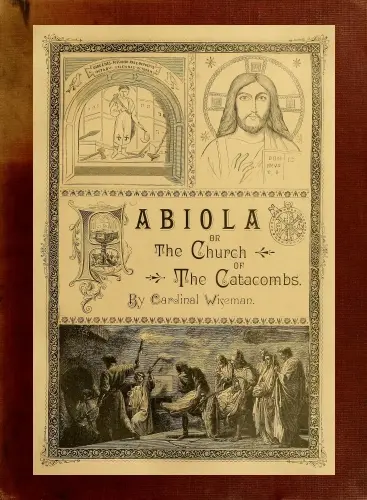
"Fabiola; Or, The Church of the Catacombs" by Nicholas Patrick Wiseman is a novel first published in 1854. Set in early fourth-century Rome during Diocletian's persecution of Christians, the story follows Fabiola, a spoiled noblewoman whose encounter with her Christian slave girl Syra sparks an unexpected transformation. Meanwhile, young Pancratius prepares for martyrdom while facing betrayal from his nemesis Corvinus. The novel weaves real martyrdom accounts with fictional drama, exploring themes of faith, forgiveness, and community among Rome's underground Christians.
Introduction adapted from the source catalogue; source summaries may be automatically generated.
Free to read · English · 141,871 words · No account needed
MAKE TIME FOR A GOOD BOOK
On by default. Untick to stop anonymous reading totals. Each page counts after 10 seconds in view. How this works.
Anonymous counting is on unless you have switched it off.
[188] The reader, when visiting the Crystal Palace, will find in the Roman Court an excellent model of the Roman Forum. On the raised mound of the Palatine hill, between the arches of Titus and Constantine, he will see a chapel of fair dimensions standing alone. It is the one to which we allude. It has been lately repaired by the Barberini family.
[189] The fountain before described.
[190] See the Acts of St. Sebastian.
[191] The coup de grace, the blow by which culprits were “put out of their pain.” Breaking the legs of the crucified was considered an ictus gratiosus.
[192] The great sewer of Rome.
[193] “If thou hadst known, and in this thy day,” etc. St. Luke, xix.
42.
[194] “Ecce quod concupivi jam video, quod speravi jam teneo; ipsi sum juncta in cœlis quem in terris posita tota devotione dilexi.” Office of St. Agnes.
[195] Jan. 21.
[196] In or near the forum stood several arches dedicated to Janus, and called simply by his name, near which usurers or money-lenders kept their posts.
[197] 1600l.
[198] “Mecum enim habeo custodem corporis mei, Angelum Domini.” The
Breviary.
[199] “Incessu patuit Dea.”
[200] “Duplex corona est præstita martyri.” Prudentius.
[201] “Ingressa Agnes turpitudinis locum, Angelum Domini præparatum invenit.” The Breviary.
[202] The Church of St. Agnes in the Piazza Navona, one of the most
beautiful in Rome.
“Cui posse soli Cunctipotens dedit
Castum vel ipsum reddere fornicem
Nil non pudicum est, quod pia visere
Dignaris, almo vel pede tangere.”
Prudentius.
[203] “Non intorto crine caput comptum.” Her head not dressed with braided hair. St. Ambrose, lib. i. de Virgin. c. 2. See Prudentius’s description of St. Eulalia, περι στεφ hymn. iii. 31.
[204] “Solvitur acris hyems, grata vice veris et Favoni.” Horace.
[205] Pudicitia.
[206] St. Ambrose, ubi supra.
“Æterne Rector, divide januas,
Cœli, obserratas terrigenis prius,
Ac te sequentem, Christe, animam voca,
Cum virginalem, tum Patris hostiam.”
Prudentius, περι στεφ 14.
[208] This was the usual practice, to behead out of the gate, at the second, third, or fourth mile-stone; but it is clear from Prudentius and other writers that St. Agnes suffered at the place of trial, of which we have other instances.
[209] Prudentius.
[210] St. Ambrose.
[211] Prudentius mentions that a sudden fall of snow shrouded thus the body of St. Eulalia lying in the Forum. Ubi sup.
[212] Red paint.
[213] Revenge.
[214] “[The tomb] of Dionysius, physician [and] priest,” lately found at the entrance to the crypt of St. Cornelius, in the cemetery of Callistus.
[215] “Qui verbo suo instaurat universa.” The Breviary.
[216] Eusebius, in his account of Serapion, teaches us that this was the manner of administering Holy Communion to the sick, without the cup, or under only one kind.
Your reading position is saved on this browser. Take it to another device with a library code. Reading pages adapt to text, rather than matching a printed edition.
BEHIND THE BOOK
This eBook is for the use of anyone anywhere in the United States and most other parts of the world at no cost and with almost no restrictions whatsoever. You may copy it, give it away or re-use it under the terms of the Project Gutenberg License included with this eBook or online at www.gutenberg.org. If you are not located in the United States, you will have to check the laws of the country where you are located before using this eBook. Read the source licence.
The original source file, including credits and licence, is retained by this library. Request an original-format copy at no charge. Please include the book title and Project Gutenberg identifier #62254.
KEEP YOUR CURIOSITY GOING
Cécile Tormay

Moritz Busch
Coulson Kernahan
John L. Ransom

Maurice Baring
Frances Wright