THE CLASSIC COLLECTION✦An outlaw’s diary: the CommuneCLASSIC FREE BOOKS
An outlaw’s diary: the Commune
Cécile Tormay
THE CLASSIC COLLECTION · 1885
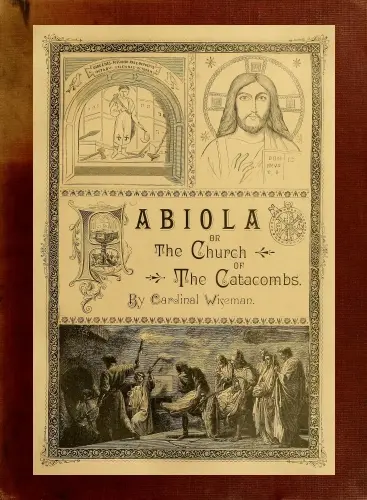
"Fabiola; Or, The Church of the Catacombs" by Nicholas Patrick Wiseman is a novel first published in 1854. Set in early fourth-century Rome during Diocletian's persecution of Christians, the story follows Fabiola, a spoiled noblewoman whose encounter with her Christian slave girl Syra sparks an unexpected transformation. Meanwhile, young Pancratius prepares for martyrdom while facing betrayal from his nemesis Corvinus. The novel weaves real martyrdom accounts with fictional drama, exploring themes of faith, forgiveness, and community among Rome's underground Christians.
Introduction adapted from the source catalogue; source summaries may be automatically generated.
Free to read · English · 141,871 words · No account needed
MAKE TIME FOR A GOOD BOOK
On by default. Untick to stop anonymous reading totals. Each page counts after 10 seconds in view. How this works.
Anonymous counting is on unless you have switched it off.
All that we have told our readers of the first period of the history of subterranean Rome, as ecclesiastical antiquarians love to call the catacombs, has no doubt been better related by Diogenes to his youthful hearers, as, taper in hand, they have been slowly walking through a long straight gallery, crossed, indeed, by many others, but adhered to faithfully; with sundry pauses, and, of course, lectures, embodying what we have put together in our prosaic second chapter.
At length Diogenes turned to the right, and Torquatus looked around him
anxiously.
“I wonder,” he said, “how many turns we have passed by, before leaving this main gallery?”
“A great many,” answered Severus, drily.
“How many do you think, ten or twenty?”
“Full that, I fancy; for I never have counted them.”
Torquatus had, however; but wished to make sure. He continued, still
pausing:
“How do you distinguish the right turn, then? Oh, what is this?” and he pretended to examine a small niche in the corner. But Severus kept too sharp a look-out, and saw that he was making a mark in the sand.
“Come, come along,” he said, “or we shall lose sight of the rest, and not see which way they turn. That little niche is to hold a lamp; you will find one at each angle. As to ourselves, we know every alley and turn here below, as you do those of the city above.”
Torquatus was somewhat reassured by this account of the lamps--those little earthen ones, evidently made on purpose for the catacombs, of which so many are there found. But not content, he kept as good count as he could of the turns, as they went; and now with one excuse, and now with another, he constantly stopped, and scrutinized particular spots and corners. But Severus had a lynx’s eye upon him, and allowed nothing to escape his attention.
At last they entered a doorway, and found themselves in a square chamber, richly adorned with paintings.
“What do you call this?” asked Tiburtius.
“It is one of the many crypts, or cubicula,[101] which abound in our cemeteries,” answered Diogenes; “sometimes they are merely family sepultures, but generally they contain the tomb of some martyr, on whose anniversary we meet here. See that tomb opposite us, which, though flush with the wall, is arched over. That becomes, on such an occasion, the altar whereon the Divine mysteries are celebrated. You are of course aware of the custom of so performing them.”
Your reading position is saved on this browser. Take it to another device with a library code. Reading pages adapt to text, rather than matching a printed edition.
BEHIND THE BOOK
This eBook is for the use of anyone anywhere in the United States and most other parts of the world at no cost and with almost no restrictions whatsoever. You may copy it, give it away or re-use it under the terms of the Project Gutenberg License included with this eBook or online at www.gutenberg.org. If you are not located in the United States, you will have to check the laws of the country where you are located before using this eBook. Read the source licence.
The original source file, including credits and licence, is retained by this library. Request an original-format copy at no charge. Please include the book title and Project Gutenberg identifier #62254.
KEEP YOUR CURIOSITY GOING
Cécile Tormay

Moritz Busch
Coulson Kernahan
John L. Ransom

Maurice Baring
Frances Wright