THE CLASSIC COLLECTION✦An outlaw’s diary: the CommuneCLASSIC FREE BOOKS
An outlaw’s diary: the Commune
Cécile Tormay
THE CLASSIC COLLECTION · 1885
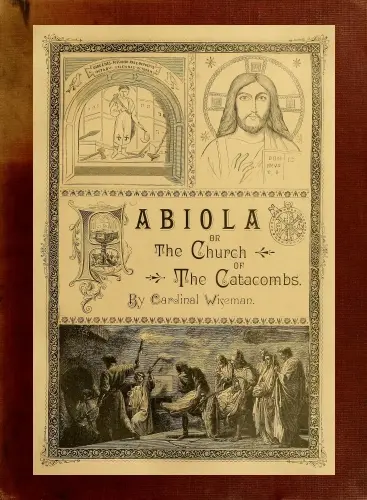
"Fabiola; Or, The Church of the Catacombs" by Nicholas Patrick Wiseman is a novel first published in 1854. Set in early fourth-century Rome during Diocletian's persecution of Christians, the story follows Fabiola, a spoiled noblewoman whose encounter with her Christian slave girl Syra sparks an unexpected transformation. Meanwhile, young Pancratius prepares for martyrdom while facing betrayal from his nemesis Corvinus. The novel weaves real martyrdom accounts with fictional drama, exploring themes of faith, forgiveness, and community among Rome's underground Christians.
Introduction adapted from the source catalogue; source summaries may be automatically generated.
Free to read · English · 141,871 words · No account needed
MAKE TIME FOR A GOOD BOOK
On by default. Untick to stop anonymous reading totals. Each page counts after 10 seconds in view. How this works.
Anonymous counting is on unless you have switched it off.
At the first dawn of morning, Corvinus was up; and, notwithstanding the gloominess of the day, proceeded straight to the Forum. He found his outposts quite undisturbed, and hastened to the principal object of his care. It would be useless to attempt describing his astonishment, his rage, his fury, when he saw the blank board, with only a few shreds of parchment left, round the nails; and beside it standing, in unconscious stolidity, his Dacian sentinel.
He would have darted at his throat, like a tiger, if he had not seen, in the barbarian’s twinkling eye, a sort of hyena squint, which told him he had better not. But he broke out at once into a passionate exclamation:
“Sirrah! how has the edict disappeared? Tell me directly!”
“Softly, softly, Herr Kornweiner,” answered the imperturbable Northern. “There it is as you left it in my charge.”
“Where, you fool? Come and look at it.”
The Dacian went to his side, and for the first time confronted the board; and after looking at it for some moments, exclaimed: “Well, is not that the board you hung up last night?”
“Yes, you blockhead, but there was writing on it, which is gone. That is what you had to guard.”
“Why, look you, captain, as to writing, you see I know nothing, having never been a scholar; but as it was raining all night, it may have been washed out.”
“And as it was blowing, I suppose the parchment on which it was written
was blown off?”
“No doubt, Herr Kornweiner; you are quite right.”
“Come, sir, this is no joking matter. Tell me, at once, who came here
last night.”
“Why, two of them came.”
“Two of what?”
“Two wizards, or goblins, or worse.”
“None of that nonsense for me.” The Dacian’s eye flashed drunkenly again. “Well, tell me, Arminius, what sort of people they were, and what they did.”
“Why, one of them was but a stripling, a boy, tall and thin; who went round the pillar, and I suppose must have taken away what you miss, while I was busy with the other.”
“And what of him? What was he like?”
The soldier opened his mouth and eyes, and stared at Corvinus for some moments, then said, with a sort of stupid solemnity, “What was he like? Why, if he was not Thor himself, he wasn’t far from it. I never felt such strength.”
“What did he do to show it?”
Your reading position is saved on this browser. Take it to another device with a library code. Reading pages adapt to text, rather than matching a printed edition.
BEHIND THE BOOK
This eBook is for the use of anyone anywhere in the United States and most other parts of the world at no cost and with almost no restrictions whatsoever. You may copy it, give it away or re-use it under the terms of the Project Gutenberg License included with this eBook or online at www.gutenberg.org. If you are not located in the United States, you will have to check the laws of the country where you are located before using this eBook. Read the source licence.
The original source file, including credits and licence, is retained by this library. Request an original-format copy at no charge. Please include the book title and Project Gutenberg identifier #62254.
KEEP YOUR CURIOSITY GOING
Cécile Tormay

Moritz Busch
Coulson Kernahan
John L. Ransom

Maurice Baring
Frances Wright