THE CLASSIC COLLECTION✦An outlaw’s diary: the CommuneCLASSIC FREE BOOKS
An outlaw’s diary: the Commune
Cécile Tormay
THE CLASSIC COLLECTION · 1885
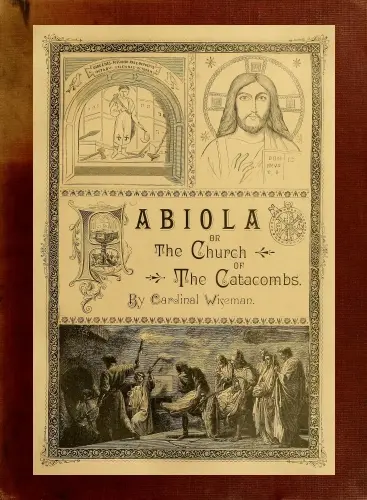
"Fabiola; Or, The Church of the Catacombs" by Nicholas Patrick Wiseman is a novel first published in 1854. Set in early fourth-century Rome during Diocletian's persecution of Christians, the story follows Fabiola, a spoiled noblewoman whose encounter with her Christian slave girl Syra sparks an unexpected transformation. Meanwhile, young Pancratius prepares for martyrdom while facing betrayal from his nemesis Corvinus. The novel weaves real martyrdom accounts with fictional drama, exploring themes of faith, forgiveness, and community among Rome's underground Christians.
Introduction adapted from the source catalogue; source summaries may be automatically generated.
Free to read · English · 141,871 words · No account needed
MAKE TIME FOR A GOOD BOOK
On by default. Untick to stop anonymous reading totals. Each page counts after 10 seconds in view. How this works.
Anonymous counting is on unless you have switched it off.
[34] A famous sorceress in Augustus’s age.
[35] The worship of interior Africa.
[36] “The sweating goal.” It was an obelisk of brick (which yet remains), cased with marble, from the top of which issued water, and flowed down like a sheet of glass, all round it, into a basin on the ground.
[37] The triumphal arch of Titus, on which are represented the spoils
of the Temple.
[38] The arch of Constantine stands exactly under the spot where this
scene is described.
[39] The place where live beasts were kept for the shows.
[40] Gaeta.
[41] The generic name for the wild beasts of that continent, as opposed to bears and others from the north.
[42] It is not mentioned what it precisely was.
[43] These were the popular ideas of Christian worship.
[44] Now Monte Cavo, above Albano.
[45] “Vidi supra montem Agnum stantem, de sub cujus pede fons vivus emanat.”--Office of St. Clement.
[46] Ammianus Marcellinus tells us that, at the decline of the empire, the streets at night were lighted so as to rival day. “Et hæc confidenter agebat (Gallus) ubi pernoctantium luminum claritudo dierum solet imitari fulgorem.” Lib. xiv. c. 1.
[47] Roma Subterr. 1. iii. c. 22.
[48] Euseb. E. H. 1. vi. c. 43.
[49] No domestic concealment surely could be more difficult than that of a wife’s religion from her husband. Yet Tertullian supposes this to have been not uncommon. For, speaking of a married woman communicating herself at home, according to practice in those ages of persecution, he says, “Let not your husband know what you taste secretly, before every other food; and if he shall know of the bread, may he not know it to be what it is called.” Ad Uxor. lib. ii. c. 5. Whereas, in another place, he writes of a Catholic husband and wife giving communion to one another. De Monogamia, c. 11.
[50] The Vicus Patricius.
[51] Job xxix. 15.
[52] The place most noted in the neighborhood of Rome for whining and
importunate beggars.
[53] Is. i. 9.
[54] “Ne quis hæredem virginem neque mulierem faceret,” that no one should leave a virgin or a woman his heiress.--Cicero in Verrem, i.
[55] The upper part of the Quirinal, leading to the Nomentan gate,
Porta Pia.
[56] “Cujus pulchritudinem sol et luna mirantur, ipsi soli servo fidem.”--Office of St. Agnes.
[57] We have it recorded of Nepotian, that on his conversion he
distributed all his property to the poor. St. Paulinus of Nola did the
same.
[58] “Dabis impio militi quod non vis dare sacerdoti, et hoc tollit fiscus, quod con accipit Christus.”--St. Aug.
[59] “Be pleased to render, O Lord, eternal life to all who for Thy Name’s sake do unto us good things.”
[60] Pampinus, pampino.
[61] Ocelli Italiæ.
Your reading position is saved on this browser. Take it to another device with a library code. Reading pages adapt to text, rather than matching a printed edition.
BEHIND THE BOOK
This eBook is for the use of anyone anywhere in the United States and most other parts of the world at no cost and with almost no restrictions whatsoever. You may copy it, give it away or re-use it under the terms of the Project Gutenberg License included with this eBook or online at www.gutenberg.org. If you are not located in the United States, you will have to check the laws of the country where you are located before using this eBook. Read the source licence.
The original source file, including credits and licence, is retained by this library. Request an original-format copy at no charge. Please include the book title and Project Gutenberg identifier #62254.
KEEP YOUR CURIOSITY GOING
Cécile Tormay

Moritz Busch
Coulson Kernahan
John L. Ransom

Maurice Baring
Frances Wright