THE CLASSIC COLLECTION✦An outlaw’s diary: the CommuneCLASSIC FREE BOOKS
An outlaw’s diary: the Commune
Cécile Tormay
THE CLASSIC COLLECTION · 1885
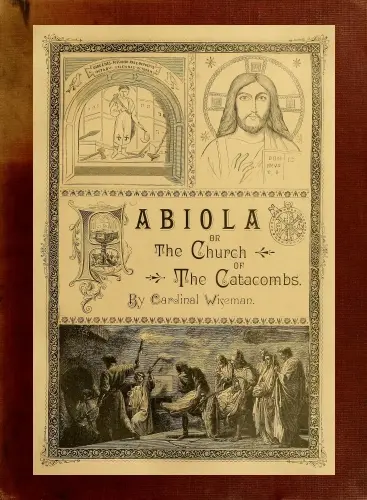
"Fabiola; Or, The Church of the Catacombs" by Nicholas Patrick Wiseman is a novel first published in 1854. Set in early fourth-century Rome during Diocletian's persecution of Christians, the story follows Fabiola, a spoiled noblewoman whose encounter with her Christian slave girl Syra sparks an unexpected transformation. Meanwhile, young Pancratius prepares for martyrdom while facing betrayal from his nemesis Corvinus. The novel weaves real martyrdom accounts with fictional drama, exploring themes of faith, forgiveness, and community among Rome's underground Christians.
Introduction adapted from the source catalogue; source summaries may be automatically generated.
Free to read · English · 141,871 words · No account needed
MAKE TIME FOR A GOOD BOOK
On by default. Untick to stop anonymous reading totals. Each page counts after 10 seconds in view. How this works.
Anonymous counting is on unless you have switched it off.
[62] Such as are given by Macrobius in his Saturnalia, lib. i., and
by Valerius Maximus.
[63] Matt. xii. 11.
[64] “The Villa of Statues,” or “at the Statues.”
[65] “At” or “to the palms.”
[66] Jos. vii.
[67] There was no post in those days, and persons wishing to send letters had to dispatch an express, or find some opportunity.
[68] Matt. v. 44.
[69] A whirlpool between Italy and Sicily.
[70] The heathen notion of the Blessed Eucharist.
[71] “Diogenes, the excavator, deposited in peace, eight days before the first of October.”--From St. Sebastian’s. Boldetti, i. 15, p. 60.
[72] “From New Street. Pollecla, who sells barley in New Street.” Found in the cemetery of Callistus.
[73] Given by F. Marchi in his Architecture of Subterranean Christian Rome, 1844; a work on which we will freely draw.
[74] The number, unfortunately, is not intelligible, being in cipher.
[75] In the cemetery of St. Agnes, pieces of lime have been found in tombs forming exact moulds of different parts of the body, with the impression of a finer linen inside, and a coarser outside. As to spices and balsams, Tertullian observes that “the Arabs and Sabæans well know that the Christians annually consume more for their dead than the heathen world did for its gods.”
[76] These terms will be explained later.
[77] On the 22d of April, 1823, this tomb was discovered unviolated. On being opened the bones, white, bright, and polished as ivory, were found, corresponding to the framework of a youth of eighteen. At his head was the phial of blood. With the head to his feet was the skeleton of a boy, of twelve or thirteen, black and charred chiefly at the head and upper parts, down to the middle of the thigh-bones, from which to the feet the bones gradually whitened. The two bodies, richly clothed, repose side by side under the altar of the Jesuits’ college at Loreto.
[78] Better known as Caracalla’s.
[79] The person who had charge of the bathers’ clothes, from capsa, a
chest.
[80] “Cucumio and Victoria made (the tomb) for themselves while living. Capsarius of the Antonine” (baths). Found in the cemetery of Callistus, first published by F. Marchi, who attributes it, erroneously, to the cemetery of Prætextatus.
[81] “Marcus Antonius Restitutus made this subterranean for himself and his family, that trust in the Lord.” Lately found in the cemetery of SS. Nereus and Achilleus. It is singular that in the inscription of the martyr Restitutus, given in the last chapter, as in this, a syllable should be omitted in the name, one easily slurred in pronouncing it.
[82] Sixty was the full age, but admission was given sometimes at forty.
[83] Now St. Sebastian’s. The older Porta Capena was nearly a mile
within the present.
Your reading position is saved on this browser. Take it to another device with a library code. Reading pages adapt to text, rather than matching a printed edition.
BEHIND THE BOOK
This eBook is for the use of anyone anywhere in the United States and most other parts of the world at no cost and with almost no restrictions whatsoever. You may copy it, give it away or re-use it under the terms of the Project Gutenberg License included with this eBook or online at www.gutenberg.org. If you are not located in the United States, you will have to check the laws of the country where you are located before using this eBook. Read the source licence.
The original source file, including credits and licence, is retained by this library. Request an original-format copy at no charge. Please include the book title and Project Gutenberg identifier #62254.
KEEP YOUR CURIOSITY GOING
Cécile Tormay

Moritz Busch
Coulson Kernahan
John L. Ransom

Maurice Baring
Frances Wright