THE CLASSIC COLLECTION✦An outlaw’s diary: the CommuneCLASSIC FREE BOOKS
An outlaw’s diary: the Commune
Cécile Tormay
THE CLASSIC COLLECTION · 1885
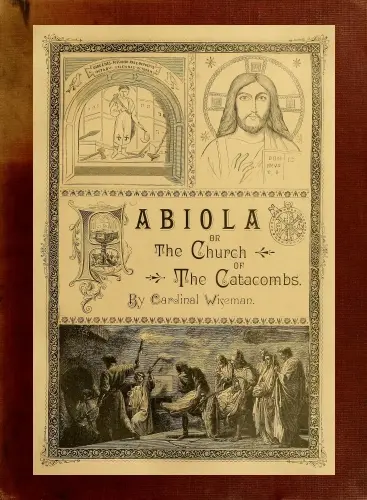
"Fabiola; Or, The Church of the Catacombs" by Nicholas Patrick Wiseman is a novel first published in 1854. Set in early fourth-century Rome during Diocletian's persecution of Christians, the story follows Fabiola, a spoiled noblewoman whose encounter with her Christian slave girl Syra sparks an unexpected transformation. Meanwhile, young Pancratius prepares for martyrdom while facing betrayal from his nemesis Corvinus. The novel weaves real martyrdom accounts with fictional drama, exploring themes of faith, forgiveness, and community among Rome's underground Christians.
Introduction adapted from the source catalogue; source summaries may be automatically generated.
Free to read · English · 141,871 words · No account needed
MAKE TIME FOR A GOOD BOOK
On by default. Untick to stop anonymous reading totals. Each page counts after 10 seconds in view. How this works.
Anonymous counting is on unless you have switched it off.
“May the Church, in her days of peace and of victories, never forget what she owes to the age of her martyrs. As for us two, we are indebted to it for our spiritual lives. May many, who will only read of it, draw from it the same mercy and grace!”
They knelt down, and prayed long together silently before the shrine.
They then parted, to meet no more.
After a few years, spent by Orontius in penitential fervor, a green mound by the palms, in the little dell near Gaza, marked the spot where he slept the sleep of the just.
And after many years of charity and holiness, Fabiola withdrew to rest in peace, in company with Agnes and Miriam.
[1] Hot-baths.
[2] Lib. iv. ep. 16.
[3] The Pompeian Court in the Crystal Palace, London, will have familiarized many readers with the forms of an ancient house.
[4] This custom suggests to St. Augustine the beautiful idea, that the Jews were the pædagogi of Christianity,--carrying for it the books which they themselves could not understand.
[5] The peculiar epithet of the Catacombs.
[6] The pancratium was the exercise which combined all other personal contests,--wrestling, boxing, etc.
[7] The implements of writing in schools, the tablets being covered with wax, on which the letters were traced by the sharp point, and effaced by the flat top, of the style.
[8] The hand-bandages worn in pugilistic combats.
[9] One of the many calumnies popular among the heathens.
[10] This scene is taken from a real occurrence.
[11] Church and gate of San Pancrazio.
[12] Old St. Pancras’s Church, London, the favorite burial-place of Catholics, till they had cemeteries of their own.
[13] Anastastasius, Biblioth, in vita Honorii.
[14] Pronounced with the accent on the i.
[15] The milk of 500 asses per day was required to furnish Poppæa, Nero’s wife, with one cosmetic.
[16] The dining-hall.
[17] Black antimony applied on the eyelids.
[18] Not all of me will die.
[19] Job xix. 27.
[20] See the noble answer of Evalpistus, an imperial slave, to the judge, in the Acts of St. Justin, ap. Ruinart, tom. i.
[21] Church.
[22] “Thy eyes are as those of cloves.”--Cantic. i. 14.
[23] Twelve was the age for marriage according to the Roman law.
[24] “Annulo fidei suæ subarrhavit me, et immensis monilibus ornavit me.”--Office of St. Agnes.
[25] “Dexteram meam et collum meum cinxit lapidibus pretiosis, tradidit auribus meis inæstimabiles margaritas.”
[26] So called from its resemblance to the letter C, the old form of Σ.
[27] Gloves.
[28] Lucian: De Morte Peregrini.
[29] “Magnificæ nemo negat; sed quæ potest esse homini polito delectatio, quum aut homo imbecillus a valentissima bestia laniatur, aut præclara bestia venabulo transverberatur?”--Ep. ad Fam. lib. vii. ep. 1.
[30] Porridge.
[31] Vengeance.
[32] 1 Cor. vii. 24.
[33] 1 Pet. ii. 14.
Your reading position is saved on this browser. Take it to another device with a library code. Reading pages adapt to text, rather than matching a printed edition.
BEHIND THE BOOK
This eBook is for the use of anyone anywhere in the United States and most other parts of the world at no cost and with almost no restrictions whatsoever. You may copy it, give it away or re-use it under the terms of the Project Gutenberg License included with this eBook or online at www.gutenberg.org. If you are not located in the United States, you will have to check the laws of the country where you are located before using this eBook. Read the source licence.
The original source file, including credits and licence, is retained by this library. Request an original-format copy at no charge. Please include the book title and Project Gutenberg identifier #62254.
KEEP YOUR CURIOSITY GOING
Cécile Tormay

Moritz Busch
Coulson Kernahan
John L. Ransom

Maurice Baring
Frances Wright