THE CLASSIC COLLECTION✦An outlaw’s diary: the CommuneCLASSIC FREE BOOKS
An outlaw’s diary: the Commune
Cécile Tormay
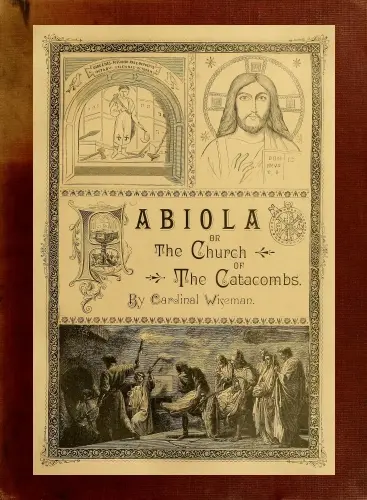
THE CLASSIC COLLECTION · 1885
"Fabiola; Or, The Church of the Catacombs" by Nicholas Patrick Wiseman is a novel first published in 1854. Set in early fourth-century Rome during Diocletian's persecution of Christians, the story follows Fabiola, a spoiled noblewoman whose encounter with her Christian slave girl Syra sparks an unexpected transformation. Meanwhile, young Pancratius prepares for martyrdom while facing betrayal from his nemesis Corvinus. The novel weaves real martyrdom accounts with fictional drama, exploring themes of faith, forgiveness, and community among Rome's underground Christians.
Introduction adapted from the source catalogue; source summaries may be automatically generated.
Free to read · English · 141,871 words · No account needed
MAKE TIME FOR A GOOD BOOK
On by default. Untick to stop anonymous reading totals. Each page counts after 10 seconds in view. How this works.
Anonymous counting is on unless you have switched it off.
“And in Jesus Christ, who was born and died for our sins?”
“Yes, in all that you believe.” The reply was more faint.
“Make haste, make haste, Orontius,” cried Fabiola, pointing to the
fountain.
He was already at its basin, filling full his two hands, and coming instantly, poured their contents on the head of the poor African, pronouncing the words of baptism; and, as she expired, the water of regeneration mingled with her blood of expiation.
After this distressing, yet consoling, scene, they entered the house, and instructed Torquatus about the burial to be given to this doubly-baptized convert.
Orontius was struck with the simple neatness of the house, so strongly contrasting with the luxurious splendor of Fabiola’s former dwelling. But suddenly his attention was arrested, in a small inner room, by a splendid shrine or casket, set with jewels, but with an embroidered curtain before it, so as to allow only the frame of it to be seen. Approaching nearer, he read inscribed on it:
Orontius turned deadly pale; then changed to a deep crimson; and almost
staggered.
Fabiola saw this, and going up to him kindly and frankly, placed her hand upon his arm, and mildly said to him:
“Orontius, there is that within, which may well make us both blush deeply, but not therefore despond.”
So saying she drew aside the curtain, and Orontius saw within a crystal plate, the embroidered scarf so much connected with his own, and his sister’s history. Upon it were lying two sharp weapons, the points of both which were rusted with blood. In one he recognized his own dagger; the other appeared to him like one of those instruments of female vengeance, with which he knew heathen ladies punished their attendant slaves.
“We have both,” said Fabiola, “unintentionally inflicted a wound, and shed the blood of her, whom now we honor as a sister in heaven. But for my part, from the day when I did so, and gave her occasion to display her virtue, I date the dawn of grace upon my soul. What say you, Orontius?”
“That I, likewise, from the instant that I so misused her, and led to her exhibition of such Christian heroism, began to feel the hand of God upon me, that has led me to repentance and forgiveness.”
“It is thus ever,” concluded Fabiola. “The example of our Lord has made the martyrs; and the example of the martyrs leads us upwards to Him. Their blood softens our hearts; His alone cleanses our souls. Theirs pleads for mercy; His bestows it.
Your reading position is saved on this browser. Take it to another device with a library code. Reading pages adapt to text, rather than matching a printed edition.
BEHIND THE BOOK
This eBook is for the use of anyone anywhere in the United States and most other parts of the world at no cost and with almost no restrictions whatsoever. You may copy it, give it away or re-use it under the terms of the Project Gutenberg License included with this eBook or online at www.gutenberg.org. If you are not located in the United States, you will have to check the laws of the country where you are located before using this eBook. Read the source licence.
The original source file, including credits and licence, is retained by this library. Request an original-format copy at no charge. Please include the book title and Project Gutenberg identifier #62254.
KEEP YOUR CURIOSITY GOING
Cécile Tormay

Moritz Busch
Coulson Kernahan
John L. Ransom

Maurice Baring
Frances Wright