THE CLASSIC COLLECTION✦An outlaw’s diary: the CommuneCLASSIC FREE BOOKS
An outlaw’s diary: the Commune
Cécile Tormay
THE CLASSIC COLLECTION · 1885
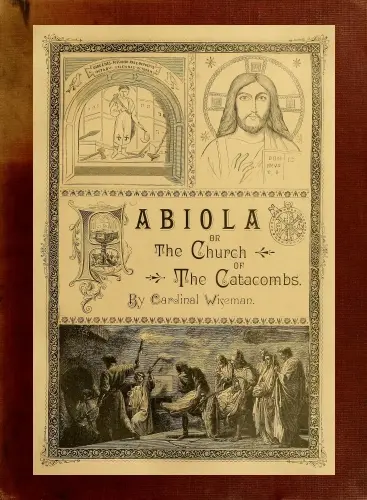
"Fabiola; Or, The Church of the Catacombs" by Nicholas Patrick Wiseman is a novel first published in 1854. Set in early fourth-century Rome during Diocletian's persecution of Christians, the story follows Fabiola, a spoiled noblewoman whose encounter with her Christian slave girl Syra sparks an unexpected transformation. Meanwhile, young Pancratius prepares for martyrdom while facing betrayal from his nemesis Corvinus. The novel weaves real martyrdom accounts with fictional drama, exploring themes of faith, forgiveness, and community among Rome's underground Christians.
Introduction adapted from the source catalogue; source summaries may be automatically generated.
Free to read · English · 141,871 words · No account needed
MAKE TIME FOR A GOOD BOOK
On by default. Untick to stop anonymous reading totals. Each page counts after 10 seconds in view. How this works.
Anonymous counting is on unless you have switched it off.
“No, dear lady, why should I come to tell you of all my woes? Oh! why did I ever leave you and your house, where I ought to have been so happy? I might then with you, and Graja, and good old departed Euphrosyne, have learnt to be good myself, and have embraced Christianity!”
“What, have you really been thinking of this, Jubala?”
“For a long time, lady, in my sorrows and remorse. For I have seen how happy Christians are, even those who have been as wicked as myself. And because I hinted this to my husband this morning, he has beaten me, and threatened to take my life. But, thank God, I have been making myself acquainted with Christian doctrines, through the teaching of a friend.”
“How long has this bad treatment gone on, Jubala?” asked Orontius, who had heard of it from his uncle.
“Ever,” she replied, “since soon after marriage, I told him of an offer made to me previously, by a dark foreigner, named Eurotas. Oh! he was indeed a wicked man, a man of black passions and remorseless villany. Connected with him, is my most racking recollection.”
“How was that?” asked Orontius, with eager curiosity.
“Why, when he was leaving Rome, he asked me to prepare for him two narcotic potions; one for any enemy, he said, should he be taken prisoner. This was to be certainly fatal; another had to suspend consciousness for a few hours only, should he require it for himself.
“When he came for them, I was just going to explain to him, that, contrary to appearances, the small phial contained a fatally concentrated poison, and the large one a more diluted and weaker dose. But my husband came in at the moment, and in a fit of jealousy thrust me from the room. I fear some mistake may have been committed, and that unintentional death may have ensued.”
Fabiola and Orontius looked at one another in silence, wondering at the just dispensations of Providence; when they were aroused by a shriek from the woman. They were horrified at seeing an arrow quivering in her bosom. As Fabiola supported her, Orontius, looking behind him, caught a glimpse of a black face grinning hideously through the fence. In the next moment a Numidian was seen flying away on his horse, with his bow bent, Parthian-wise over his shoulder, ready for any pursuer. The arrow had passed, unobserved, between Orontius and the lady.
“Jubala,” asked Fabiola, “dost thou wish to die a Christian?”
“Most earnestly,” she replied.
“Dost thou believe in One God in Three Persons?”
“I firmly believe in all the Christian Church teaches.”
Your reading position is saved on this browser. Take it to another device with a library code. Reading pages adapt to text, rather than matching a printed edition.
BEHIND THE BOOK
This eBook is for the use of anyone anywhere in the United States and most other parts of the world at no cost and with almost no restrictions whatsoever. You may copy it, give it away or re-use it under the terms of the Project Gutenberg License included with this eBook or online at www.gutenberg.org. If you are not located in the United States, you will have to check the laws of the country where you are located before using this eBook. Read the source licence.
The original source file, including credits and licence, is retained by this library. Request an original-format copy at no charge. Please include the book title and Project Gutenberg identifier #62254.
KEEP YOUR CURIOSITY GOING
Cécile Tormay

Moritz Busch
Coulson Kernahan
John L. Ransom

Maurice Baring
Frances Wright