THE CLASSIC COLLECTION✦A dead man’s diaryCLASSIC FREE BOOKS
A dead man’s diary
Coulson Kernahan
THE CLASSIC COLLECTION · 1883
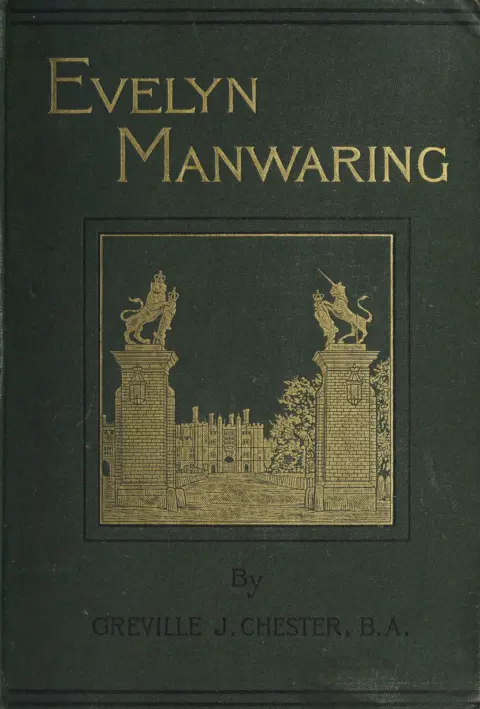
"Evelyn Manwaring: A Tale of Hampton Court Palace" by Greville John Chester is a novel written in the late 19th century. It centers on the grace-and-favour world of Hampton Court and the storied, troubled Manwaring family, where pride of lineage collides with love, loyalty, and scandal. The main figures include gentle, steadfast Evelyn, her proud genealogist father, her soldier-brother Lionel, her brilliant younger brother Wilfred, and kind neighbors like Miss Sarah Strong and the Duchess of Ribblesdale. The opening of the story follows Evelyn’s fog-shrouded arrival at Hampton Court to take over Lady Glengriskin’s rooms, her private collapse of grief, and her rescue by her warm-hearted neighbor, Miss Sarah Strong, who feeds, comforts, and promises to present her to the Duchess. The narrative then turns to Holmcastle Manor in North Lancashire: the Manwarings’ ancient seat, the Squire’s consuming obsession with pedigree, and the children’s upbringing—Evelyn beloved as “the Lily of Arrow Dale,” Lionel a rising officer, and Wilfred a gifted youth. Sent to the tutor Dr. Massenger, Wilfred bonds with the young Duke of Ribblesdale and clashes with the slippery Augustus Cubleigh; after a visit to a local collector, stolen gold coins are “found” in Wilfred’s waistcoat, and he is falsely branded a thief. Cast out by his implacable father despite the Rector’s plea and Evelyn’s love, Wilfred leaves home in despair and disappears under an assumed name. As searches reveal he has sailed abroad, Massenger arrives at Holmcastle to confess that Wilfred’s innocence is proved and Cubleigh was the culprit, leaving the Squire devastated.
Introduction adapted from the source catalogue; source summaries may be automatically generated.
Free to read · English · 49,406 words · No account needed
MAKE TIME FOR A GOOD BOOK
On by default. Untick to stop anonymous reading totals. Each page counts after 10 seconds in view. How this works.
Anonymous counting is on unless you have switched it off.
MENTION having already been casually made of a certain Lady M’Adam, it will be proper to inform the reader of some of the antecedents of that bright orange luminary and devoted disciple of the great Mr. Moodle. Clara M’Dougal, then, was the only daughter of a worthy pork-merchant of Carrickfergus, who, at the mature age of five-and-twenty, espoused one Peter M’Adam, an eminent whiskey distiller, and elder of the Presbyterian sect at Belfast. This Peter M’Adam was a great Orangeman, and a staunch supporter of a very clever lawyer, who, chiefly through this distiller’s moral influence and indifferent whiskey, became Member of Parliament for Lisdoonacorrigan, and afterwards, by his own talents, Solicitor General, and who finally ascended the woolsack as Lord Yellowlily of Carrignatuohil in the County of Antrim. His Lordship, unlike those base wretches who are always ready to kick down the ladder by which they rose, never forgot a favour, or one who had rendered it. “He knew a trick worth two of that,” he once coarsely observed to a colleague. Like Napoleon the Little, Lord Yellowlily always repaid an obligation, but, like the same parvenu despot, he repaid it as an obligation, and then he stopt short. He never repaid it with interest, however small, and he neither felt nor expressed gratitude. He nicely discriminated the precise amount of the debt, and as nicely calculated the amount he ought to pay in return; and then, and not before then, he paid it, and had done with his benefactor for ever. Thus it was that, when Peter M’Adam, who had been knighted for presenting an address of congratulation to Her Majesty on the occasion of the birth of one of her numerous German grand-children, had gone the way of all flesh, with his claims unsatisfied, Lord Yellowlily remembered his former supporter, and made personal application to the Queen in behalf of his widow. It thus happened that the pork-merchant’s daughter and the whiskey distiller’s widow, much to her own surprise, found herself in possession of a handsome set of apartments looking into the royal gardens at Hampton Court. Here at first her ladyship did certainly feel somewhat fish-out-of-waterish, but she was a “converted” woman, and she had two great consolations. The first of these was to keep continually declaiming against the Chaplain of the Palace, who was one of the simplest, gentlest, and most charitable of men. His sermons, declared Sir Peter’s relict--for, like most ultra-Protestant ladies, she considered herself to be infallible--were not “gospel.” Why, too, didn’t he publicly testify against the goings-on of those flaunting Jezebels, the Ladies Skandaliza and Coreopsis Corker, who were creditably reported to have left the Palace in broad daylight in pink bathing-dresses, and to have publicly bathed with Lieutenant Sprattles (in blue) in Hampton Lasher? Why did he continue to visit Lady Rathmullen, who was known to have fitted up an oratory in her own private apartments? Why didn’t he leave undone everything he had done, and why didn’t he do everything he had left undone? And above all, why didn’t he conduct the Services of the Church in a manner pleasing to herself, Lady M’Adam, who was not a Churchwoman at all? The widow’s other consolation was to sit and talk scandal with her dear Christian friends, Lady Lavinia Gathercole and Miss Helen Scheimes. This last-named lady was the sister of Somebody or Something diplomatic. The Somebody had held a high consular or semi-diplomatic post on the borders of the Caucasus, and, under threat of assassination, had signed a treaty in the directly contrary sense to the orders he had received from the Foreign Office. He was accordingly deemed signally worthy of promotion, and was instantly named a Companion of the Order of SS. Michael and George. Dying, however, at the seat of his jurisdiction of too great devotion to arraki and French cognac, apartments were obtained in the Palace for his sister Helen, who had acted as his secretary and factotum at Tomareyeh. While in that remote Oriental city, Miss Scheimes had written a work entitled Harem Life of the Muslim Circassians of the Nether Caucasus, and although it had a considerable run at the circulating libraries, a very nasty book it was. Therein, the authoress (who at the time was eight-and-thirty if she was eight) conclusively showed that it was only by the most heroic and heroine-like display of firmness and austerity that she had escaped being added to the already overgrown female establishment of H.H. the Emir. Lady M’Adam had still a share in the whiskey business; had a very substantial jointure, and owned a very snug Brougham; and Miss Scheimes--who, like Lady Lavinia, was by no means averse to creature comforts, and idolised wealth--was her very particular friend and toady, while in her inmost heart she hated her like poison. While in person Lady M’Adam was short and stout, had a broad face with a high colour, not without a suspicion of rouge, and was gifted with a loud voice, Miss Scheimes, on the contrary, was tall and thin, and had a sallow face, with dark snaky eyes, which sparkled with malevolence and cunning. Her lips were thin, and she had an ugly way of drawing them inwards when she spoke, which was commonly in a tone but little removed from a whisper. While the widow dressed herself in rich silks and satins, and rejoiced in flounces and furbelows, the spinster attired herself in the cheapest materials, and her favourite colours were drab or some shade of yellow, which certainly accorded rather than contrasted with her sallow complexion. She wore her “waist” close under her armpits, and her figure was perfectly straight from her chin to her very long feet.
Your reading position is saved on this browser. Take it to another device with a library code. Reading pages adapt to text, rather than matching a printed edition.
BEHIND THE BOOK
This eBook is for the use of anyone anywhere in the United States and most other parts of the world at no cost and with almost no restrictions whatsoever. You may copy it, give it away or re-use it under the terms of the Project Gutenberg License included with this eBook or online at www.gutenberg.org. If you are not located in the United States, you will have to check the laws of the country where you are located before using this eBook. Read the source licence.
The original source file, including credits and licence, is retained by this library. Request an original-format copy at no charge. Please include the book title and Project Gutenberg identifier #76400.
KEEP YOUR CURIOSITY GOING
Coulson Kernahan

Maurice Baring
Frances Wright
Cécile Tormay

Frederic Jesup Stimson

W. H. P. (William Henry Pope) Jarvis