THE CLASSIC COLLECTION✦A dead man’s diaryCLASSIC FREE BOOKS
A dead man’s diary
Coulson Kernahan
THE CLASSIC COLLECTION · 1883
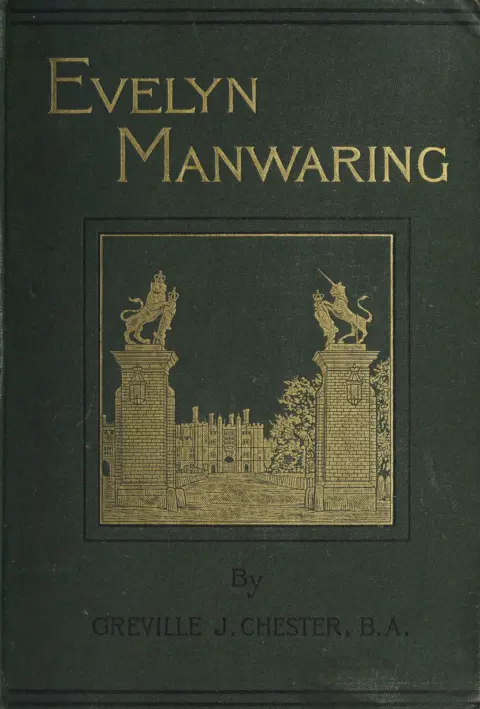
"Evelyn Manwaring: A Tale of Hampton Court Palace" by Greville John Chester is a novel written in the late 19th century. It centers on the grace-and-favour world of Hampton Court and the storied, troubled Manwaring family, where pride of lineage collides with love, loyalty, and scandal. The main figures include gentle, steadfast Evelyn, her proud genealogist father, her soldier-brother Lionel, her brilliant younger brother Wilfred, and kind neighbors like Miss Sarah Strong and the Duchess of Ribblesdale. The opening of the story follows Evelyn’s fog-shrouded arrival at Hampton Court to take over Lady Glengriskin’s rooms, her private collapse of grief, and her rescue by her warm-hearted neighbor, Miss Sarah Strong, who feeds, comforts, and promises to present her to the Duchess. The narrative then turns to Holmcastle Manor in North Lancashire: the Manwarings’ ancient seat, the Squire’s consuming obsession with pedigree, and the children’s upbringing—Evelyn beloved as “the Lily of Arrow Dale,” Lionel a rising officer, and Wilfred a gifted youth. Sent to the tutor Dr. Massenger, Wilfred bonds with the young Duke of Ribblesdale and clashes with the slippery Augustus Cubleigh; after a visit to a local collector, stolen gold coins are “found” in Wilfred’s waistcoat, and he is falsely branded a thief. Cast out by his implacable father despite the Rector’s plea and Evelyn’s love, Wilfred leaves home in despair and disappears under an assumed name. As searches reveal he has sailed abroad, Massenger arrives at Holmcastle to confess that Wilfred’s innocence is proved and Cubleigh was the culprit, leaving the Squire devastated.
Introduction adapted from the source catalogue; source summaries may be automatically generated.
Free to read · English · 49,406 words · No account needed
MAKE TIME FOR A GOOD BOOK
On by default. Untick to stop anonymous reading totals. Each page counts after 10 seconds in view. How this works.
Anonymous counting is on unless you have switched it off.
These views and pretensions, as may be supposed, did not render the lord of Holmcastle very popular amongst the neighbouring aristocracy; but for this he didn’t care a rush, and in fact he rather liked the state of isolation in which his own pride and folly placed him. While, however, Mr. Manwaring treated his richer and more aristocratic neighbours with scant civility or ill-concealed contempt, he was extremely courteous to his own tenantry, and to the class of yeoman farmers, of whom there were many in the Dale of the Arrow. A porcupine with quills erect towards those who, he feared, might be disposed to assert an equality or superiority which he refused to admit, he was as smooth as a Persian cat (and in some respects as treacherous) towards those whom he regarded as so immeasurably beneath him as to have no pretensions at all. The Squire, too, had in many matters the instincts of a gentleman of the old school. He ceremoniously removed his hat when he entered the cottage of the humblest labourer, and he always requited the bobs and curtseys of the village children with a grand bow, worthy of Sir Charles Grandison himself. Nor was he a bad landlord. His ancestors, who were richer men than he was himself, had underlet their farms, and so he conceived it to be a piece of Family Honour not to raise his rents, although the value of his land had largely increased. Finding, too, from ancient accounts, that his forebears had given large doles to the poor, he too was liberal in his Christmas gifts; and though he would have grudged a cup of cold water for Christ’s sake, to save a brother as a brother from perishing of thirst, he gave freely to those who asked, because he thought it accorded with the ancient dignity of his House to do so. Thus, with the poorer sort of his neighbours, who appreciated material benefits without too curiously investigating motives, the Squire of Holmcastle was not otherwise than popular. Mr. Manwaring’s manner of life, moreover, was eminently respectable. No one could breathe a word against his moral character, which indeed was beyond reproach. He was particular, too, in attending to his “religious duties.” He went regularly to the Parish Church; but as he sat in the Manwaring Chantry, in the southern isle of the chancel, his eyes were fixed upon the noble altar-tombs and quaint brasses of his Family, rather than on his Prayer Book or on the Priest of the Church of Christ, and his thoughts turned to the rusty swords and helmets and tattered banners which hung over the monuments of his race, rather than to the Liturgy and the Word of God. Mr. Manwaring was, in point of fact, as near a Pagan as a Church-going man of moral life could be. The very building in which he attended Divine Service he regarded rather as a Family Shrine, a Tomb-house of the Manwarings, than as a Consecrated House of Prayer, where all men, rich and poor, noble and simple, might meet together on equal terms to worship the common Father of all. There was one thing, however, connected with the Church and Rectory, which he could neither forget nor forgive. His predecessor, worn out by the solicitations of parsons’ wives for the presentation of the benefice of Holmcastle, then vacant, to their own proper husbands, had, by solemn deed of gift, made over the advowson of the living to the Bishop of the Diocese. The present Rector was the first one appointed under the new regime, and had he been a man of less tact than he was, and any other than an Elthorne of Elthorne, he would, without doubt, have speedily been made to feel that his lines had fallen in any but pleasant places. As it was, the Squire was on good terms with his parish Priest, the Rev. Charles Elthorne, and liked him as well as he was capable in his cold nature of liking anyone. Mr. Elthorne, who had been fellow of his College at Oxford, was a quiet man of considerable learning and holy life, and as the Squire held the common conservative notion that the Church existed to minister to the wants of the State, he was content to allow the Rector to have his own way in the religious training of his children. It was “respectable,” the Squire thought, to be (at all events outwardly) religious; there had been one or two great churchmen in the Family, and so it was right that his children should be brought up in the faith of their forefathers.
Your reading position is saved on this browser. Take it to another device with a library code. Reading pages adapt to text, rather than matching a printed edition.
BEHIND THE BOOK
This eBook is for the use of anyone anywhere in the United States and most other parts of the world at no cost and with almost no restrictions whatsoever. You may copy it, give it away or re-use it under the terms of the Project Gutenberg License included with this eBook or online at www.gutenberg.org. If you are not located in the United States, you will have to check the laws of the country where you are located before using this eBook. Read the source licence.
The original source file, including credits and licence, is retained by this library. Request an original-format copy at no charge. Please include the book title and Project Gutenberg identifier #76400.
KEEP YOUR CURIOSITY GOING
Coulson Kernahan

Maurice Baring
Frances Wright
Cécile Tormay

Frederic Jesup Stimson

W. H. P. (William Henry Pope) Jarvis