
Last letters from the living dead man
David Patterson (Spirit) Hatch
THE CLASSIC COLLECTION · 1923
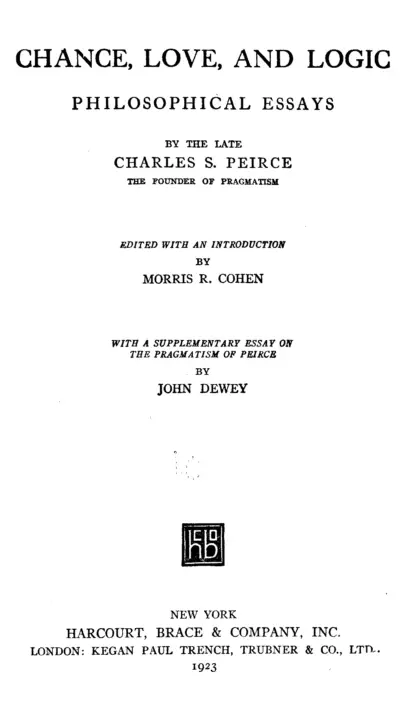
"Chance, Love, and Logic: Philosophical Essays" by Charles S. Peirce is a collection of philosophical essays written in the early 20th century. This work encompasses Peirce's thoughts on logic, science, and the intersection of chance and human experience, presenting a comprehensive view of his philosophical contributions that laid the groundwork for pragmatism. The essays delve into the nature of inquiry, belief, and the foundations of knowledge, highlighting the interconnectedness of chance and the role of love in understanding reality. The opening of this collection outlines Peirce's philosophical approach, emphasizing the importance of clear reasoning and the processes by which beliefs are formed and fixed. He critiques traditional methods of inquiry, such as reliance on authority or simple tenacity, advocating instead for a scientific approach that allows for the reconstruction of beliefs based on evidence and logical reasoning. Throughout this introduction, Peirce establishes the framework for examining how beliefs are maintained within a community, the role of inquiry in human cognition, and the necessity of a methodical approach to philosophy that embraces both uncertainty and the evolution of thought.
Introduction adapted from the source catalogue; source summaries may be automatically generated.
Free to read · English · 96,020 words · No account needed
MAKE TIME FOR A GOOD BOOK
On by default. Untick to stop anonymous reading totals. Each page counts after 10 seconds in view. How this works.
Anonymous counting is on unless you have switched it off.
When we have drawn any statistical induction—such, for instance, as that one-half of all births are of male children—it is always possible to discover, by investigation sufficiently prolonged, a class of which the same predicate may be affirmed universally; to find out, for instance, what sort of births are of male children. The truth of this principle follows immediately from the theorem that there is a character peculiar to every possible group of objects. The form in which the principle is usually stated is, that every event must have a cause.
But, though there exists a cause for every event, and that of a kind which is capable of being discovered, yet if there be nothing to guide us to the discovery; if we have to hunt among all the events in the world without any scent; if, for instance, the sex of a child might equally be supposed to depend on the configuration of the planets, on what was going on at the antipodes, or on anything else—then the discovery would have no chance of ever getting made.
That we ever do discover the precise causes of things, that any induction whatever is absolutely without exception, is what we have no right to assume. On the contrary, it is an easy corollary, from the theorem just referred to, that every empirical rule has an exception.[50] But there are certain of our inductions which present an approach to universality so extraordinary that, even if we are to suppose that they are not strictly universal truths, we cannot possibly think that they have been reached merely by accident. The most remarkable laws of this kind are those of time and space. With reference to space, Bishop Berkeley first showed, in a very conclusive manner, that it was not a thing seen, but a thing inferred. Berkeley chiefly insists on the impossibility of directly seeing the third dimension of space, since the retina of the eye is a surface. But, in point of fact, the retina is not even a surface; it is a conglomeration of nerve-needles directed toward the light and having only their extreme points sensitive, these points lying at considerable distances from one another compared with their areas. Now, of these points, certainly the excitation of no one singly can produce the perception of a surface, and consequently not the aggregate of all the sensations can amount to this. But certain relations subsist between the excitations of different nerve-points, and these constitute the premises upon which the hypothesis of space is founded, and from which it is inferred. That space is not immediately perceived is now universally admitted; and a mediate cognition is what is called an inference, and is subject to the criticism of logic. But what are we to say to the fact of every chicken as soon as it is hatched solving a problem whose data are of a complexity sufficient to try the greatest mathematical powers? It would be insane to deny that the tendency to light upon the conception of space is inborn in the mind of the chicken and of every animal. The same thing is equally true of time. That time is not directly perceived is evident, since no lapse of time is present, and we only perceive what is present. That, not having the idea of time, we should never be able to perceive the flow in our sensations without some particular aptitude for it, will probably also be admitted. The idea of force—at least, in its rudiments—is another conception so early arrived at, and found in animals so low in the scale of intelligence, that it must be supposed innate. But the innateness of an idea admits of degree, for it consists in the tendency of that idea to present itself to the mind. Some ideas, like that of space, do so present themselves irresistibly at the very dawn of intelligence, and take possession of the mind on small provocation, while of other conceptions we are prepossessed, indeed, but not so strongly, down a scale which is greatly extended. The tendency to personify every thing, and to attribute human characters to it, may be said to be innate; but it is a tendency which is very soon overcome by civilized man in regard to the greater part of the objects about him. Take such a conception as that of gravitation varying inversely as the square of the distance. It is a very simple law. But to say that it is simple is merely to say that it is one which the mind is particularly adapted to apprehend with facility. Suppose the idea of a quantity multiplied into another had been no more easy to the mind than that of a quantity raised to the power indicated by itself—should we ever have discovered the law of the solar system?
Your reading position is saved on this browser. Take it to another device with a library code. Reading pages adapt to text, rather than matching a printed edition.
BEHIND THE BOOK
This eBook is for the use of anyone anywhere in the United States and most other parts of the world at no cost and with almost no restrictions whatsoever. You may copy it, give it away or re-use it under the terms of the Project Gutenberg License included with this eBook or online at www.gutenberg.org. If you are not located in the United States, you will have to check the laws of the country where you are located before using this eBook. Read the source licence.
The original source file, including credits and licence, is retained by this library. Request an original-format copy at no charge. Please include the book title and Project Gutenberg identifier #65274.
KEEP YOUR CURIOSITY GOING
David Patterson (Spirit) Hatch

David Patterson (Spirit) Hatch

David Patterson (Spirit) Hatch
Coulson Kernahan

Ralph Waldo Emerson

Maurice Baring