
Last letters from the living dead man
David Patterson (Spirit) Hatch
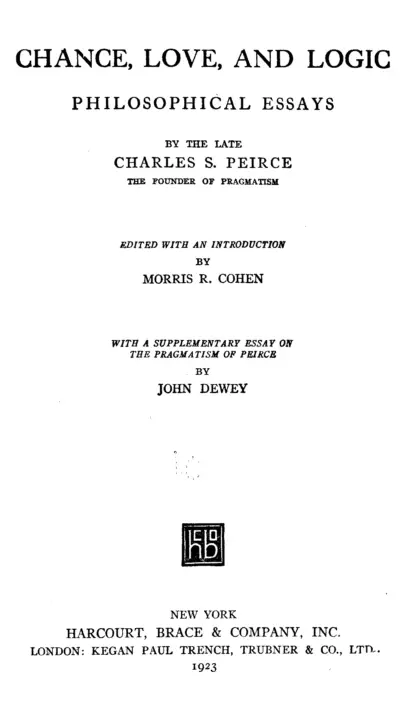
THE CLASSIC COLLECTION · 1923
"Chance, Love, and Logic: Philosophical Essays" by Charles S. Peirce is a collection of philosophical essays written in the early 20th century. This work encompasses Peirce's thoughts on logic, science, and the intersection of chance and human experience, presenting a comprehensive view of his philosophical contributions that laid the groundwork for pragmatism. The essays delve into the nature of inquiry, belief, and the foundations of knowledge, highlighting the interconnectedness of chance and the role of love in understanding reality. The opening of this collection outlines Peirce's philosophical approach, emphasizing the importance of clear reasoning and the processes by which beliefs are formed and fixed. He critiques traditional methods of inquiry, such as reliance on authority or simple tenacity, advocating instead for a scientific approach that allows for the reconstruction of beliefs based on evidence and logical reasoning. Throughout this introduction, Peirce establishes the framework for examining how beliefs are maintained within a community, the role of inquiry in human cognition, and the necessity of a methodical approach to philosophy that embraces both uncertainty and the evolution of thought.
Introduction adapted from the source catalogue; source summaries may be automatically generated.
Free to read · English · 96,020 words · No account needed
MAKE TIME FOR A GOOD BOOK
On by default. Untick to stop anonymous reading totals. Each page counts after 10 seconds in view. How this works.
Anonymous counting is on unless you have switched it off.
It is a common observation that a science first begins to be exact when it is quantitatively treated. What are called the exact sciences are no others than the mathematical ones. Chemists reasoned vaguely until Lavoisier showed them how to apply the balance to the verification of their theories, when chemistry leaped suddenly into the position of the most perfect of the classificatory sciences. It has thus become so precise and certain that we usually think of it along with optics, thermotics, and electrics. But these are studies of general laws, while chemistry considers merely the relations and classification of certain objects; and belongs, in reality, in the same category as systematic botany and zoölogy. Compare it with these last, however, and the advantage that it derives from its quantitative treatment is very evident.
The rudest numerical scales, such as that by which the mineralogists distinguish the different degrees of hardness, are found useful. The mere counting of pistils and stamens sufficed to bring botany out of total chaos into some kind of form. It is not, however, so much from counting as from measuring, not so much from the conception of number as from that of continuous quantity, that the advantage of mathematical treatment comes. Number, after all, only serves to pin us down to a precision in our thoughts which, however beneficial, can seldom lead to lofty conceptions, and frequently descends to pettiness. Of those two faculties of which Bacon speaks, that which marks differences and that which notes resemblances, the employment of number can only aid the lesser one; and the excessive use of it must tend to narrow the powers of the mind. But the conception of continuous quantity has a great office to fulfill, independently of any attempt at precision. Far from tending to the exaggeration of differences, it is the direct instrument of the finest generalizations. When a naturalist wishes to study a species, he collects a considerable number of specimens more or less similar. In contemplating them, he observes certain ones which are more or less alike in some particular respect. They all have, for instance, a certain S-shaped marking. He observes that they are not precisely alike, in this respect; the S has not precisely the same shape, but the differences are such as to lead him to believe that forms could be found intermediate between any two of those he possesses. He, now, finds other forms apparently quite dissimilar—say a marking in the form of a C—and the question is, whether he can find intermediate ones which will connect these latter with the others. This he often succeeds in doing in cases where it would at first be thought impossible; whereas he sometimes finds those which differ, at first glance, much less, to be separated in Nature by the non-occurrence of intermediaries. In this way, he builds up from the study of Nature a new general conception of the character in question. He obtains, for example, an idea of a leaf which includes every part of the flower, and an idea of a vertebra which includes the skull. I surely need not say much to show what a logical engine there is here. It is the essence of the method of the naturalist.[35] How he applies it first to one character, and then to another, and finally obtains a notion of a species of animals, the differences between whose members, however great, are confined within limits, is a matter which does not here concern us. The whole method of classification must be considered later; but, at present, I only desire to point out that it is by taking advantage of the idea of continuity, or the passage from one form to another by insensible degrees, that the naturalist builds his conceptions. Now, the naturalists are the great builders of conceptions; there is no other branch of science where so much of this work is done as in theirs; and we must, in great measure, take them for our teachers in this important part of logic. And it will be found everywhere that the idea of continuity is a powerful aid to the formation of true and fruitful conceptions. By means of it, the greatest differences are broken down and resolved into differences of degree, and the incessant application of it is of the greatest value in broadening our conceptions. I propose to make a great use of this idea in the present series of papers; and the particular series of important fallacies, which, arising from a neglect of it, have desolated philosophy, must further on be closely studied. At present, I simply call the reader’s attention to the utility of this conception.
Your reading position is saved on this browser. Take it to another device with a library code. Reading pages adapt to text, rather than matching a printed edition.
BEHIND THE BOOK
This eBook is for the use of anyone anywhere in the United States and most other parts of the world at no cost and with almost no restrictions whatsoever. You may copy it, give it away or re-use it under the terms of the Project Gutenberg License included with this eBook or online at www.gutenberg.org. If you are not located in the United States, you will have to check the laws of the country where you are located before using this eBook. Read the source licence.
The original source file, including credits and licence, is retained by this library. Request an original-format copy at no charge. Please include the book title and Project Gutenberg identifier #65274.
KEEP YOUR CURIOSITY GOING
David Patterson (Spirit) Hatch

David Patterson (Spirit) Hatch

David Patterson (Spirit) Hatch
Coulson Kernahan

Ralph Waldo Emerson

Maurice Baring