
Last letters from the living dead man
David Patterson (Spirit) Hatch
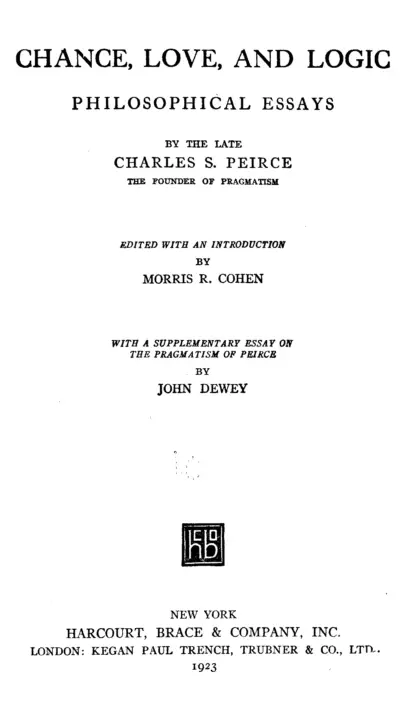
THE CLASSIC COLLECTION · 1923
"Chance, Love, and Logic: Philosophical Essays" by Charles S. Peirce is a collection of philosophical essays written in the early 20th century. This work encompasses Peirce's thoughts on logic, science, and the intersection of chance and human experience, presenting a comprehensive view of his philosophical contributions that laid the groundwork for pragmatism. The essays delve into the nature of inquiry, belief, and the foundations of knowledge, highlighting the interconnectedness of chance and the role of love in understanding reality. The opening of this collection outlines Peirce's philosophical approach, emphasizing the importance of clear reasoning and the processes by which beliefs are formed and fixed. He critiques traditional methods of inquiry, such as reliance on authority or simple tenacity, advocating instead for a scientific approach that allows for the reconstruction of beliefs based on evidence and logical reasoning. Throughout this introduction, Peirce establishes the framework for examining how beliefs are maintained within a community, the role of inquiry in human cognition, and the necessity of a methodical approach to philosophy that embraces both uncertainty and the evolution of thought.
Introduction adapted from the source catalogue; source summaries may be automatically generated.
Free to read · English · 96,020 words · No account needed
MAKE TIME FOR A GOOD BOOK
On by default. Untick to stop anonymous reading totals. Each page counts after 10 seconds in view. How this works.
Anonymous counting is on unless you have switched it off.
Let us now approach the subject of logic, and consider a conception which particularly concerns it, that of reality. Taking clearness in the sense of familiarity, no idea could be clearer than this. Every child uses it with perfect confidence, never dreaming that he does not understand it. As for clearness in its second grade, however, it would probably puzzle most men, even among those of a reflective turn of mind, to give an abstract definition of the real. Yet such a definition may perhaps be reached by considering the points of difference between reality and its opposite, fiction. A figment is a product of somebody’s imagination; it has such characters as his thought impresses upon it. That those characters are independent of how you or I think is an external reality. There are, however, phenomena within our own minds, dependent upon our thought, which are at the same time real in the sense that we really think them. But though their characters depend on how we think, they do not depend on what we think those characters to be. Thus, a dream has a real existence as a mental phenomenon, if somebody has really dreamt it; that he dreamt so and so, does not depend on what anybody thinks was dreamt, but is completely independent of all opinion on the subject. On the other hand, considering, not the fact of dreaming, but the thing dreamt, it retains its peculiarities by virtue of no other fact than that it was dreamt to possess them. Thus we may define the real as that whose characters are independent of what anybody may think them to be.
But, however satisfactory such a definition may be found, it would be a great mistake to suppose that it makes the idea of reality perfectly clear. Here, then, let us apply our rules. According to them, reality, like every other quality, consists in the peculiar sensible effects which things partaking of it produce. The only effect which real things have is to cause belief, for all the sensations which they excite emerge into consciousness in the form of beliefs. The question, therefore, is, how is true belief (or belief in the real) distinguished from false belief (or belief in fiction). Now, as we have seen in the former paper, the ideas of truth and falsehood, in their full development, appertain exclusively to the scientific method of settling opinion. A person who arbitrarily chooses the propositions which he will adopt can use the word truth only to emphasize the expression of his determination to hold on to his choice. Of course, the method of tenacity never prevailed exclusively; reason is too natural to men for that. But in the literature of the dark ages we find some fine examples of it. When Scotus Erigena is commenting upon a poetical passage in which hellebore is spoken of as having caused the death of Socrates, he does not hesitate to inform the inquiring reader that Helleborus and Socrates were two eminent Greek philosophers, and that the latter having been overcome in argument by the former took the matter to heart and died of it! What sort of an idea of truth could a man have who could adopt and teach, without the qualification of a perhaps, an opinion taken so entirely at random? The real spirit of Socrates, who I hope would have been delighted to have been “overcome in argument,” because he would have learned something by it, is in curious contrast with the naïve idea of the glossist, for whom discussion would seem to have been simply a struggle. When philosophy began to awake from its long slumber, and before theology completely dominated it, the practice seems to have been for each professor to seize upon any philosophical position he found unoccupied and which seemed a strong one, to intrench himself in it, and to sally forth from time to time to give battle to the others. Thus, even the scanty records we possess of those disputes enable us to make out a dozen or more opinions held by different teachers at one time concerning the question of nominalism and realism. Read the opening part of the Historia Calamitatum of Abelard, who was certainly as philosophical as any of his contemporaries, and see the spirit of combat which it breathes. For him, the truth is simply his particular stronghold. When the method of authority prevailed, the truth meant little more than the Catholic faith. All the efforts of the scholastic doctors are directed toward harmonizing their faith in Aristotle and their faith in the Church, and one may search their ponderous folios through without finding an argument which goes any further. It is noticeable that where different faiths flourish side by side, renegades are looked upon with contempt even by the party whose belief they adopt; so completely has the idea of loyalty replaced that of truth-seeking. Since the time of Descartes, the defect in the conception of truth has been less apparent. Still, it will sometimes strike a scientific man that the philosophers have been less intent on finding out what the facts are, than on inquiring what belief is most in harmony with their system. It is hard to convince a follower of the a priori method by adducing facts; but show him that an opinion he is defending is inconsistent with what he has laid down elsewhere, and he will be very apt to retract it. These minds do not seem to believe that disputation is ever to cease; they seem to think that the opinion which is natural for one man is not so for another, and that belief will, consequently, never be settled. In contenting themselves with fixing their own opinions by a method which would lead another man to a different result, they betray their feeble hold of the conception of what truth is.
Your reading position is saved on this browser. Take it to another device with a library code. Reading pages adapt to text, rather than matching a printed edition.
BEHIND THE BOOK
This eBook is for the use of anyone anywhere in the United States and most other parts of the world at no cost and with almost no restrictions whatsoever. You may copy it, give it away or re-use it under the terms of the Project Gutenberg License included with this eBook or online at www.gutenberg.org. If you are not located in the United States, you will have to check the laws of the country where you are located before using this eBook. Read the source licence.
The original source file, including credits and licence, is retained by this library. Request an original-format copy at no charge. Please include the book title and Project Gutenberg identifier #65274.
KEEP YOUR CURIOSITY GOING
David Patterson (Spirit) Hatch

David Patterson (Spirit) Hatch

David Patterson (Spirit) Hatch
Coulson Kernahan

Ralph Waldo Emerson

Maurice Baring