
Last letters from the living dead man
David Patterson (Spirit) Hatch
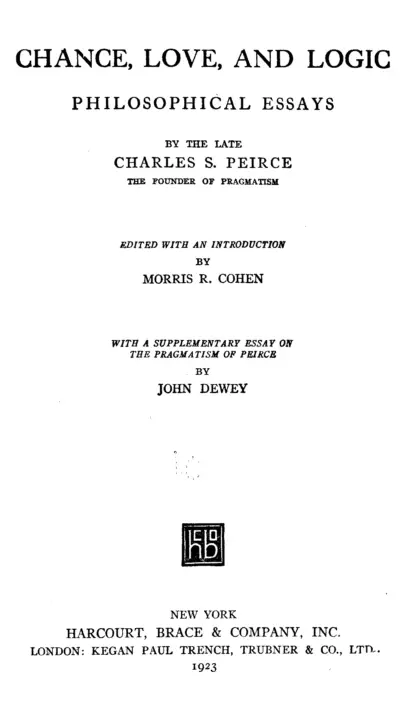
THE CLASSIC COLLECTION · 1923
"Chance, Love, and Logic: Philosophical Essays" by Charles S. Peirce is a collection of philosophical essays written in the early 20th century. This work encompasses Peirce's thoughts on logic, science, and the intersection of chance and human experience, presenting a comprehensive view of his philosophical contributions that laid the groundwork for pragmatism. The essays delve into the nature of inquiry, belief, and the foundations of knowledge, highlighting the interconnectedness of chance and the role of love in understanding reality. The opening of this collection outlines Peirce's philosophical approach, emphasizing the importance of clear reasoning and the processes by which beliefs are formed and fixed. He critiques traditional methods of inquiry, such as reliance on authority or simple tenacity, advocating instead for a scientific approach that allows for the reconstruction of beliefs based on evidence and logical reasoning. Throughout this introduction, Peirce establishes the framework for examining how beliefs are maintained within a community, the role of inquiry in human cognition, and the necessity of a methodical approach to philosophy that embraces both uncertainty and the evolution of thought.
Introduction adapted from the source catalogue; source summaries may be automatically generated.
Free to read · English · 96,020 words · No account needed
MAKE TIME FOR A GOOD BOOK
On by default. Untick to stop anonymous reading totals. Each page counts after 10 seconds in view. How this works.
Anonymous counting is on unless you have switched it off.
A. Five Papers on Logic, read before the American Academy of Arts and Sciences. Published in the Proceedings of the Academy, Vol. 7 (1867).
1. “On an Improvement in Boole’s Calculus of Logic,” pp. 250-261. (Suggests improvements in Boole’s logic, especially in the representation of particular propositions. The association of probability with the notion of relative frequency became a leading idea of Peirce’s thought.)
2. “On the Natural Classification of Arguments,” pp. 261-287. (A suggestive distinction between the leading principle and the premise of an argument. Contains also an interesting note (pp. 283-284) denying the positivistic maxim that, “no hypothesis is admissible which is not capable of verification by direct observation.”)
3. “On a New List of Categories,” pp. 287-298. The categories are: Being, Quality (Reference to a Ground), Relation (Reference to a Correlate), Representation (Reference to an Interpretant), Substance. “Logic has for its subject-genus all symbols and not merely concepts.” Symbols include terms, propositions, and arguments.
4. “Upon the Logic of Mathematics,” pp. 402-412. “There are certain general propositions from which the truths of mathematics follow syllogistically.”
5. “Upon Logical Comprehension and Extension,” pp. 416-432. (Interesting historical references to the use of these terms and an attack on the supposed rule as to their inverse proportionality.)
B. “Description of a Notation for the Logic of Relations,” in Memoires of the American Academy, Vol. 9 (1870), pp. 317-378. (Shows the relation of inclusion between classes to be more fundamental than Boole’s use of equality. Extends the Booleian calculus to DeMorgan’s logic of relative terms.)
C. “On the Algebra of Logic,” American Journal of Mathematics, Vol. 3 (1880), pp. 15-57. (Referred to by Schroeder as Peirce’s Hauptwerk in “Vorlesungen über die Algebra der Logik,” Vol. 1., p. 107.)
D. “On the Logic of Number,” American Journal of Mathematics, Vol. 4 (1881), pp. 85-95.
E. “Brief Description of the Algebra of Relatives,” Reprinted from
??, pp. 1-6.
F. “On the Algebra of Logic: A Contribution to the Philosophy of Notation,” American Journal of Mathematics, Vol. 7 (1884), pp. 180-202.
G. “A Theory of Probable Inference” and notes “On a Limited Universe of Marks” and on the “Logic of Relatives” in “Studies in Logic by members of the Johns Hopkins University,” Boston, 1883, pp. 126-203.
H. “The Regenerated Logic,” Monist, Vol. 7, pp. 19-40.
“The Logic of Relatives,” Monist, Vol. 7, pp. 161-217. (An elaborate development of his own logic of relatives, by way of review of Schroeder’s book.)
I. Miscellaneous Notes, etc.
1. Review of Venn’s “Logic of Chance,” North American Review,
July, 1867.
2. “On the Application of Logical Analysis to Multiple Algebra,” Proceedings of the American Academy, Vol. 10 (1875), pp. 392-394.
3. “Note on Grassman’s ‘Calculus of Extension,’” Proceedings of the American Academy, Vol. 13 (1878), pp. 115-116.
Your reading position is saved on this browser. Take it to another device with a library code. Reading pages adapt to text, rather than matching a printed edition.
BEHIND THE BOOK
This eBook is for the use of anyone anywhere in the United States and most other parts of the world at no cost and with almost no restrictions whatsoever. You may copy it, give it away or re-use it under the terms of the Project Gutenberg License included with this eBook or online at www.gutenberg.org. If you are not located in the United States, you will have to check the laws of the country where you are located before using this eBook. Read the source licence.
The original source file, including credits and licence, is retained by this library. Request an original-format copy at no charge. Please include the book title and Project Gutenberg identifier #65274.
KEEP YOUR CURIOSITY GOING
David Patterson (Spirit) Hatch

David Patterson (Spirit) Hatch

David Patterson (Spirit) Hatch
Coulson Kernahan

Ralph Waldo Emerson

Maurice Baring