
Last letters from the living dead man
David Patterson (Spirit) Hatch
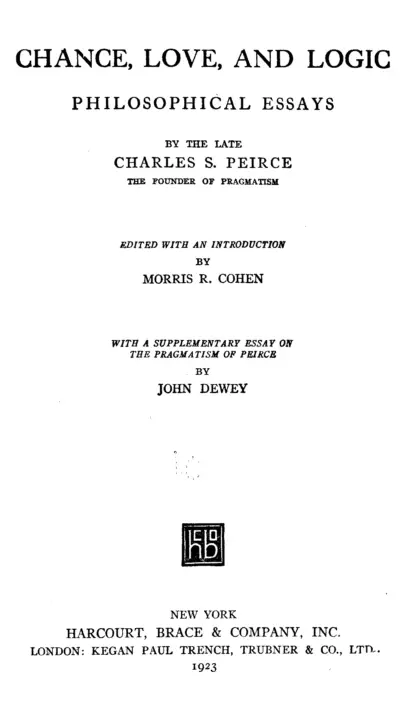
THE CLASSIC COLLECTION · 1923
"Chance, Love, and Logic: Philosophical Essays" by Charles S. Peirce is a collection of philosophical essays written in the early 20th century. This work encompasses Peirce's thoughts on logic, science, and the intersection of chance and human experience, presenting a comprehensive view of his philosophical contributions that laid the groundwork for pragmatism. The essays delve into the nature of inquiry, belief, and the foundations of knowledge, highlighting the interconnectedness of chance and the role of love in understanding reality. The opening of this collection outlines Peirce's philosophical approach, emphasizing the importance of clear reasoning and the processes by which beliefs are formed and fixed. He critiques traditional methods of inquiry, such as reliance on authority or simple tenacity, advocating instead for a scientific approach that allows for the reconstruction of beliefs based on evidence and logical reasoning. Throughout this introduction, Peirce establishes the framework for examining how beliefs are maintained within a community, the role of inquiry in human cognition, and the necessity of a methodical approach to philosophy that embraces both uncertainty and the evolution of thought.
Introduction adapted from the source catalogue; source summaries may be automatically generated.
Free to read · English · 96,020 words · No account needed
MAKE TIME FOR A GOOD BOOK
On by default. Untick to stop anonymous reading totals. Each page counts after 10 seconds in view. How this works.
Anonymous counting is on unless you have switched it off.
7. “Methods and Results. A Catalogue of Stars for Observations of Latitude.” Washington. 1879.
8. “On the Ghosts in Rutherford’s ‘Diffraction Spectra,’” American Journal of Mathematics, Vol. 2 (1879), pp. 330-347.
9. “Note on a Comparison of a Wave-Length with a Meter,” American Journal of Science, Vol. 18 (1879), p. 51.
10. “A Quincuncial Projection of the Sphere,” American Journal of Mathematics, Vol. 2 (1879), pp. 394, 396.
11. “Numerical Measure of Success of Predictions,” Science, Vol. 4
(1884), p. 453.
12. “Proceedings Assay Commission” Washington, 1888. (Joint Reports
on Weighing.)
B. Geodetic Researches. The Pendulum.
1. “Measurement of Gravity at Initial Stations in America and Europe,” Report of the U. S. Coast Survey, 1876, pp. 202-237 and 410-416.
2. “De l’influence de la flexibilité du trépied sur l’oscillation du pendule a réversion,” Conférence Geodesique Internationale (1877) Comptes Rendus, Berlin, 1878, pp. 171-187. (This paper was introduced by Plantamour and was followed by the notes of Appolzer.)
3. “On the Influence of Internal Friction upon the Correction of the Length of the Second’s Pendulum,” Proceedings of the American Academy, Vol. 13 (1878), pp. 396-401.
4. “On a Method of Swinging Pendulums for the Determination of Gravity proposed by M. Faye,” American Journal of Science, Vol. 18 (1879), pp. 112-119.
5. “Results of Pendulum Experiments,” American Journal of Science,
Vol. 20 (1880).
6. “Flexure of Pendulum Supports,” Report of the U. S. Coast Survey, 1881, pp. 359-441.
7. “On the Deduction of the Ellipticity of the Earth from the Pendulum Experiment,” Report of the U. S. Coast Survey, 1881, pp. 442-456.
8. “Determinations of Gravity at Stations in Pennsylvania,” Report of U. S. Coast Survey, 1883, Appendix 19 and pp. 473-486.
9. “On the Use of the Noddy,” Report of the U. S. Coast Survey,
1884, pp. 475-482.
10. “Effect of the Flexure of a Pendulum upon the Period of Oscillation,” Report of the U. S. Coast Survey, 1884, pp. 483-485.
11. “On the Influence of a Noddy, and of Unequal Temperature upon the Periods of a Pendulum,” Report of the U. S. Coast and Geodetic Survey for 1885, pp. 509-512.
C. Psychologic. “On Small Differences in Sensation” (in cooperation with J. Jastrow), National Academy of Sciences, Vol. 3 (1884), pp. 1-11.
Your reading position is saved on this browser. Take it to another device with a library code. Reading pages adapt to text, rather than matching a printed edition.
BEHIND THE BOOK
This eBook is for the use of anyone anywhere in the United States and most other parts of the world at no cost and with almost no restrictions whatsoever. You may copy it, give it away or re-use it under the terms of the Project Gutenberg License included with this eBook or online at www.gutenberg.org. If you are not located in the United States, you will have to check the laws of the country where you are located before using this eBook. Read the source licence.
The original source file, including credits and licence, is retained by this library. Request an original-format copy at no charge. Please include the book title and Project Gutenberg identifier #65274.
KEEP YOUR CURIOSITY GOING
David Patterson (Spirit) Hatch

David Patterson (Spirit) Hatch

David Patterson (Spirit) Hatch
Coulson Kernahan

Ralph Waldo Emerson

Maurice Baring