
Last letters from the living dead man
David Patterson (Spirit) Hatch
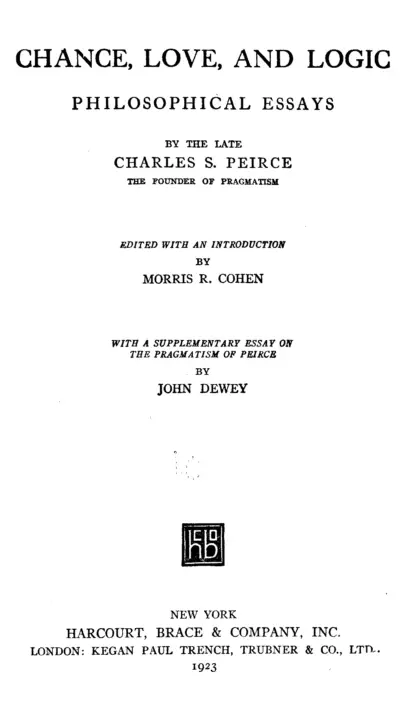
THE CLASSIC COLLECTION · 1923
"Chance, Love, and Logic: Philosophical Essays" by Charles S. Peirce is a collection of philosophical essays written in the early 20th century. This work encompasses Peirce's thoughts on logic, science, and the intersection of chance and human experience, presenting a comprehensive view of his philosophical contributions that laid the groundwork for pragmatism. The essays delve into the nature of inquiry, belief, and the foundations of knowledge, highlighting the interconnectedness of chance and the role of love in understanding reality. The opening of this collection outlines Peirce's philosophical approach, emphasizing the importance of clear reasoning and the processes by which beliefs are formed and fixed. He critiques traditional methods of inquiry, such as reliance on authority or simple tenacity, advocating instead for a scientific approach that allows for the reconstruction of beliefs based on evidence and logical reasoning. Throughout this introduction, Peirce establishes the framework for examining how beliefs are maintained within a community, the role of inquiry in human cognition, and the necessity of a methodical approach to philosophy that embraces both uncertainty and the evolution of thought.
Introduction adapted from the source catalogue; source summaries may be automatically generated.
Free to read · English · 96,020 words · No account needed
MAKE TIME FOR A GOOD BOOK
On by default. Untick to stop anonymous reading totals. Each page counts after 10 seconds in view. How this works.
Anonymous counting is on unless you have switched it off.
Suppose, now, that, in reference to any question, both give the same answer. Then (the questions being always such as are to be answered by yes or no), those in reference to which their answers agree are the same as those which both answer correctly together with those which both answer falsely, or 93/100 x 81/100 + 7/100 x 19/100 of all. The proportion of those which both answer correctly out of those their answers to which agree is, therefore—
((93 × 81)/(100 × 100))/((93 × 81)/(100 × 100)) + ((7 × 19)/(100 × 100)) or (93 × 81)/((93 × 81) + (7 × 19)).
This is, therefore, the probability that, if both modes of inference yield the same result, that result is correct. We may here conveniently make use of another mode of expression. Probability is the ratio of the favorable cases to all the cases. Instead of expressing our result in terms of this ratio, we may make use of another—the ratio of favorable to unfavorable cases. This last ratio may be called the chance of an event. Then the chance of a true answer by the first mode of inference is 81/19 and by the second is 93/7; and the chance of a correct answer from both, when they agree, is—
(81 × 93)/(19 × 7) or 81/19 × 93/7,
or the product of the chances of each singly yielding a true answer.
It will be seen that a chance is a quantity which may have any magnitude, however great. An event in whose favor there is an even chance, or 1/1, has a probability of 1/2. An argument having an even chance can do nothing toward re-enforcing others, since according to the rule its combination with another would only multiply the chance of the latter by 1.
Probability and chance undoubtedly belong primarily to consequences, and are relative to premises; but we may, nevertheless, speak of the chance of an event absolutely, meaning by that the chance of the combination of all arguments in reference to it which exist for us in the given state of our knowledge. Taken in this sense it is incontestable that the chance of an event has an intimate connection with the degree of our belief in it. Belief is certainly something more than a mere feeling; yet there is a feeling of believing, and this feeling does and ought to vary with the chance of the thing believed, as deduced from all the arguments. Any quantity which varies with the chance might, therefore, it would seem, serve as a thermometer for the proper intensity of belief. Among all such quantities there is one which is peculiarly appropriate. When there is a very great chance, the feeling of belief ought to be very intense. Absolute certainty, or an infinite chance, can never be attained by mortals, and this may be represented appropriately by an infinite belief. As the chance diminishes the feeling of believing should diminish, until an even chance is reached, where it should completely vanish and not incline either toward or away from the proposition. When the chance becomes less, then a contrary belief should spring up and should increase in intensity as the chance diminishes, and as the chance almost vanishes (which it can never quite do) the contrary belief should tend toward an infinite intensity. Now, there is one quantity which, more simply than any other, fulfills these conditions; it is the logarithm of the chance. But there is another consideration which must, if admitted, fix us to this choice for our thermometer. It is that our belief ought to be proportional to the weight of evidence, in this sense, that two arguments which are entirely independent, neither weakening nor strengthening each other, ought, when they concur, to produce a belief equal to the sum of the intensities of belief which either would produce separately. Now, we have seen that the chances of independent concurrent arguments are to be multiplied together to get the chance of their combination, and, therefore, the quantities which best express the intensities of belief should be such that they are to be added when the chances are multiplied in order to produce the quantity which corresponds to the combined chance. Now, the logarithm is the only quantity which fulfills this condition. There is a general law of sensibility, called Fechner’s psychophysical law. It is that the intensity of any sensation is proportional to the logarithm of the external force which produces it. It is entirely in harmony with this law that the feeling of belief should be as the logarithm of the chance, this latter being the expression of the state of facts which produces the belief.
Your reading position is saved on this browser. Take it to another device with a library code. Reading pages adapt to text, rather than matching a printed edition.
BEHIND THE BOOK
This eBook is for the use of anyone anywhere in the United States and most other parts of the world at no cost and with almost no restrictions whatsoever. You may copy it, give it away or re-use it under the terms of the Project Gutenberg License included with this eBook or online at www.gutenberg.org. If you are not located in the United States, you will have to check the laws of the country where you are located before using this eBook. Read the source licence.
The original source file, including credits and licence, is retained by this library. Request an original-format copy at no charge. Please include the book title and Project Gutenberg identifier #65274.
KEEP YOUR CURIOSITY GOING
David Patterson (Spirit) Hatch

David Patterson (Spirit) Hatch

David Patterson (Spirit) Hatch
Coulson Kernahan

Ralph Waldo Emerson

Maurice Baring