
Last letters from the living dead man
David Patterson (Spirit) Hatch
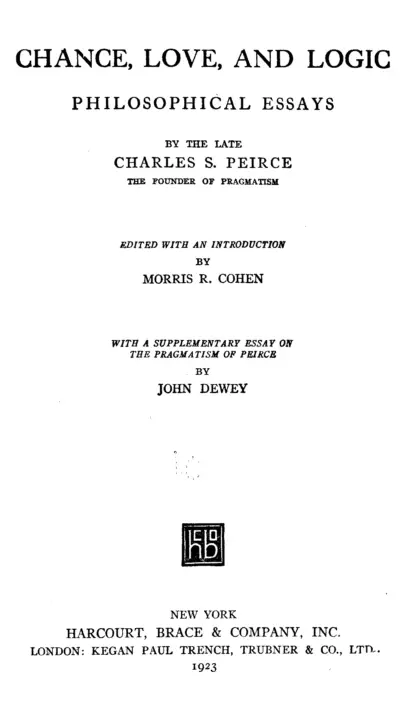
THE CLASSIC COLLECTION · 1923
"Chance, Love, and Logic: Philosophical Essays" by Charles S. Peirce is a collection of philosophical essays written in the early 20th century. This work encompasses Peirce's thoughts on logic, science, and the intersection of chance and human experience, presenting a comprehensive view of his philosophical contributions that laid the groundwork for pragmatism. The essays delve into the nature of inquiry, belief, and the foundations of knowledge, highlighting the interconnectedness of chance and the role of love in understanding reality. The opening of this collection outlines Peirce's philosophical approach, emphasizing the importance of clear reasoning and the processes by which beliefs are formed and fixed. He critiques traditional methods of inquiry, such as reliance on authority or simple tenacity, advocating instead for a scientific approach that allows for the reconstruction of beliefs based on evidence and logical reasoning. Throughout this introduction, Peirce establishes the framework for examining how beliefs are maintained within a community, the role of inquiry in human cognition, and the necessity of a methodical approach to philosophy that embraces both uncertainty and the evolution of thought.
Introduction adapted from the source catalogue; source summaries may be automatically generated.
Free to read · English · 96,020 words · No account needed
MAKE TIME FOR A GOOD BOOK
On by default. Untick to stop anonymous reading totals. Each page counts after 10 seconds in view. How this works.
Anonymous counting is on unless you have switched it off.
Students of the history of mind there be of an erudition to fill an imperfect scholar like me with envy edulcorated by joyous admiration, who maintain that ideas when just started are and can be little more than freaks, since they cannot yet have been critically examined, and further that everywhere and at all times progress has been so gradual that it is difficult to make out distinctly what original step any given man has taken. It would follow that tychasm has been the sole method of intellectual development. I have to confess I cannot read history so; I cannot help thinking that while tychasm has sometimes been operative, at others great steps covering nearly the same ground and made by different men independently, have been mistaken for a succession of small steps, and further that students have been reluctant to admit a real entitative “spirit” of an age or of a people, under the mistaken and unscrutinized impression that they should thus be opening the door to wild and unnatural hypotheses. I find, on the contrary, that, however it may be with the education of individual minds, the historical development of thought has seldom been of a tychastic nature, and exclusively in backward and barbarizing movements. I desire to speak with the extreme modesty which befits a student of logic who is required to survey so very wide a field of human thought that he can cover it only by a reconnaissance, to which only the greatest skill and most adroit methods can impart any value at all; but, after all, I can only express my own opinions and not those of anybody else; and in my humble judgment, the largest example of tychasm is afforded by the history of Christianity, from about its establishment by Constantine, to, say, the time of the Irish monasteries, an era or eon of about 500 years. Undoubtedly the external circumstance which more than all others at first inclined men to accept Christianity in its loveliness and tenderness, was the fearful extent to which society was broken up into units by the unmitigated greed and hard-heartedness into which the Romans had seduced the world. And yet it was that very same fact, more than any other external circumstance, that fostered that bitterness against the wicked world of which the primitive gospel of Mark contains not a single trace. At least, I do not detect it in the remark about the blasphemy against the Holy Ghost, where nothing is said about vengeance, nor even in that speech where the closing lines of Isaiah are quoted, about the worm and the fire that feed upon the “carcasses of the men that have transgressed against me.” But little by little the bitterness increases until in the last book of the New Testament, its poor distracted author represents that all the time Christ was talking about having come to save the world, the secret design was to catch the entire human race, with the exception of a paltry 144,000, and souse them all in a brimstone lake, and as the smoke of their torment went up forever and ever, to turn and remark, “There is no curse any more.” Would it be an insensible smirk or a fiendish grin that should accompany such an utterance? I wish I could believe St. John did not write it; but it is his gospel which tells about the “resurrection unto condemnation,”—that is of men’s being resuscitated just for the sake of torturing them;—and, at any rate, the Revelation is a very ancient composition. One can understand that the early Christians were like men trying with all their might to climb a steep declivity of smooth wet clay; the deepest and truest element of their life, animating both heart and head, was universal love; but they were continually, and against their wills, slipping into a party spirit, every slip serving as a precedent, in a fashion but too familiar to every man. This party feeling insensibily grew until by about A.D. 330 the luster of the pristine integrity that in St. Mark reflects the white spirit of light was so far tarnished that Eusebius, (the Jared Sparks of that day), in the preface to his History, could announce his intention of exaggerating everything that tended to the glory of the church and of suppressing whatever might disgrace it. His Latin contemporary Lactantius is worse, still; and so the darkling went on increasing until before the end of the century the great library of Alexandria was destroyed by Theophilus,[75] until Gregory the Great, two centuries later, burnt the great library of Rome, proclaiming that “Ignorance is the mother of devotion,” (which is true, just as oppression and injustice is the mother of spirituality), until a sober description of the state of the church would be a thing our not too nice newspapers would treat as “unfit for publication.” All this movement is shown by the application of the test given above to have been tychastic. Another very much like it on a small scale, only a hundred times swifter, for the study of which there are documents by the library-full, is to be found in the history of the French Revolution.
Your reading position is saved on this browser. Take it to another device with a library code. Reading pages adapt to text, rather than matching a printed edition.
BEHIND THE BOOK
This eBook is for the use of anyone anywhere in the United States and most other parts of the world at no cost and with almost no restrictions whatsoever. You may copy it, give it away or re-use it under the terms of the Project Gutenberg License included with this eBook or online at www.gutenberg.org. If you are not located in the United States, you will have to check the laws of the country where you are located before using this eBook. Read the source licence.
The original source file, including credits and licence, is retained by this library. Request an original-format copy at no charge. Please include the book title and Project Gutenberg identifier #65274.
KEEP YOUR CURIOSITY GOING
David Patterson (Spirit) Hatch

David Patterson (Spirit) Hatch

David Patterson (Spirit) Hatch
Coulson Kernahan

Ralph Waldo Emerson

Maurice Baring