
Last letters from the living dead man
David Patterson (Spirit) Hatch
THE CLASSIC COLLECTION · 1923
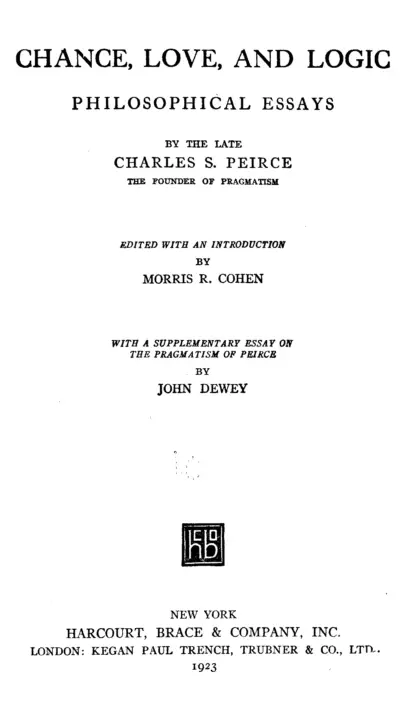
"Chance, Love, and Logic: Philosophical Essays" by Charles S. Peirce is a collection of philosophical essays written in the early 20th century. This work encompasses Peirce's thoughts on logic, science, and the intersection of chance and human experience, presenting a comprehensive view of his philosophical contributions that laid the groundwork for pragmatism. The essays delve into the nature of inquiry, belief, and the foundations of knowledge, highlighting the interconnectedness of chance and the role of love in understanding reality. The opening of this collection outlines Peirce's philosophical approach, emphasizing the importance of clear reasoning and the processes by which beliefs are formed and fixed. He critiques traditional methods of inquiry, such as reliance on authority or simple tenacity, advocating instead for a scientific approach that allows for the reconstruction of beliefs based on evidence and logical reasoning. Throughout this introduction, Peirce establishes the framework for examining how beliefs are maintained within a community, the role of inquiry in human cognition, and the necessity of a methodical approach to philosophy that embraces both uncertainty and the evolution of thought.
Introduction adapted from the source catalogue; source summaries may be automatically generated.
Free to read · English · 96,020 words · No account needed
MAKE TIME FOR A GOOD BOOK
On by default. Untick to stop anonymous reading totals. Each page counts after 10 seconds in view. How this works.
Anonymous counting is on unless you have switched it off.
Much is to be said on both sides. I have not concealed, I could not conceal, my own passionate predilection. Such a confession will probably shock my scientific brethren. Yet the strong feeling is in itself, I think, an argument of some weight in favor of the agapastic theory of evolution,—so far as it may be presumed to bespeak the normal judgment of the Sensible Heart. Certainly, if it were possible to believe in agapasm without believing it warmly, that fact would be an argument against the truth of the doctrine. At any rate, since the warmth of feeling exists, it should on every account be candidly confessed; especially since it creates a liability to onesidedness on my part against which it behooves my readers and me to be severally on our guard.
Let us try to define the logical affinities of the different theories of evolution. Natural selection, as conceived by Darwin, is a mode of evolution in which the only positive agent of change in the whole passage from moner to man is fortuitous variation. To secure advance in a definite direction chance has to be seconded by some action that shall hinder the propagation of some varieties or stimulate that of others. In natural selection, strictly so called, it is the crowding out of the weak. In sexual selection, it is the attraction of beauty, mainly.
The Origin of Species was published toward the end of the year 1859. The preceding years since 1846 had been one of the most productive seasons,—or if extended so as to cover the great book we are considering, the most productive period of equal length in the entire history of science from its beginnings until now. The idea that chance begets order, which is one of the corner-stones of modern physics (although Dr. Carus considers it “the weakest point in Mr. Peirce’s system,”) was at that time put into its clearest light. Quetelet had opened the discussion by his Letters on the Application of Probabilities to the Moral and Political Sciences, a work which deeply impressed the best minds of that day, and to which Sir John Herschel had drawn general attention in Great Britain. In 1857, the first volume of Buckle’s History of Civilisation had created a tremendous sensation, owing to the use he made of this same idea. Meantime, the “statistical method” had, under that very name, been applied with brilliant success to molecular physics. Dr. John Herapath, an English chemist, had in 1847 outlined the kinetical theory of gases in his Mathematical Physics; and the interest the theory excited had been refreshed in 1856 by notable memoirs by Clausius and Krönig. In the very summer preceding Darwin’s publication, Maxwell had read before the British Association the first and most important of his researches on this subject. The consequence was that the idea that fortuitous events may result in a physical law, and further that this is the way in which those laws which appear to conflict with the principle of the conservation of energy are to be explained, had taken a strong hold upon the minds of all who were abreast of the leaders of thought. By such minds, it was inevitable that the Origin of Species, whose teaching was simply the application of the same principle to the explanation of another “non-conservative” action, that of organic development, should be hailed and welcomed. The sublime discovery of the conservation of energy by Helmholtz in 1847, and that of the mechanical theory of heat by Clausius and by Rankine, independently, in 1850, had decidedly overawed all those who might have been inclined to sneer at physical science. Thereafter a belated poet still harping upon “science peddling with the names of things” would fail of his effect. Mechanism was now known to be all, or very nearly so. All this time, utilitarianism,—that improved substitute for the Gospel,—was in its fullest feather; and was a natural ally of an individualistic theory. Dean Mansell’s injudicious advocacy had led to mutiny among the bondsmen of Sir William Hamilton, and the nominalism of Mill had profited accordingly; and although the real science that Darwin was leading men to was sure some day to give a death-blow to the sham-science of Mill, yet there were several elements of the Darwinian theory which were sure to charm the followers of Mill. Another thing: anæsthetics had been in use for thirteen years. Already, people’s acquaintance with suffering had dropped off very much; and as a consequence, that unlovely hardness by which our times are so contrasted with those that immediately preceded them, had already set in, and inclined people to relish a ruthless theory. The reader would quite mistake the drift of what I am saying if he were to understand me as wishing to suggest that any of those things (except perhaps Malthus) influenced Darwin himself. What I mean is that his hypothesis, while without dispute one of the most ingenious and pretty ever devised, and while argued with a wealth of knowledge, a strength of logic, a charm of rhetoric, and above all with a certain magnetic genuineness that was almost irresistible, did not appear, at first, at all near to being proved; and to a sober mind its case looks less hopeful now than it did twenty years ago; but the extraordinarily favorable reception it met with was plainly owing, in large measure, to its ideas being those toward which the age was favorably disposed, especially, because of the encouragement it gave to the greed-philosophy.
Your reading position is saved on this browser. Take it to another device with a library code. Reading pages adapt to text, rather than matching a printed edition.
BEHIND THE BOOK
This eBook is for the use of anyone anywhere in the United States and most other parts of the world at no cost and with almost no restrictions whatsoever. You may copy it, give it away or re-use it under the terms of the Project Gutenberg License included with this eBook or online at www.gutenberg.org. If you are not located in the United States, you will have to check the laws of the country where you are located before using this eBook. Read the source licence.
The original source file, including credits and licence, is retained by this library. Request an original-format copy at no charge. Please include the book title and Project Gutenberg identifier #65274.
KEEP YOUR CURIOSITY GOING
David Patterson (Spirit) Hatch

David Patterson (Spirit) Hatch

David Patterson (Spirit) Hatch
Coulson Kernahan

Ralph Waldo Emerson

Maurice Baring