
Last letters from the living dead man
David Patterson (Spirit) Hatch
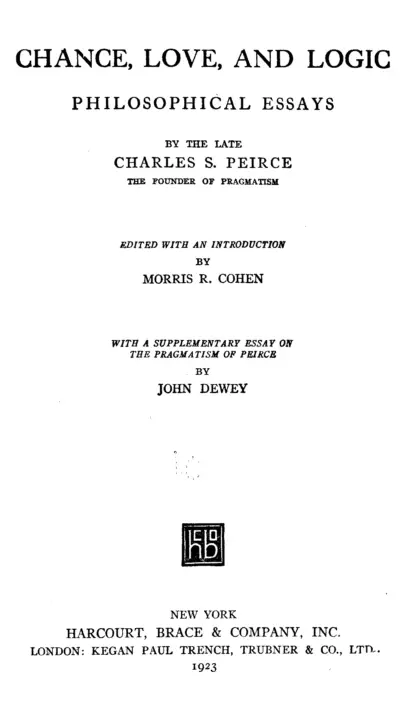
THE CLASSIC COLLECTION · 1923
"Chance, Love, and Logic: Philosophical Essays" by Charles S. Peirce is a collection of philosophical essays written in the early 20th century. This work encompasses Peirce's thoughts on logic, science, and the intersection of chance and human experience, presenting a comprehensive view of his philosophical contributions that laid the groundwork for pragmatism. The essays delve into the nature of inquiry, belief, and the foundations of knowledge, highlighting the interconnectedness of chance and the role of love in understanding reality. The opening of this collection outlines Peirce's philosophical approach, emphasizing the importance of clear reasoning and the processes by which beliefs are formed and fixed. He critiques traditional methods of inquiry, such as reliance on authority or simple tenacity, advocating instead for a scientific approach that allows for the reconstruction of beliefs based on evidence and logical reasoning. Throughout this introduction, Peirce establishes the framework for examining how beliefs are maintained within a community, the role of inquiry in human cognition, and the necessity of a methodical approach to philosophy that embraces both uncertainty and the evolution of thought.
Introduction adapted from the source catalogue; source summaries may be automatically generated.
Free to read · English · 96,020 words · No account needed
MAKE TIME FOR A GOOD BOOK
On by default. Untick to stop anonymous reading totals. Each page counts after 10 seconds in view. How this works.
Anonymous counting is on unless you have switched it off.
Some minds will here jump to the conclusion that a past idea cannot in any sense be present. But that is hasty and illogical. How extravagant, too, to pronounce our whole knowledge of the past to be mere delusion! Yet it would seem that the past is as completely beyond the bounds of possible experience as a Kantian thing-in-itself.
How can a past idea be present? Not vicariously. Then, only by direct perception. In other words, to be present, it must be ipso facto present. That is, it cannot be wholly past; it can only be going, infinitesimally past, less past than any assignable past date. We are thus brought to the conclusion that the present is connected with the past by a series of real infinitesimal steps.
It has already been suggested by psychologists that consciousness necessarily embraces an interval of time. But if a finite time be meant, the opinion is not tenable. If the sensation that precedes the present by half a second were still immediately before me, then, on the same principle the sensation preceding that would be immediately present, and so on ad infinitum. Now, since there is a time, say a year, at the end of which an idea is no longer ipso facto present, it follows that this is true of any finite interval, however short.
But yet consciousness must essentially cover an interval of time; for if it did not, we could gain no knowledge of time, and not merely no veracious cognition of it, but no conception whatever. We are, therefore, forced to say that we are immediately conscious through an infinitesimal interval of time.
This is all that is requisite. For, in this infinitesimal interval, not only is consciousness continuous in a subjective sense, that is, considered as a subject or substance having the attribute of duration; but also, because it is immediate consciousness, its object is ipso facto continuous. In fact, this infinitesimally spread-out consciousness is a direct feeling of its contents as spread out. This will be further elucidated below. In an infinitesimal interval we directly perceive the temporal sequence of its beginning, middle, and end,—not, of course, in the way of recognition, for recognition is only of the past, but in the way of immediate feeling. Now upon this interval follows another, whose beginning is the middle of the former, and whose middle is the end of the former. Here, we have an immediate perception of the temporal sequence of its beginning, middle, and end, or say of the second, third, and fourth instants. From these two immediate perceptions, we gain a mediate, or inferential, perception of the relation of all four instants. This mediate perception is objectively, or as to the object represented, spread over the four instants; but subjectively, or as itself the subject of duration, it is completely embraced in the second moment. (The reader will observe that I use the word instant to mean a point of time, and moment to mean an infinitesimal duration.) If it is objected that, upon the theory proposed, we must have more than a mediate perception of the succession of the four instants, I grant it; for the sum of the two infinitesimal intervals is itself infinitesimal, so that it is immediately perceived. It is immediately perceived in the whole interval, but only mediately perceived in the last two-thirds of the interval. Now, let there be an indefinite succession of these inferential acts of comparative perception; and it is plain that the last moment will contain objectively the whole series. Let there be, not merely an indefinite succession, but a continuous flow of inference through a finite time; and the result will be a mediate objective consciousness of the whole time in the last moment. In this last moment, the whole series will be recognized, or known as known before, except only the last moment, which of course will be absolutely unrecognizable to itself. Indeed, even this last moment will be recognized like the rest, or, at least, be just beginning to be so. There is a little elenchus, or appearance of contradiction, here, which the ordinary logic of reflection quite suffices to resolve.
Your reading position is saved on this browser. Take it to another device with a library code. Reading pages adapt to text, rather than matching a printed edition.
BEHIND THE BOOK
This eBook is for the use of anyone anywhere in the United States and most other parts of the world at no cost and with almost no restrictions whatsoever. You may copy it, give it away or re-use it under the terms of the Project Gutenberg License included with this eBook or online at www.gutenberg.org. If you are not located in the United States, you will have to check the laws of the country where you are located before using this eBook. Read the source licence.
The original source file, including credits and licence, is retained by this library. Request an original-format copy at no charge. Please include the book title and Project Gutenberg identifier #65274.
KEEP YOUR CURIOSITY GOING
David Patterson (Spirit) Hatch

David Patterson (Spirit) Hatch

David Patterson (Spirit) Hatch
Coulson Kernahan

Ralph Waldo Emerson

Maurice Baring