THE CLASSIC COLLECTION✦Lost DiariesCLASSIC FREE BOOKS
Lost Diaries
Maurice Baring
THE CLASSIC COLLECTION · 1874
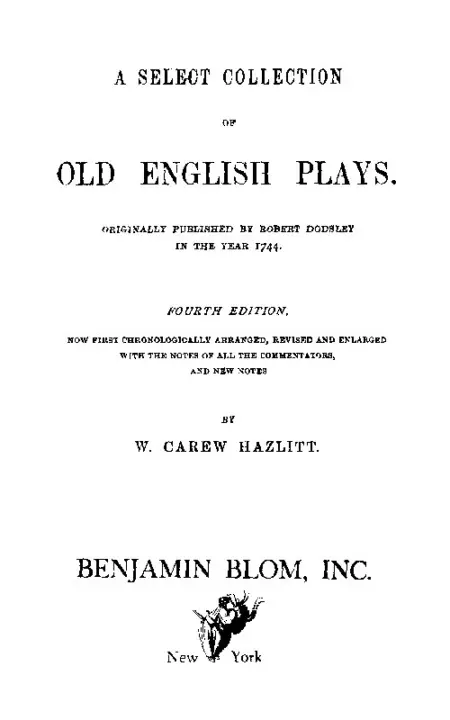
"A Select Collection of Old English Plays, Volume 12" by Robert Dodsley is a compilation of early English dramas, likely assembled in the 18th century. This volume includes works that reflect the theatrical traditions of that period, particularly focusing on themes of love, avarice, and social critique. Readers can expect the plays collected within to showcase a variety of characters and scenarios typical of old English comedy. The opening portion introduces "The Old Couple," a comedy by Thomas May, featuring prominent characters like Eugeny, humanity's tragic figure, and Theodore, the virtuous son of the miserly Earthworm. The narrative centers around the secret meeting of Eugeny and Artemia, highlighting themes of forbidden love and societal constraints. The dialogue reveals the emotional turmoil faced by Eugeny due to his past deeds, setting a tone for the complexities of the relationships that unfold within the comedic framework. Through witty exchanges and poignant reflections, the play promises a blend of humor and introspection that is characteristic of its time.
Introduction adapted from the source catalogue; source summaries may be automatically generated.
Free to read · English · 148,252 words · No account needed
MAKE TIME FOR A GOOD BOOK
On by default. Untick to stop anonymous reading totals. Each page counts after 10 seconds in view. How this works.
Anonymous counting is on unless you have switched it off.
[1] [It is difficult to allow that this piece is particularly allegorical in any of its parts or characters. It has the air of a drama which had lain by for some time, and been hastily finished, as some of the incidents and characters are not developed with due regard to dramatic propriety. The conversion of Earthworm, especially, is unnaturally abrupt and violent.]
[2] "The Goblins" was publicly performed, whereas the "Old Couple" does not seem to have been so. Suckling died early in 1641. I confess that the evidence appears to me to lie strongly against May, who was a great borrower--even from himself, the most allowable kind of plagiarism.
[3] Former editions--
"This happy garden, once while I was happy."
--Pegge.
[4] Dante ("Inferno," c. v.) says--
"Nessun maggior dolore
Che ricordarsi del tempo felice
Ne la miseria."
--Collier.
[5] Two romances of the time, very well known, often reprinted, and frequently mentioned in old authors.--Collier.
[6] i.e., Shrive her, hear her at confession. So in Shakespeare's
"King Richard III."--
"What, talking with a priest, Lord Chamberlain? Your lordship hath no shriving-work in hand."
--Steevens.
[7] These lines seem a parody on the following one in "Bonduca," by Beaumont and Fletcher, act iv. sc. 3--
"Lie lightly on my ashes, gentle earth."
The time when Prior wrote his beautiful Ode to the Memory of Colonel George Villiers, drowned in the river Piave, in Friuli, 1703, is so near the period in which Mr Pope composed his elegy to the memory of an unfortunate lady, that it is difficult to say which of these great men borrowed from the other. It appears certain, however, that one of them, in the following lines, was indebted to his friend, unless it can be supposed that both of them were obliged to the above line of Beaumont and Fletcher. Prior says--
"Lay the dead hero graceful in a grave
(The only honour he can now receive),
And fragrant mould upon his body throw.
And plant the warrior laurel o'er his brow;
Light lie the earth, and flourish green the bough."
Mr Pope writes thus--
"What though no sacred earth allow thee room, Nor hallow'd dirge be mutter'd o'er thy tomb; Yet shall thy grave with rising flowers be drest, And thy green turf lie lightly on thy breast."
I know not why we should suppose that Pope borrowed from Prior, or that either of them was indebted to Beaumont and Fletcher on this occasion. Sit tibi terra levis! is a wish expressed in many of the ancient Roman inscriptions. So in that on Pylades--
"Dicite qui legitis, solito de more, sepulto, Pro meritis, Pylade, sit tibi terra levis!"
Your reading position is saved on this browser. Take it to another device with a library code. Reading pages adapt to text, rather than matching a printed edition.
BEHIND THE BOOK
This eBook is for the use of anyone anywhere in the United States and most other parts of the world at no cost and with almost no restrictions whatsoever. You may copy it, give it away or re-use it under the terms of the Project Gutenberg License included with this eBook or online at www.gutenberg.org. If you are not located in the United States, you will have to check the laws of the country where you are located before using this eBook. Read the source licence.
The original source file, including credits and licence, is retained by this library. Request an original-format copy at no charge. Please include the book title and Project Gutenberg identifier #46791.
KEEP YOUR CURIOSITY GOING
Maurice Baring
W. B. (William Butler) Yeats
Edward Martyn

John Brougham & Charlotte Brontë
Marguerite Merington
Leonid Andreyev