THE CLASSIC COLLECTION✦Lost DiariesCLASSIC FREE BOOKS
Lost Diaries
Maurice Baring
THE CLASSIC COLLECTION · 1874
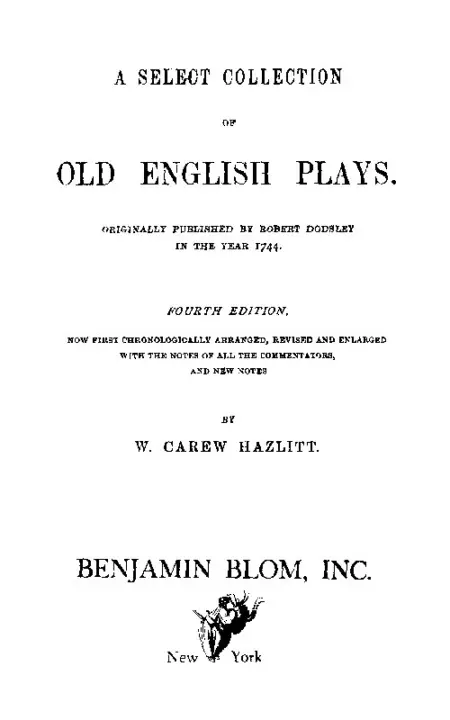
"A Select Collection of Old English Plays, Volume 12" by Robert Dodsley is a compilation of early English dramas, likely assembled in the 18th century. This volume includes works that reflect the theatrical traditions of that period, particularly focusing on themes of love, avarice, and social critique. Readers can expect the plays collected within to showcase a variety of characters and scenarios typical of old English comedy. The opening portion introduces "The Old Couple," a comedy by Thomas May, featuring prominent characters like Eugeny, humanity's tragic figure, and Theodore, the virtuous son of the miserly Earthworm. The narrative centers around the secret meeting of Eugeny and Artemia, highlighting themes of forbidden love and societal constraints. The dialogue reveals the emotional turmoil faced by Eugeny due to his past deeds, setting a tone for the complexities of the relationships that unfold within the comedic framework. Through witty exchanges and poignant reflections, the play promises a blend of humor and introspection that is characteristic of its time.
Introduction adapted from the source catalogue; source summaries may be automatically generated.
Free to read · English · 148,252 words · No account needed
MAKE TIME FOR A GOOD BOOK
On by default. Untick to stop anonymous reading totals. Each page counts after 10 seconds in view. How this works.
Anonymous counting is on unless you have switched it off.
MRS FOS. Then worldly care did so o'erload my weakness, That I must have a second stay; I chose again, And there begins my griefs to multiply.
WID. It cannot be, friend; your husband's kind.
DOC. A man of fair condition, well-reputed.
CLOWN. But it may be he has not that should please her.
WID. Peace, sirrah! How can your sorrows increase from him?
MRS FOS. How can they but o'erwhelm me? He keeps a son,
That makes my state his prodigality;
To him a brother, one of the city scandals.
The one the hand, the other is the maw;
And between both my goods are swallowed up.
The full quantity that I brought amongst 'em
Is now consum'd to half.
WID. The fire of your spleen wastes it:
Good sooth, gossip, I could laugh at thee, and only grieve
I have not some cause of sorrow with thee:
Prythee, be temperate, and suffer.
DOC. 'Tis good counsel, mistress; receive it so.
WID. Canst thou devise to lay them half on me?
And I'll bear 'em willingly.
MRS FOS. Would I could! that I might laugh another while: But you are wise to heed at others' harms; You'll keep you happy in your widowhood.
WID. Not I, in good faith, were I sure marriage
Would make me unhappy.
MRS FOS. Try, try, you shall not need to wish; You'll sing another song, and bear a part In my grief's descant, when you're vex'd at heart: Your second choice will differ from the first; So oft as widows marry, they are accurs'd.
CLOWN. Ay, cursed widows are; but if they had all stiff husbands to tame 'em, they'd be quiet enough.
WID. You'll be gone, sir, and see dinner ready.
CLOWN. I care not if I do, mistress, now my stomach's ready; Yet I'll stay a little, an't be but to vex you.
WID. When go you, sirrah?
CLOWN. I will not go yet.
WID. Ha, ha, ha! thou makest me laugh at thee; prythee, stay.
CLOWN. Nay, then, I'll go to vex you. [Exit CLOWN.
MRS FOS. You have a light heart, gossip.
WID. So should you, woman, would you be rul'd by me. Come, we'll dine together; after walk abroad Unto my suburb garden,[60] where, if thou'lt hear, I'll read my heart to thee, and thou from thence Shall learn to vex thy cares with patience. [Exeunt.
[31] [This play was first reprinted by Dilke in his "Old English
Plays," 1816.]
[32] The word factor is here used in a more limited sense than at present, as Richard and George appear to have been the exclusive servants of the other two.
[33] So Titania, in "A Midsummer Night's Dream"--
Your reading position is saved on this browser. Take it to another device with a library code. Reading pages adapt to text, rather than matching a printed edition.
BEHIND THE BOOK
This eBook is for the use of anyone anywhere in the United States and most other parts of the world at no cost and with almost no restrictions whatsoever. You may copy it, give it away or re-use it under the terms of the Project Gutenberg License included with this eBook or online at www.gutenberg.org. If you are not located in the United States, you will have to check the laws of the country where you are located before using this eBook. Read the source licence.
The original source file, including credits and licence, is retained by this library. Request an original-format copy at no charge. Please include the book title and Project Gutenberg identifier #46791.
KEEP YOUR CURIOSITY GOING
Maurice Baring
W. B. (William Butler) Yeats
Edward Martyn

John Brougham & Charlotte Brontë
Marguerite Merington
Leonid Andreyev