THE CLASSIC COLLECTION✦Lost DiariesCLASSIC FREE BOOKS
Lost Diaries
Maurice Baring
THE CLASSIC COLLECTION · 1874
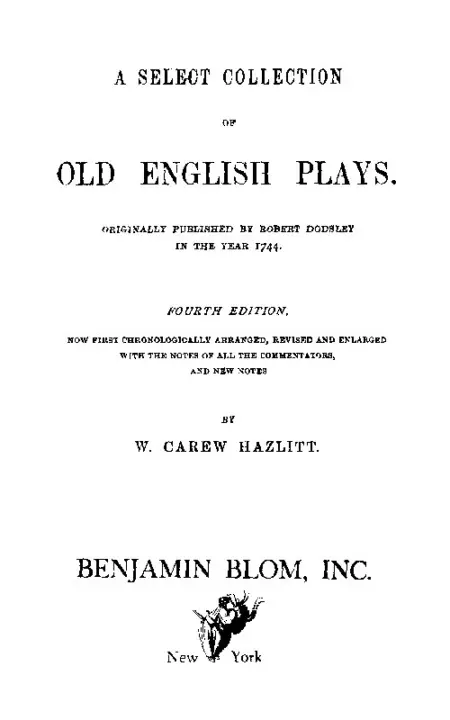
"A Select Collection of Old English Plays, Volume 12" by Robert Dodsley is a compilation of early English dramas, likely assembled in the 18th century. This volume includes works that reflect the theatrical traditions of that period, particularly focusing on themes of love, avarice, and social critique. Readers can expect the plays collected within to showcase a variety of characters and scenarios typical of old English comedy. The opening portion introduces "The Old Couple," a comedy by Thomas May, featuring prominent characters like Eugeny, humanity's tragic figure, and Theodore, the virtuous son of the miserly Earthworm. The narrative centers around the secret meeting of Eugeny and Artemia, highlighting themes of forbidden love and societal constraints. The dialogue reveals the emotional turmoil faced by Eugeny due to his past deeds, setting a tone for the complexities of the relationships that unfold within the comedic framework. Through witty exchanges and poignant reflections, the play promises a blend of humor and introspection that is characteristic of its time.
Introduction adapted from the source catalogue; source summaries may be automatically generated.
Free to read · English · 148,252 words · No account needed
MAKE TIME FOR A GOOD BOOK
On by default. Untick to stop anonymous reading totals. Each page counts after 10 seconds in view. How this works.
Anonymous counting is on unless you have switched it off.
This writer is ranked by the editors of the "Biographia Dramatica" in the third class of dramatic writers, and Mr Gifford justly observes it is impossible to place him higher. [Mr Collier, in a note to Rowley's "Match at Midnight," 1633, Introd., supposed that Samuel Rowley, the writer of the historical play on "Henry VIII.," 1605, might be the "Master Rowley, once a rare scholar of Pembroke Hall," mentioned by Meres ("Politeuphuia," 1598, "Anc. Crit. Essays," iii. 154), as one of the best for comedy; but Meres, who was himself a university man, would scarcely confound either Samuel or William Rowley with the Ralph Rowley of Pembroke Hall, writer of certain occasional poetry now forgotten (Cooper's "Athenæ," ii. 388); and it is grossly improbable, surely, that Meres should cite Ralph Rowley as "one of the best for comedy" on the strength of such pieces as are connected with Samuel Rowley's name. Mr Collier remarks, that it appears from Henslowe's memoranda ("Diary," pp. 120, 218) that "in the very year in which Meres wrote, [Samuel Rowley] was reduced to accept the situation of a hireling at Henslowe's theatre." There is no trace of anything written by him earlier than Jan. 7, 1601-2, when he assisted William Haughton and William Borne in writing a piece called "Judas." As to William, he could scarcely have acquired any reputation so early, and what, on the whole, is most likely to have been the truth is, that Ralph Rowley composed pieces which, like those of the Earl of Oxford and others, have not survived.[22] Of the time or place of his birth, or decease, we are altogether ignorant. Of his life it is only known that he was a player. That he lived on terms of intimacy with the dramatic writers of his time is sufficiently evident from his having written in conjunction with many of them; and, if we may believe the title-page, [which we cannot, we should be able to believe that] in one[23] he received assistance from Shakespeare himself. He was a comedian, and one of the Prince's company of players; and Oldys observes, in his MSS. notes to Langbaine, on the authority of [transcripts made by Vertue from] the office books of Lord Harrington, Treasurer of the Chambers in those years, that "One William Rowley was head of the Prince's company of comedians from 1613 to 1616:" this, there can be [no] doubt, was our author; and [he continued to belong to that company till the death of James I.[24]] The tragedy of "All's Lost by Lust" (as it is better known) would perhaps have been selected in preference, but for the resemblance it bears, in the general outline, to the "Women beware Women" of Middleton, and the "Appius and Virginia" of Webster,[25] to either of which, in my opinion, it is inferior. On the present play Langbaine observes that the passage of the widow's finding her wedding-ring, which she dropped in crossing the Thames, in the belly of a fish which her maid bought accidently in the market, is founded either upon the story of Polycrates of Samos, as the author may read at large in Herodotus, lib. 3, sive Thalia; or upon the like story related of one Anderson of Newcastle, by Doctor Fuller, in his "Worthies of England." The story here referred to is this: "A citizen of Newcastle (whose name I take to be M. Anderson) talking with a friend of his upon Newcastle bridge, and fingering his ring, before he was aware let it fall into the river; and was much troubled with the losse of it, till by a fish caught in the river that losse was repaired, and his ring restored to him." It is quite impossible, however, that our author could have had this story from Fuller's "Worthies," which was not published till many years after this drama was in print: he might, however, have found it, whence indeed Fuller himself took it (and the story of Polycrates is likewise quoted there), in the Preface to a little work called "Vox Piscis, or the Book-Fish, containing three Treatises, which were found in the belly of a Cod-fish in Cambridge Market, on Midsummer Eve last, Anno Domini 1626;" published in London in 1627. It is not noticed either by Langbaine or the editors of the "Biographia Dramatica" that this play is, in part, historical. This, however, is the case; and I have collected together, from various scattered notices in Stow and Strype, the best account I was enabled of Stephen Foster, his wife, and Alderman Brewen,[26] three of the principal persons in the drama. Sir Stephen Foster was the son of Robert Foster of London, stock-fishmonger; he was elected Sheriff of London in the year 1444, and Lord Mayor in 1454, and served as member for that city in the parliament held at Westminster in the thirteenth of Henry VI. Speaking of Ludgate, Strype says, (Append, p. 26), "There happened to be prisoner there, one Stephen Foster, who (as poor men are at this day) was a cryer at the grate, to beg the benevolent charities of pious and commiserate benefactors that passed by. As he was doing his doleful office, a rich widow of London hearing his complaint, enquired of him what would release him? To which he answered, Twenty pound; which she in charity expended; and clearing him out of prison, entertained him in her service; who, afterward falling into the way of merchandise, and increasing as well in wealth as courage, wooed his mistress, Dame Agnes, and married her.
Your reading position is saved on this browser. Take it to another device with a library code. Reading pages adapt to text, rather than matching a printed edition.
BEHIND THE BOOK
This eBook is for the use of anyone anywhere in the United States and most other parts of the world at no cost and with almost no restrictions whatsoever. You may copy it, give it away or re-use it under the terms of the Project Gutenberg License included with this eBook or online at www.gutenberg.org. If you are not located in the United States, you will have to check the laws of the country where you are located before using this eBook. Read the source licence.
The original source file, including credits and licence, is retained by this library. Request an original-format copy at no charge. Please include the book title and Project Gutenberg identifier #46791.
KEEP YOUR CURIOSITY GOING
Maurice Baring
W. B. (William Butler) Yeats
Edward Martyn

John Brougham & Charlotte Brontë
Marguerite Merington
Leonid Andreyev