THE CLASSIC COLLECTION✦Lost DiariesCLASSIC FREE BOOKS
Lost Diaries
Maurice Baring
THE CLASSIC COLLECTION · 1874
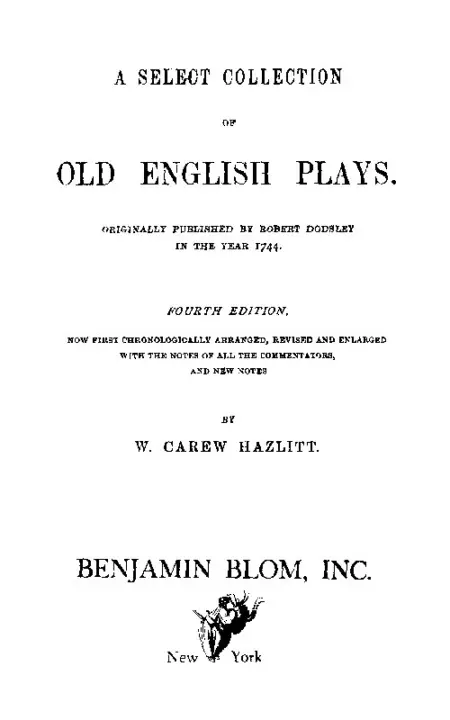
"A Select Collection of Old English Plays, Volume 12" by Robert Dodsley is a compilation of early English dramas, likely assembled in the 18th century. This volume includes works that reflect the theatrical traditions of that period, particularly focusing on themes of love, avarice, and social critique. Readers can expect the plays collected within to showcase a variety of characters and scenarios typical of old English comedy. The opening portion introduces "The Old Couple," a comedy by Thomas May, featuring prominent characters like Eugeny, humanity's tragic figure, and Theodore, the virtuous son of the miserly Earthworm. The narrative centers around the secret meeting of Eugeny and Artemia, highlighting themes of forbidden love and societal constraints. The dialogue reveals the emotional turmoil faced by Eugeny due to his past deeds, setting a tone for the complexities of the relationships that unfold within the comedic framework. Through witty exchanges and poignant reflections, the play promises a blend of humor and introspection that is characteristic of its time.
Introduction adapted from the source catalogue; source summaries may be automatically generated.
Free to read · English · 148,252 words · No account needed
MAKE TIME FOR A GOOD BOOK
On by default. Untick to stop anonymous reading totals. Each page counts after 10 seconds in view. How this works.
Anonymous counting is on unless you have switched it off.
CLE. 'Fore Venus, he talks with authority. I know not well what he has said; but methinks there is something in it: prythee, let's hearken to him.
PHOR. Do; and if I do not dispossess you of all your opinions,
let me be----
ERG. You must deal by enchantment then; for I am resolved to
stick to my conclusions.
PHOR. 'Tis the best holdfast your foolish devil has; but strong
reasons shall be your exorcism. Tell me first, what is she you
love?
ERG. Would I could.
PHOR. Then, for all thy jesting, there's some hope thou art yet
in thy wits.
ERG. You mistake me; I mean I could not tell, because no tongue
can speak her to her merit.
PHOR. Heyday! if the ballad of the rose and honeycomb do not do it more than she deserves, or almost any woman, let me be condemned to sing the funerals of parrots.
CLE. Would the ladies heard you!
PHOR. They would believe me, though they would be sorry your honours should. But what, this love--has it transformed us all? Cleon, you can tell who 'tis he thus admires?
CLE. Yes, and will; 'tis Hermione, Pindarus his heir.
PHOR. What, Epictetus in a petticoat! She that disputes love into nothing--or, what's worse, a friendship with a woman?
CLE. The same; and I know you'll confess she's deserving.
PHOR. Yes; but the mischief is, she'll ne'er think so of him. If polygamy were in fashion, I would persuade him to marry her, to be governess to the rest; but not till then. Wouldst thou be content to lie with a statue, that will never confess more of love than suffering the effects of thine?
CLE. And have his liberties in the discourse of her friends, that her retiredness may be more magnified.
PHOR. Believe me, Ergasto, these severe beauties, that are to be looked on with the eyes of respect, are not for us: we must have them, that love to be praised more for fair ladies than judicious.
ERG. You mistake me, gentlemen; I choose for myself, not for
you.
PHOR. Faith, for that, whoever marries, must sacrifice to fortune; and she, whose wisdom makes her snow to you may be fire to another. Some odd wrinkled fellow, that conquers her with wit, may throw her on her back with reason. Take this from the oracle, that for the general calamity of husbands all women are reputed vicious, and for the quiet of particulars every one thinks his wife the phoenix.
ERG. You have met with rare fortunes.
PHOR. Calumny is so general, that truth has lost her credit. But to th' purpose--what rivals? what hopes?
Your reading position is saved on this browser. Take it to another device with a library code. Reading pages adapt to text, rather than matching a printed edition.
BEHIND THE BOOK
This eBook is for the use of anyone anywhere in the United States and most other parts of the world at no cost and with almost no restrictions whatsoever. You may copy it, give it away or re-use it under the terms of the Project Gutenberg License included with this eBook or online at www.gutenberg.org. If you are not located in the United States, you will have to check the laws of the country where you are located before using this eBook. Read the source licence.
The original source file, including credits and licence, is retained by this library. Request an original-format copy at no charge. Please include the book title and Project Gutenberg identifier #46791.
KEEP YOUR CURIOSITY GOING
Maurice Baring
W. B. (William Butler) Yeats
Edward Martyn

John Brougham & Charlotte Brontë
Marguerite Merington
Leonid Andreyev