THE CLASSIC COLLECTION✦Lost DiariesCLASSIC FREE BOOKS
Lost Diaries
Maurice Baring
THE CLASSIC COLLECTION · 1874
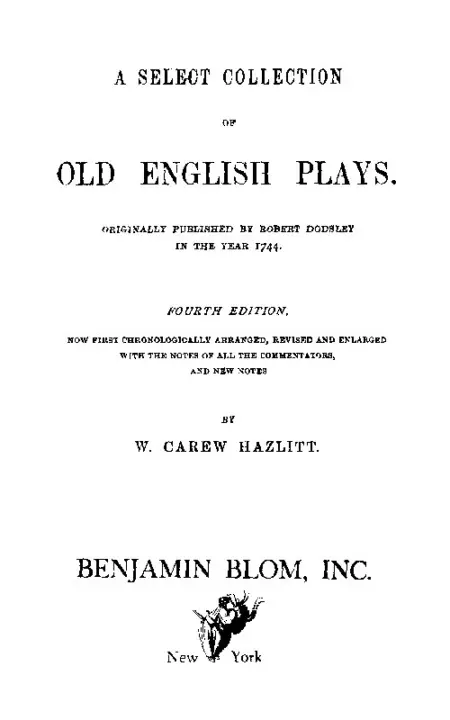
"A Select Collection of Old English Plays, Volume 12" by Robert Dodsley is a compilation of early English dramas, likely assembled in the 18th century. This volume includes works that reflect the theatrical traditions of that period, particularly focusing on themes of love, avarice, and social critique. Readers can expect the plays collected within to showcase a variety of characters and scenarios typical of old English comedy. The opening portion introduces "The Old Couple," a comedy by Thomas May, featuring prominent characters like Eugeny, humanity's tragic figure, and Theodore, the virtuous son of the miserly Earthworm. The narrative centers around the secret meeting of Eugeny and Artemia, highlighting themes of forbidden love and societal constraints. The dialogue reveals the emotional turmoil faced by Eugeny due to his past deeds, setting a tone for the complexities of the relationships that unfold within the comedic framework. Through witty exchanges and poignant reflections, the play promises a blend of humor and introspection that is characteristic of its time.
Introduction adapted from the source catalogue; source summaries may be automatically generated.
Free to read · English · 148,252 words · No account needed
MAKE TIME FOR A GOOD BOOK
On by default. Untick to stop anonymous reading totals. Each page counts after 10 seconds in view. How this works.
Anonymous counting is on unless you have switched it off.
MER. Jove's will is finish'd: and, though Juno frown, That no more Trojan blood shall dye the stage, The world's fourth empire Britain doth embrace. The thunder-bearer with a Janus look At once views ruddy morn and cloudy west: Her wings, display'd o'er this terrestrial egg, Will shortly hatch an universal peace; For Jove intends a favour to the world. It now remains that you two martial wights Cease from your braving one another's worth: You must be friends at last. The close is sweet, When, after tumults, hearts and hands do meet. [Exeunt.
Nec lusisse pudet, sed non incidere ludum.
[339] The wife of Locrine. See Geoffrey of Monmouth, bk. ii. c. 4.
[340] A coxcomb, or conceited person. So in "The Emperor of the East,"
act iv. sc. 1--
"I have a heart, yet
As ready to do service for my leg
As any princock, peacock of you all."
And again, "The Old Law," act iii. sc. 2--
"That wet one has cost many a princock's life."
See also Mr Steevens's note on "Romeo and Juliet," act i. sc. 5.
[341] This sentiment, and many others in the course of the play, are borrowed: it is a translation from a very well known passage in Tacitus: solitudinem faciunt, &c.--Collier.
[342] i.e., Poignard, sword. So in "The Return from Parnassus"--
"Strikes his poynado at a button's breadth."
[343] Alluding to Spenser's celebrated poem.--Steevens.
[344] See note to "Albumazar," [xi. 346.]
[345] The Tower of London, said to have been built by Julius Cæsar.
[346] [The winter solstice.]
[347] The 4o has it--
"The sea with rivers' water doth
The plants and flowers dainty."
--Collier.
[348] Or broken-banked with the flood.
[349] The slaughter made at the battle of Allia, in the year of Rome
363.
The Lost Lady. A Tragy Comedy. Imprinted at London by Jo. Okes, for John Colby, and are to be sold at his Shop, at the Signe of the Holy Lambe on Ludgate-hill. 1639. Folio.
[Sir William Barclay or Berkley was probably related to Sir Richard Barclay, author of "A Discourse of the Felicity of Man," first printed in 1598. He wrote, besides the "Lost Lady," a "Description of Virginia." An account of him will be found in Bliss's edition of Wood's "Athenæ," iii. 1111-12.
"The Lost Lady" was reprinted by Dodsley in 1744, but excluded from the second and third editions of the collection.]
Men.
Women.
[350] [Not in the old copy.]
Your reading position is saved on this browser. Take it to another device with a library code. Reading pages adapt to text, rather than matching a printed edition.
BEHIND THE BOOK
This eBook is for the use of anyone anywhere in the United States and most other parts of the world at no cost and with almost no restrictions whatsoever. You may copy it, give it away or re-use it under the terms of the Project Gutenberg License included with this eBook or online at www.gutenberg.org. If you are not located in the United States, you will have to check the laws of the country where you are located before using this eBook. Read the source licence.
The original source file, including credits and licence, is retained by this library. Request an original-format copy at no charge. Please include the book title and Project Gutenberg identifier #46791.
KEEP YOUR CURIOSITY GOING
Maurice Baring
W. B. (William Butler) Yeats
Edward Martyn

John Brougham & Charlotte Brontë
Marguerite Merington
Leonid Andreyev