THE CLASSIC COLLECTION✦Lost DiariesCLASSIC FREE BOOKS
Lost Diaries
Maurice Baring
THE CLASSIC COLLECTION · 1874
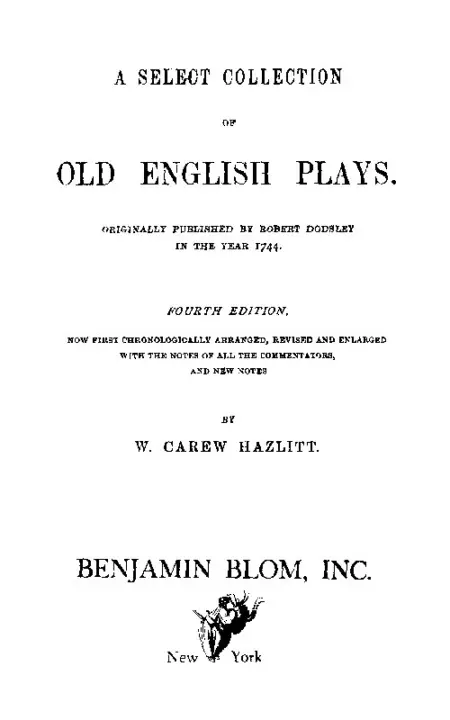
"A Select Collection of Old English Plays, Volume 12" by Robert Dodsley is a compilation of early English dramas, likely assembled in the 18th century. This volume includes works that reflect the theatrical traditions of that period, particularly focusing on themes of love, avarice, and social critique. Readers can expect the plays collected within to showcase a variety of characters and scenarios typical of old English comedy. The opening portion introduces "The Old Couple," a comedy by Thomas May, featuring prominent characters like Eugeny, humanity's tragic figure, and Theodore, the virtuous son of the miserly Earthworm. The narrative centers around the secret meeting of Eugeny and Artemia, highlighting themes of forbidden love and societal constraints. The dialogue reveals the emotional turmoil faced by Eugeny due to his past deeds, setting a tone for the complexities of the relationships that unfold within the comedic framework. Through witty exchanges and poignant reflections, the play promises a blend of humor and introspection that is characteristic of its time.
Introduction adapted from the source catalogue; source summaries may be automatically generated.
Free to read · English · 148,252 words · No account needed
MAKE TIME FOR A GOOD BOOK
On by default. Untick to stop anonymous reading totals. Each page counts after 10 seconds in view. How this works.
Anonymous counting is on unless you have switched it off.
There is no music in a voice
That is but one, and still the same:
Inconstancy is but a name
To fright poor lovers from a better choice.
CHORUS. Come then to me, &c.
Orpheus, that on Eurydice
Spent all his love, on others scorn,
Now on the banks of Hebrus torn,
Finds the reward of foolish constancy.
CHORUS. Come then to me, &c.
And sigh no more for one love lost:
I have a thousand Cupids here,
Shall recompense with better cheer
Thy misspent labours and thy bitter cost.
CHORUS. Come then to me, &c.
The dance ended, enter a Messenger.
NUN. Shepherds, if you have any pity, come
And see a woful spectacle.
MIR. What is't,
That can be worth the breaking of our sports?
NUN. The gentle nymph Nerina--
HYL. What of her?
NUN. The last of her: I think see lies a-dying,
And calls to speak with you.
HYL. Curse of your follies!
Do I live here whilst she is dying there?
MIR. But, shepherd, what disease is't that so soon Could spend his force upon her? she was well This morning, when she made poor Hylas sick.
MON. I know not; I am sent unto the well Of Esculapius to fetch some water For her recovery. I must be gone. [Exit.
MIR. Shepherds, here let us end. I think we are
Perfect in all the rest. This night the king
Must see't, resolve on that.
CHORUS. We are all ready.
MIR. Then let's away, and see what will betide
This gentle nymph Nerina.
CHORUS. We'll go with you.
Hold up thy head, good child: see, he is come. Bring me the water quickly, whilst there is Some life in her. Now chafe her, good Dorinda.
NER. All is in vain, I cannot live; dear father,
Farewell. What shepherd's that lies on the ground?
Is it not Hylas?
DOR. Yes, it is he, Nerina.
NER. Alas, poor shepherd! 'tis my greatest grief,
That I have grieved him; I would beg life
For nothing but to make him satisfaction.
MIR. Hylas, what, on the ground! look up and speak:
Alas, he's dead!
NER. It cannot be: good father,
Let me go to him, and but touch his ear,
It may be that my voice may have more virtue.
CHAR. Do what thou wilt, sweetheart: see, my poor child,
How charitable she is: being half-dead
Herself, she pities others.
MIR. Mark her finesse,
How at the brink of death she kisses him,
And took this way to mock her simple father:
O fine invention! sure, a woman's wit
Does never fail her. [Aside.
Your reading position is saved on this browser. Take it to another device with a library code. Reading pages adapt to text, rather than matching a printed edition.
BEHIND THE BOOK
This eBook is for the use of anyone anywhere in the United States and most other parts of the world at no cost and with almost no restrictions whatsoever. You may copy it, give it away or re-use it under the terms of the Project Gutenberg License included with this eBook or online at www.gutenberg.org. If you are not located in the United States, you will have to check the laws of the country where you are located before using this eBook. Read the source licence.
The original source file, including credits and licence, is retained by this library. Request an original-format copy at no charge. Please include the book title and Project Gutenberg identifier #46791.
KEEP YOUR CURIOSITY GOING
Maurice Baring
W. B. (William Butler) Yeats
Edward Martyn

John Brougham & Charlotte Brontë
Marguerite Merington
Leonid Andreyev