THE CLASSIC COLLECTION✦Lost DiariesCLASSIC FREE BOOKS
Lost Diaries
Maurice Baring
THE CLASSIC COLLECTION · 1874
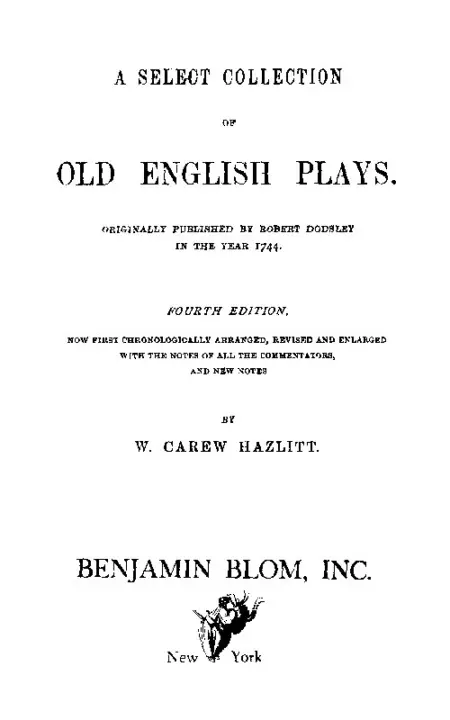
"A Select Collection of Old English Plays, Volume 12" by Robert Dodsley is a compilation of early English dramas, likely assembled in the 18th century. This volume includes works that reflect the theatrical traditions of that period, particularly focusing on themes of love, avarice, and social critique. Readers can expect the plays collected within to showcase a variety of characters and scenarios typical of old English comedy. The opening portion introduces "The Old Couple," a comedy by Thomas May, featuring prominent characters like Eugeny, humanity's tragic figure, and Theodore, the virtuous son of the miserly Earthworm. The narrative centers around the secret meeting of Eugeny and Artemia, highlighting themes of forbidden love and societal constraints. The dialogue reveals the emotional turmoil faced by Eugeny due to his past deeds, setting a tone for the complexities of the relationships that unfold within the comedic framework. Through witty exchanges and poignant reflections, the play promises a blend of humor and introspection that is characteristic of its time.
Introduction adapted from the source catalogue; source summaries may be automatically generated.
Free to read · English · 148,252 words · No account needed
MAKE TIME FOR A GOOD BOOK
On by default. Untick to stop anonymous reading totals. Each page counts after 10 seconds in view. How this works.
Anonymous counting is on unless you have switched it off.
MIR. Why, what is love, say you, if mine be not?
HYL. I know, Mirtillus, that no lover yet
Purchas'd a lasting pleasure without grief;
For love has gall in it as well as honey,
And so compounded that, whosoe'er will taste
The sweets of it, must take the bitter too,
Out of both which is made our constancy.
You, that embrace the false delights alone,
Are a feign'd lover or (more truly) none.
MIR. I know not what you mean by constancy:
I'm sure I love the fairest.
HYL. Still you err;
For, if you lov'd the fairest, none had been
The object of your choice but my Nerina;
Nerina, she the glory of these woods,
The only subject of all shepherds' song.
MIR. She has her share of beauty with the rest,
And I confess she's fit for love as any;
But why she only should take up your breast,
And shut out all that have a right as good,
Whose equal or transcendent beauty pleads
As just a title to't as hers can do,
I cannot reach the reason, but admire
Your faith and (what you praise) your constancy.
HYL. Mirtillus, though I know your stubborn heart
Could never entertain a lover's thought,
Yet did I think you would have been more tender
How you profan'd a name so sacred as
Nerina's is, whom never any swain,
Nor rural god, nor satyr, though he be
Of savage kind, would ever violate:
Nerina, in whose form love ever dwells,
Attended by the Graces, which do range
Themselves in order 'bout her comely face:
Whose breasts without are hills of whitest snow,
Within, the seat of blameless modesty,
Regard of honour and pure chastity;
Nor may a loose thought ever harbour there
To tempt such lovers as you seem to be:
Is it for that you slight her?
MIR. No, I love her
As I do others, with whom I compare her.
But you, that love with such intemperance,
Make of your love a glass, wherein you see
Each thing much greater than indeed it is:
My love's too cold, you say; but I am sure
Yours is too hot for any to endure:
A mean, perhaps, 'twixt these I might approve.
HYL. You might, if there were any mean in love.
MIR. But whilst we talk thus, see, the flame has caught you; Your beauteous flame, Nerina, is at hand, Dorinda with her: dare you stay th' encounter?
HYL. No, let's withdraw, and watch her, where she goes.
Dorinda, I have miss'd the chase to-day,
Such is my chance, and he that lodg'd the deer
Told me it was the fairest in these woods.
Your reading position is saved on this browser. Take it to another device with a library code. Reading pages adapt to text, rather than matching a printed edition.
BEHIND THE BOOK
This eBook is for the use of anyone anywhere in the United States and most other parts of the world at no cost and with almost no restrictions whatsoever. You may copy it, give it away or re-use it under the terms of the Project Gutenberg License included with this eBook or online at www.gutenberg.org. If you are not located in the United States, you will have to check the laws of the country where you are located before using this eBook. Read the source licence.
The original source file, including credits and licence, is retained by this library. Request an original-format copy at no charge. Please include the book title and Project Gutenberg identifier #46791.
KEEP YOUR CURIOSITY GOING
Maurice Baring
W. B. (William Butler) Yeats
Edward Martyn

John Brougham & Charlotte Brontë
Marguerite Merington
Leonid Andreyev