THE CLASSIC COLLECTION✦Lost DiariesCLASSIC FREE BOOKS
Lost Diaries
Maurice Baring
THE CLASSIC COLLECTION · 1874
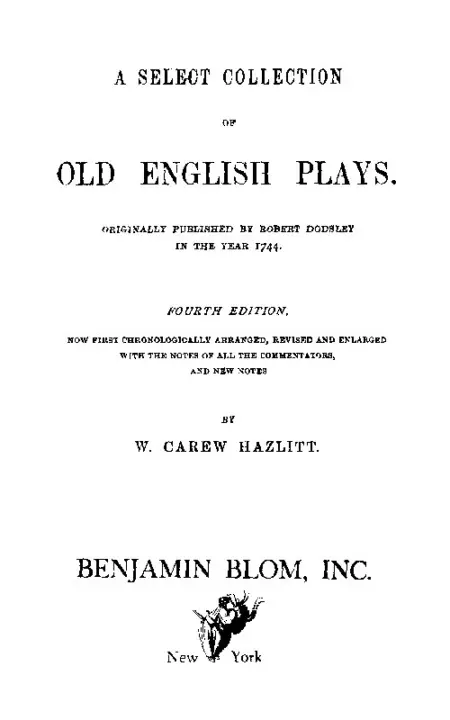
"A Select Collection of Old English Plays, Volume 12" by Robert Dodsley is a compilation of early English dramas, likely assembled in the 18th century. This volume includes works that reflect the theatrical traditions of that period, particularly focusing on themes of love, avarice, and social critique. Readers can expect the plays collected within to showcase a variety of characters and scenarios typical of old English comedy. The opening portion introduces "The Old Couple," a comedy by Thomas May, featuring prominent characters like Eugeny, humanity's tragic figure, and Theodore, the virtuous son of the miserly Earthworm. The narrative centers around the secret meeting of Eugeny and Artemia, highlighting themes of forbidden love and societal constraints. The dialogue reveals the emotional turmoil faced by Eugeny due to his past deeds, setting a tone for the complexities of the relationships that unfold within the comedic framework. Through witty exchanges and poignant reflections, the play promises a blend of humor and introspection that is characteristic of its time.
Introduction adapted from the source catalogue; source summaries may be automatically generated.
Free to read · English · 148,252 words · No account needed
MAKE TIME FOR A GOOD BOOK
On by default. Untick to stop anonymous reading totals. Each page counts after 10 seconds in view. How this works.
Anonymous counting is on unless you have switched it off.
BAR. The more
Thy worth appears, the more her judgment's seen.
O, 'tis a gallant lady! Well, she might
Have cast her eye on me or Euphues;
But 'twas not our good fortune!
DOT. Do not despair;
Some other woman may love thee as well:
Come, thou hast worth, Barnet, as well as I.
BAR. Nay, nay, abuse not your poor friends; but tell me, What dost thou think of young Artemia now?
DOT. Of her! a foolish girl, a simple thing!
She'd make a pretty wife for me! I confess
I courted her; but she had not the wit
To find out what I was, for all my talk.
BAR. And that was strange she should not; but 'tis fate
That governs marriages.
DOT. Let her repent,
And know what she hath lost, when 'tis too late.
But dost thou think this gallant Lady Whimsey
Will marry me?
BAR. Mak'st thou a doubt of that?
'Tis thy own fault, boy, if thou hast her not.
DOT. That I protest it shall not be; but, tell me,
Shall I express my love to her in verse
Or prose?
BAR. In which you will.
DOT. I am alike at both of them indeed.
BAR. I know thou art.
DOT. Come, let's go in.
BAR. Thou long'st to see thy mistress?
DOT. We'll drink her health in a crown'd cup,[15] my lad.
[Exeunt.
[9] Richard Braithwaite printed precisely the same thought in 1621, in his "Times Curtaine Drawne"--
"For who (remembering the cause why clothes were made,
Even then when Adam fled unto his shade,
For covert nakedness) will not blame
Himself to glory in his parents' shame?"
The coincidence is remarkable.--Collier.
"Quæ nec Sarmentus iniquas
Cæsaris ad mensas, nec vilis Galba tulisset."
--Juv., Sat. v. 3.
[11] [Conscience.]
[12] Mr Gifford, in a note on Massinger's "Virgin Martyr," points out an elegy by Secundus as the origin of this pretty fancy, which is thus employed by Fairfax in his translation of Tasso's "Jerusalem Delivered"--
"Death hath again exchanged his darts with Love,
And Cupid thus lets borrow'd arrows fly."
The allusion is not to be found in the original Italian (bk. ii. s. 34). Davenant, in bk. ii. c. 7, of his "Gondibert," also mentions the fable, and it would be easy among foreign writers to point out many instances in which more extensive use has been made of it. The sonnets by Annibale Nozzolini and by Girolamo Pompei are well known.--Collier.
[13] [Old copy, was.]
[14] So in "Macbeth," act v. sc. 5--
Your reading position is saved on this browser. Take it to another device with a library code. Reading pages adapt to text, rather than matching a printed edition.
BEHIND THE BOOK
This eBook is for the use of anyone anywhere in the United States and most other parts of the world at no cost and with almost no restrictions whatsoever. You may copy it, give it away or re-use it under the terms of the Project Gutenberg License included with this eBook or online at www.gutenberg.org. If you are not located in the United States, you will have to check the laws of the country where you are located before using this eBook. Read the source licence.
The original source file, including credits and licence, is retained by this library. Request an original-format copy at no charge. Please include the book title and Project Gutenberg identifier #46791.
KEEP YOUR CURIOSITY GOING
Maurice Baring
W. B. (William Butler) Yeats
Edward Martyn

John Brougham & Charlotte Brontë
Marguerite Merington
Leonid Andreyev